Comparison · Agents, APIs & MCP
Open-Model API Providers Compared: Prices and Limits
Together AI, Fireworks, Groq and DeepInfra all serve open-weight models behind an API. We compare their Nov 23 list prices on four popular models, plus caching, batch, rate limits and when each one wins.
Sabeen Hartwell · Nov 23, 2026 · 9 min read
Documentation-based research
On this page
If you want open-weight models such as gpt-oss-120b, DeepSeek V4.1 Flash, GLM-5.3 or Kimi K3.1 Pro behind an API, four hosts come up first: Together AI, Fireworks AI, Groq and DeepInfra. Together and Fireworks charge identical list prices on every model they share, DeepInfra is cheapest or tied on all four we checked, and Groq sells speed on a deliberately small catalog. Which one is cheapest for you depends less on the headline rate than on caching, batch discounts and promotions.
Prices as of Nov 23, 2026, taken from each provider's official pricing page and docs (linked throughout and in Sources). They are standard serverless list prices in US dollars per 1 million tokens, unless we say otherwise. We did not run a speed test for this piece; any throughput figure below is vendor-reported.
Quick verdict
- Lowest bill on popular open models: DeepInfra. Lowest or tied-lowest list price on all four models we compared, plus frequent per-model promotions.
- Broadest platform from one vendor: Together AI or Fireworks AI. Same list prices on shared models; pick on modes (Fireworks has Priority, Fast, Batch and Spot), fine-tuning and dedicated capacity.
- Fastest responses on a small model list: Groq. gpt-oss-120b at the same $0.15/$0.60 as Together and Fireworks, with a vendor-listed 500 tokens per second, but most larger models are enterprise-only.
- Many models and failover behind one key: OpenRouter in front of these hosts, for a 5.5% platform fee on its Standard plan.
Open-model API prices side by side
The fairest comparison is the same model on each host. We picked four open-weight models that appear on most of these price lists, from a small fast model to a frontier-class one.
Scroll the table horizontally on smaller screens.
| Model | Together AI | Fireworks AI | Groq | DeepInfra |
|---|---|---|---|---|
| gpt-oss-120b | $0.15 / no cached rate listed / $0.60 | $0.15 / $0.015 / $0.60 | $0.15 / 50% off on cache hits / $0.60 | $0.037 / $0.019 / $0.17 |
| DeepSeek V4.1 Flash | $0.30 / $0.006 / $1.20 | $0.30 / $0.006 / $1.20 | Not on public list | $0.20 / $0.006 / $0.60 (promo: $0.14 / $0.0042 / $0.42) |
| GLM-5.3 | $1.40 / $0.26 / $4.40 | $1.40 / $0.26 / $4.40 | Not on public list | $0.90 / $0.20 / $4.00 (promo: $0.5625 / $0.125 / $2.50) |
| Kimi K3.1 Pro | $2.00 / $0.20 / $10.00 | $2.00 / $0.20 / $10.00 | Not on public list | $2.00 / $0.20 / $10.00 (promo: $1.90 / $0.19 / $9.50) |
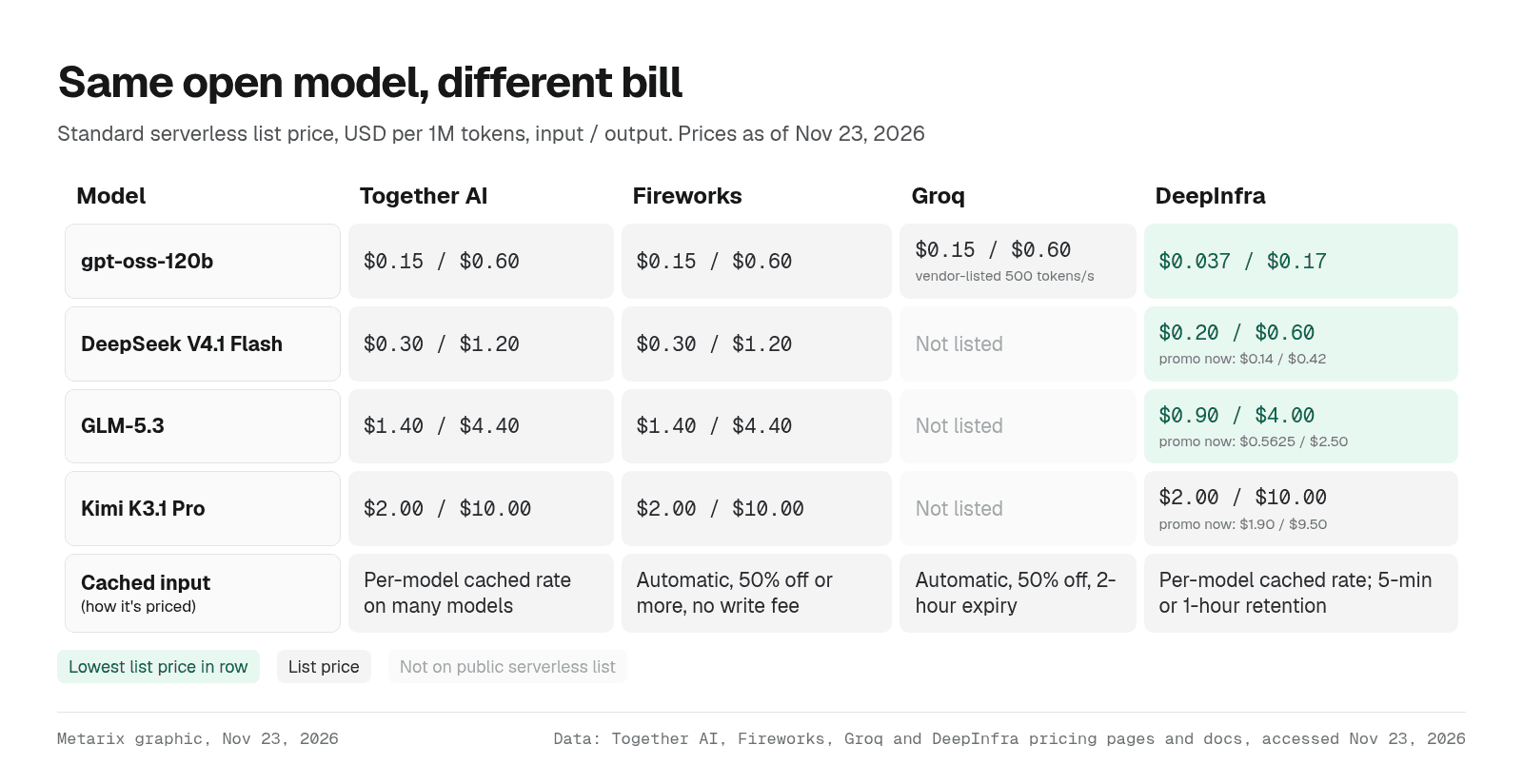
Two things stand out. First, Together and Fireworks match each other to the cent on every model they both list, including cached-input rates where both publish one. Second, DeepInfra undercuts both on three of the four models before any promotion, and by a wide margin on gpt-oss-120b: its model page lists $0.037 input and $0.17 output, roughly a quarter of the others' rate. On Kimi K3.1 Pro, all three hosts that list it charge the same $2.00/$10.00 base.
Promotions move often. On the day we checked, DeepInfra showed discounts of 5% to 51% on individual models, and Together's pricing page flagged a Qwen4 Max promotion valid only until Nov 23, 2026. Budget on list prices and treat promos as a bonus.
What a month actually costs
Per-token rates are hard to feel, so here is an illustrative workload: an app that sends 100 million input tokens and receives 20 million output tokens a month. The arithmetic below uses the list prices above and no promotions.
Scroll the table horizontally on smaller screens.
| Model | Together AI | Fireworks AI | Groq | DeepInfra |
|---|---|---|---|---|
| gpt-oss-120b | $27.00 | $27.00 | $27.00 | $7.10 |
| DeepSeek V4.1 Flash | $54.00 | $54.00 | n/a | $32.00 |
| GLM-5.3 | $228.00 | $228.00 | n/a | $170.00 |
| Kimi K3.1 Pro | $400.00 | $400.00 | n/a | $400.00 |
Now add caching. Agents and chat apps resend the same system prompt, tool definitions and history on every turn, so a high share of input tokens can be cache hits. If 80% of that DeepSeek V4.1 Flash input were cached, the Together or Fireworks bill would fall from $54.00 to about $30.48 (20M uncached input at $0.30, 80M cached at $0.006, plus $24 of output). Kimi K3.1 Pro would drop from $400 to $256. The cache hit rate moved the bill more than switching hosts did. Our prompt caching break-even guide covers how to structure prompts so prefixes actually match.
Together AI: big catalog, matching prices, more than inference
Together AI lists dozens of chat, vision, image, video, audio and embedding models on its pricing page, including the latest GLM, Kimi, DeepSeek, Qwen, MiniMax and NVIDIA Nemotron releases. Many chat models carry a separate cached-input price. Its Batch Inference product advertises up to 50% savings, with 50% off many top models.
The case for Together is breadth: serverless inference, provisioned throughput, dedicated endpoints, GPU clusters, fine-tuning and post-training under one account. The case against is that, on shared models, you pay the same as Fireworks and more than DeepInfra. It also changes prices on individual models; we covered its 67% Qwen3.7-Max increase earlier this month.
Fireworks AI: the most pricing modes per request
Fireworks AI bills every serverless request on input, cached input and output tokens and lets you switch mode per request on the same endpoint. Its pricing page lists six: Standard; Priority, which costs roughly 1.2 to 1.5 times Standard depending on the model (gpt-oss-120b goes from $0.15 to $0.18 input); Fast, aimed at 100+ tokens per second; Ultra-fast (preview); Batch at 50% off; and Spot at 30% off Standard on select models, where throughput can drop to zero.
Caching is automatic, with no write fee, and cached input is billed at half price or less by default; on gpt-oss-120b it's $0.015, a tenth of the input rate. Two costs to watch: US-only serverless carries a 50% premium on select models, and region-restricted dedicated deployments are priced at 1.5 times. Fireworks also sells per-minute reserved throughput and on-demand GPUs (H100 and H200 at $8 an hour) for when serverless rate limits get in the way.
Groq: speed first, short menu
Groq runs its own LPU accelerators, and its models page is short. In production it lists gpt-oss-120b ($0.15 input, $0.60 output, vendor-listed 500 tokens per second, 131,072-token context) and gpt-oss-20b ($0.075/$0.30), plus Whisper speech models. Qwen3.8-27B is in preview at $0.80/$4.00, more than the $0.20/$2.50 DeepInfra lists for it before its current promotion. Llama 3.3 70B, Muse Spark Open and MiniMax M2.7 appear as enterprise models with pricing on request.
The billing extras are simple. Prompt caching is automatic, takes 50% off cached input and expires after two hours unused. Batch is 50% off with a 24-hour to seven-day window, but doesn't stack with the caching discount. Flex processing, for paid accounts, gives about 10 times the normal rate limits at the same price, but fails fast with a 498 capacity_exceeded error when capacity runs out, so you need retries. The developer plan's limit for gpt-oss-120b is 250,000 tokens and 1,000 requests per minute.
DeepInfra: lowest list prices, simplest limits
DeepInfra has the broadest cheap catalog of the four, with prices set per model and frequent model-level promotions on its pricing page. Requests can choose a service tier: Standard at the base price, Priority at 1.5 times for faster time to first token at peak, or Flex at 0.8 times for work that tolerates slower responses and occasional unavailability. Its OpenAI-compatible Batch API is only 20% off, against 50% at Fireworks and Groq, so the gap with the others narrows for offline jobs.
Its rate limits are concurrency-based: 200 concurrent requests per model per account by default, which DeepInfra estimates at about 12,000 requests per minute for one-second requests, with increases on request. Its data privacy page says inputs and outputs stay in memory rather than on disk, request content isn't logged and data isn't used for training, with exceptions for Google and Anthropic models it resells.
OpenRouter: one API across all of them
OpenRouter doesn't run GPUs; it routes requests to hosts like these. Its pricing page lists 600+ models from 80+ providers, a 5.5% platform fee on the Standard pay-as-you-go plan and 8% on Business, plus auto-routing, preferred-provider settings and data-policy routing on paid plans. That fee buys failover and a single bill. Our AI gateways comparison covers the alternatives.
If privacy terms matter, set them explicitly rather than trusting defaults. OpenRouter recently pulled 125 endpoints from its Zero Data Retention list, a reminder that which host receives your prompt can change under a router.
How to choose an open-model API provider
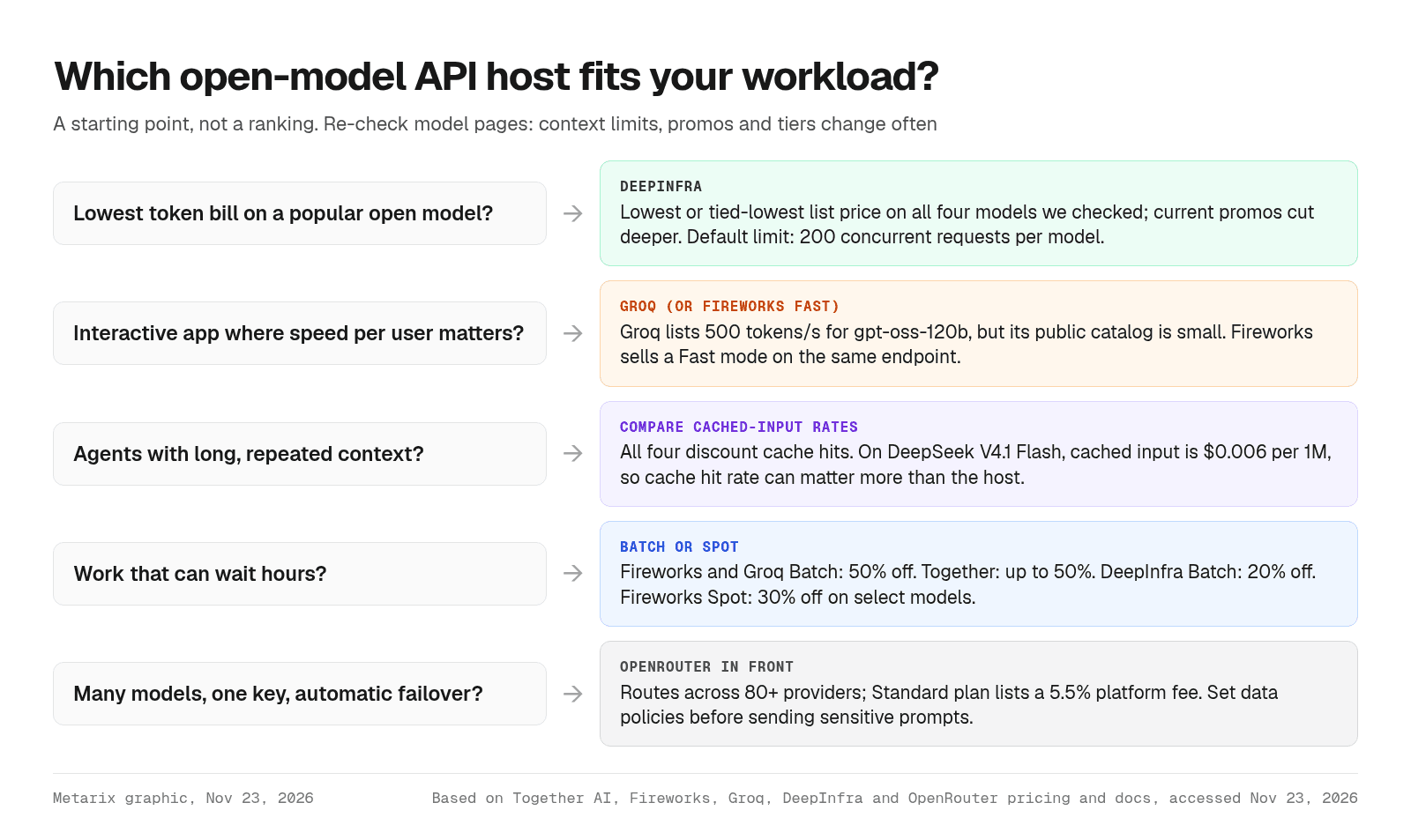
- Price per token on mainstream open models: start with DeepInfra, then confirm the context length and quantization on the model page match what you tested.
- Latency-sensitive chat or voice: test Groq if your model is on its list; otherwise compare Fireworks Fast mode or Priority tiers. Measure time to first token and tokens per second on your own prompts; our inference benchmarking guide shows how.
- Agents with long contexts: compare cached-input rates and cache lifetimes, not just input prices.
- Offline jobs: Fireworks or Groq Batch at 50% off, Together Batch up to 50%, DeepInfra Batch at 20%. Our processing tiers guide covers the closed-model equivalents.
- Spiky traffic or many models: put OpenRouter or another gateway in front and pin preferred providers.
- Steady, very high volume: price dedicated capacity against serverless; see self-hosted LLM vs API cost.
All four expose OpenAI-compatible endpoints, so switching is usually a base URL, key and model ID change. A minimal, illustrative client that keeps the host configurable:
# Illustrative only: same OpenAI SDK, host chosen by configfrom openai import OpenAIimport osclient = OpenAI(base_url=os.environ["LLM_BASE_URL"], api_key=os.environ["LLM_API_KEY"])resp = client.chat.completions.create( model=os.environ["LLM_MODEL"], # model IDs differ per host messages=[{"role": "user", "content": "Summarize this ticket"}])
Model IDs are not always portable: check each host's exact string for the model you want, and expect default sampling settings, context limits and tool-calling behavior can differ. Run your eval set on each host before you switch production traffic.
Verdict
For most teams paying list price on popular open models, DeepInfra is the cheapest place to start, and its promotions widen the gap. Choose Together AI or Fireworks AI when you need one vendor for serverless, dedicated capacity and fine-tuning; on shared models their prices are identical, so pick on features, with Fireworks offering the most per-request pricing modes. Choose Groq when output speed is the product and your model is on its short list. Whatever you pick, cache hit rate and batch eligibility will move your bill more than the host's headline price, so design for those first and keep the host swappable.
Sources
- Together AI pricing and Batch Inference, accessed Nov 23, 2026
- Fireworks AI pricing, accessed Nov 23, 2026
- Groq models and pricing, Batch, Flex processing and Prompt caching docs, accessed Nov 23, 2026
- DeepInfra pricing, gpt-oss-120b model page, Batch API, Rate limits and Data privacy docs, accessed Nov 23, 2026
- OpenRouter pricing, accessed Nov 23, 2026
Tools covered in this guide
Frequently asked questions
- Which open-model API provider is cheapest?
- On the four models we compared on Nov 23, 2026 (gpt-oss-120b, DeepSeek V4.1 Flash, GLM-5.3 and Kimi K3.1 Pro), DeepInfra had the lowest or tied-lowest standard list price. Together AI and Fireworks AI charged identical prices on all shared models, and Groq matched them on gpt-oss-120b.
- Is Groq faster than Together AI or Fireworks?
- Groq lists 500 tokens per second for gpt-oss-120b on its models page, but that is a vendor figure and speed varies with prompt length, load and region. Fireworks also sells a Fast mode. Measure time to first token and output speed on your own prompts before deciding.
- Do Together AI, Fireworks, Groq and DeepInfra offer batch discounts?
- Yes. Fireworks and Groq take 50% off for batch jobs, Together advertises up to 50% off on many models, and DeepInfra's Batch API is 20% below real-time prices. Groq's batch discount does not stack with its prompt caching discount.
- Should I use OpenRouter instead of going direct to a provider?
- Use OpenRouter when you want many models, automatic failover and one bill, and accept its 5.5% platform fee on the Standard plan. Go direct when you rely on one host's specific features, such as Fireworks pricing modes or dedicated capacity, or want the lowest total cost.
- Can I switch between these providers without rewriting code?
- Mostly. All four offer OpenAI-compatible APIs, so you usually change the base URL, API key and model ID. Model IDs, context limits, quantization and tool-calling behavior can differ, so rerun your evals after switching.