Comparison · Quality, cost & reliability
Self-Hosted LLM vs API Cost: The Break-Even Math
When running an open model on your own GPUs beats paying per token: break-even math for gpt-oss-120b on an H100, using GPU prices and benchmark throughput as of Nov 18, 2026.
Nalini Groves · Nov 18, 2026 · Updated Nov 24, 2026 · 11 min read
Documentation-based research
On this page
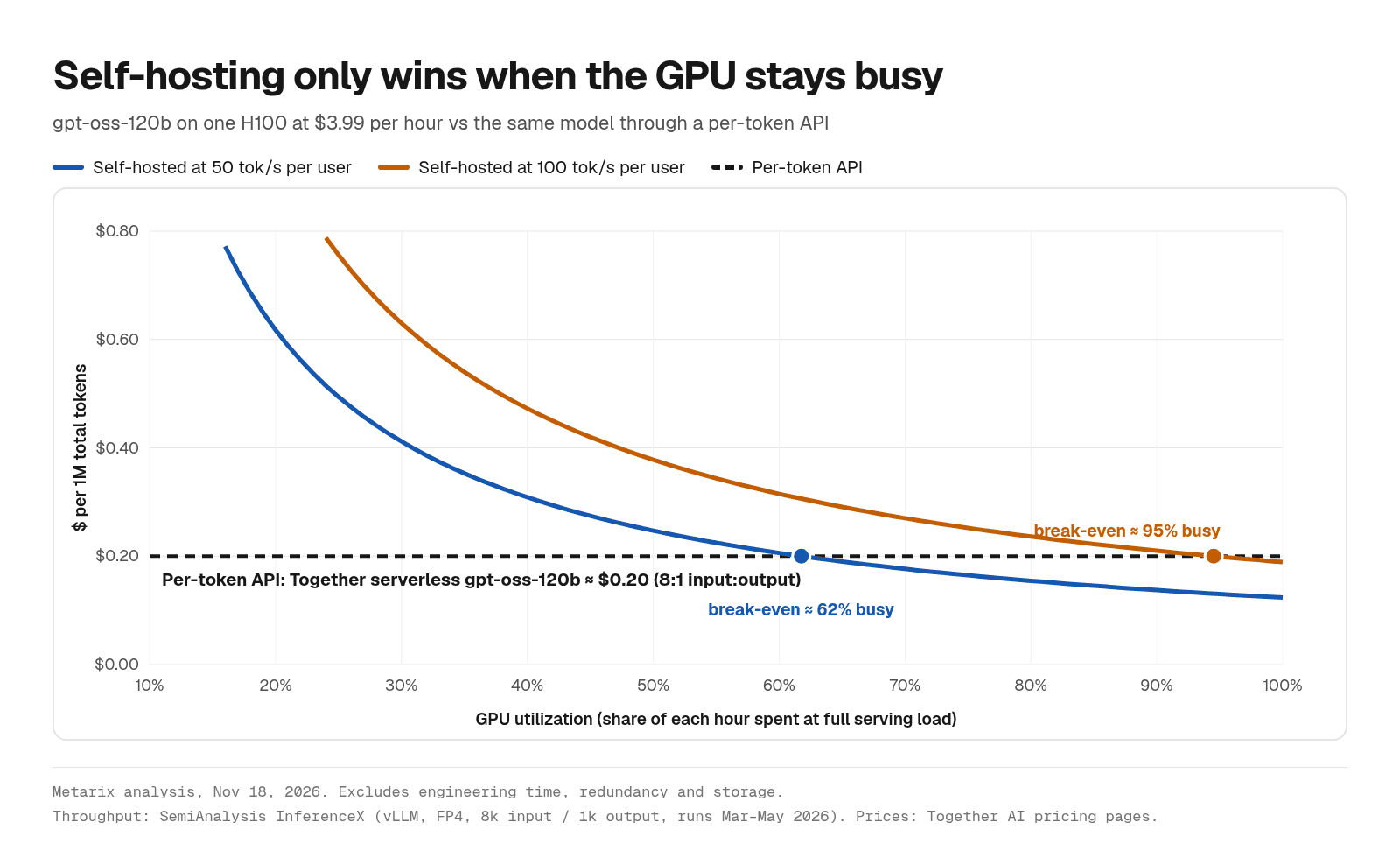
Self-hosting an open-weight LLM is cheaper than calling an API only when you keep the GPU busy. On a rented H100, gpt-oss-120b has to run at roughly 60% to 95% utilization around the clock just to match the same model's per-token API price, depending on how fast each user needs their tokens. Below that, the API wins on cost before you count a single hour of engineering.
This guide shows the break-even math step by step, using published GPU prices, published throughput numbers and a per-token price for the same model. The example is OpenAI's open-weight gpt-oss-120b, which fits on a single 80 GB GPU (model card), served on an NVIDIA H100. Prices are as of Nov 18, 2026. Throughput comes from third-party benchmarks, linked inline, not from a test we ran.
Quick verdict
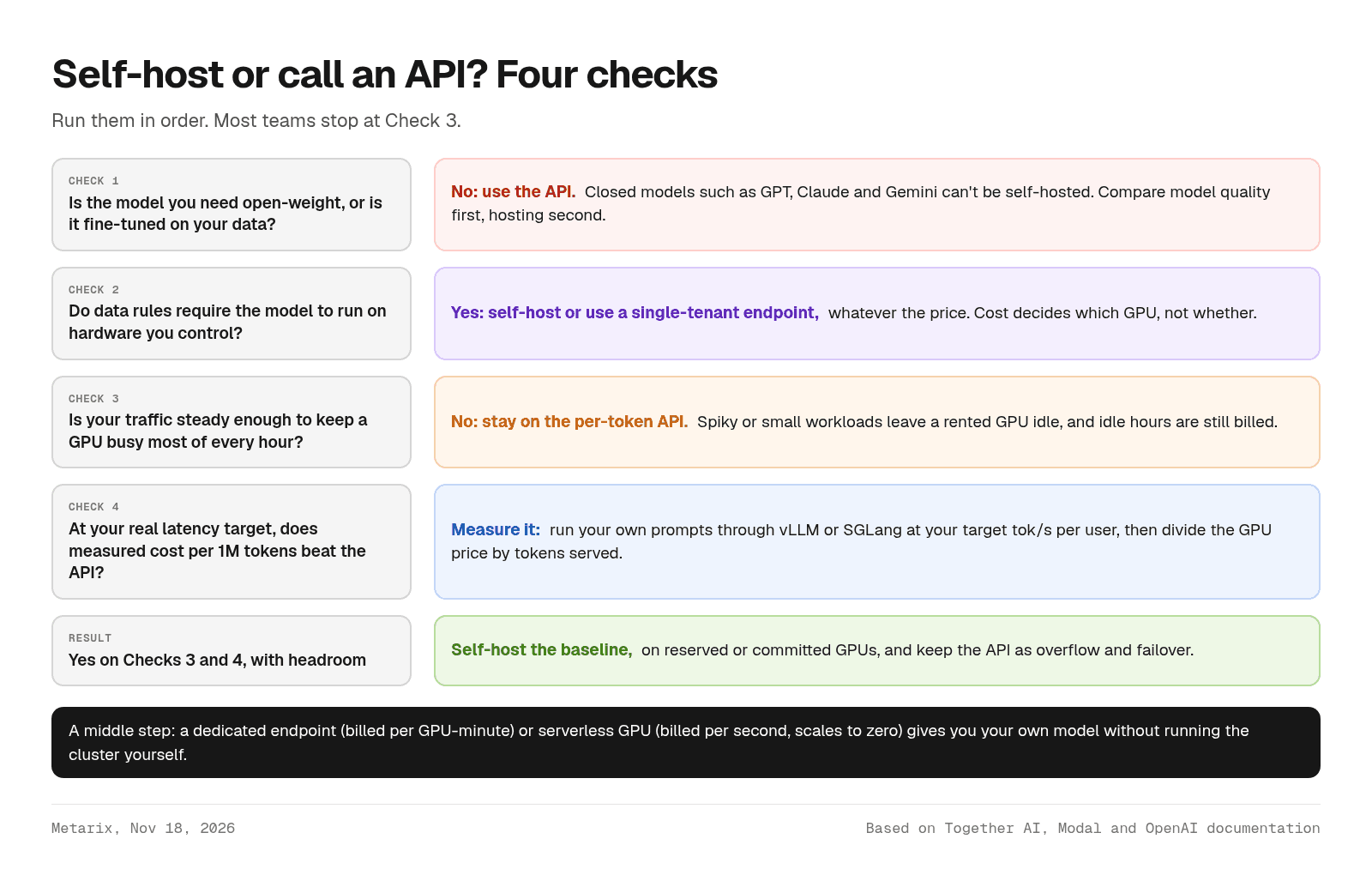
Start on a per-token API, even for open models. Move to your own GPUs only when three things are true: your traffic is steady enough to keep a GPU busy most of every hour, your measured throughput at your real latency target beats the API on cost per million tokens, and the savings are bigger than the cost of running the stack. Data residency and custom fine-tunes are the main reasons to self-host when the numbers don't work.
Scroll the table horizontally on smaller screens.
| Factor | Per-token API | Dedicated endpoint | Self-hosted GPU |
|---|---|---|---|
| You pay for | Tokens processed | GPU time while the endpoint runs | GPU time, all of it |
| Idle time costs you | Nothing | Yes, until it scales down | Yes |
| Who runs the serving stack | Provider | Provider | You |
| Model choice | Provider's catalog | Open or custom weights | Any open or custom weights |
| Latency control | Limited (tiers, priority options) | Good | Full |
| Best for | Prototypes, spiky or small workloads | Steady traffic, custom models, no ops team | Very high steady volume, strict data rules |
How to calculate the break-even point
Every self-host vs API comparison comes down to one question: how many tokens does a GPU hour have to produce before it costs less than buying the same tokens from an API? You need three numbers.
1. The API price for your token mix
APIs charge separately for input and output tokens, so turn them into one blended price for your workload. Together AI lists gpt-oss-120b at $0.15 per million input tokens and $0.60 per million output tokens (model page). For a chat or RAG workload with 8 input tokens for every output token, that blends to $0.20 per million total tokens. At 3:1 it's $0.26; at 1:1 it's $0.38. Output-heavy workloads raise the blended price, which flatters self-hosting on paper, but output tokens are also the slow ones for a GPU to generate, so measure throughput on your own mix.
2. The real price of a GPU hour
Use the price you would actually pay, including the commitment it needs. One H100 for an hour costs anywhere from about $2 to $6 depending on where and how you rent it (see the table below).
3. Throughput at your latency target
This is the number people get wrong. A GPU's peak throughput is only reachable when it serves many requests at once, and every extra concurrent request slows down the tokens each user sees. So the useful question isn't "how fast is an H100?" but "how many tokens per second does it sustain while each user still gets, say, 50 or 100 tokens per second?" Per-user speed and total throughput pull against each other, so always read the two together.
Then the formula is simple:
break-even tokens per second = GPU $ per hour / (API $ per 1M tokens x 3,600) x 1,000,000break-even utilization = self-hosted $ per 1M at 100% load / API $ per 1M
Utilization here means the share of each paid hour your GPU spends serving at that throughput. Nights, weekends, quiet hours and headroom for spikes all pull it down.
What an H100 hour costs
Prices as of Nov 18, 2026, per GPU per hour, from each provider's official pricing page. The last column shows how many tokens per second one GPU would have to serve, every second of the hour, to match the $0.20 blended API price for gpt-oss-120b.
Scroll the table horizontally on smaller screens.
| Provider and option | $ per GPU-hour | Billing and commitment | Tokens/s needed at 100% load |
|---|---|---|---|
| Together GPU Clusters, preemptible | $1.99 | Pay as you go; can be preempted | 2,764 |
| Together GPU Clusters, reserved 31 to 90 days | $3.45 | Reserved term | 4,792 |
| Modal, H100 SXM5 | $3.95 ($0.001097 per second) | Per second; scales to zero | 5,485 |
| Together GPU Clusters, on-demand | $3.99 | Pay as you go | 5,542 |
| RunPod Pods, H100 SXM | $4.39 | Per-hour list price | 6,097 |
| Lambda, 8x H100 instance | $4.59 | On-demand, per GPU | 6,375 |
| Together Dedicated Model Inference, H100 | $5.49 | Billed per minute while running; managed serving | 7,625 |
| AWS EC2 Capacity Blocks, p5.48xlarge | $5.97 ($47.757 per 8-GPU instance) | Reservation fee paid up front, plus OS fee | 8,292 |
Two things stand out. First, the cheapest rows come with strings: preemptible capacity can disappear mid-request, and reserved rates need a term. Our guide to spot vs reserved GPUs for inference covers how to mix them. Second, managed options such as Together's dedicated endpoints cost more per hour, but you're paying for someone else to run the serving stack. Together notes that dedicated inference bills per GPU-minute regardless of request volume and is cheaper than serverless only at high utilization (dedicated endpoints docs).
Can one H100 actually serve that much?
Published benchmarks say yes, but only at modest per-user speeds. SemiAnalysis's open-source InferenceX benchmark measured gpt-oss-120b on H100 with vLLM in FP4 on a single-turn chat workload of 8,000 input and 1,000 output tokens, in runs dated March 27 to May 17, 2026 (InferenceX results). The table converts its throughput ladder into cost per million tokens at Together's $3.99 on-demand H100 price.
Scroll the table horizontally on smaller screens.
| Speed each user sees | Tokens/s per GPU (InferenceX) | Cost per 1M tokens at 100% load | Utilization needed to beat $0.20 API |
|---|---|---|---|
| 50 tokens/s | 8,973 | $0.124 | 62% |
| 75 tokens/s | 7,136 | $0.155 | 78% |
| 100 tokens/s | 5,863 | $0.189 | 95% |
| 150 tokens/s | 3,931 | $0.282 | Never (API is cheaper) |
| 200 tokens/s | 2,558 | $0.433 | Never (API is cheaper) |
A second, independent data point lines up. GPUStack's performance lab ran gpt-oss-120b with vLLM 0.10.2 on H100 SXM GPUs using the ShareGPT dataset: an untuned single-GPU setup reached about 6,095 total tokens per second, and a tuned two-GPU setup reached 16,042, roughly 8,000 per GPU (GPUStack). That gap, about 30% per GPU from configuration alone, is a reminder that your engine and settings matter as much as the hardware. Our comparison of vLLM, SGLang and TensorRT-LLM covers the engine choice.
Treat all of these as best-case reference points from tuned benchmark runs. Real traffic has uneven prompt lengths, long contexts, retries and bursts, so your sustained number will likely be lower. Measure your own before you sign anything; how to benchmark LLM inference walks through the tools.
Costs the per-hour price hides
The break-even above assumes a GPU that does nothing but serve tokens. Production adds costs that an API bundles in for free.
- Redundancy. One GPU is a single point of failure. Two H100s at $3.99 run about $5,825 a month (730 hours each). At $0.20 per million tokens, that buys roughly 29 billion tokens of API usage, so below that monthly volume the API is cheaper before utilization even enters the picture.
- Idle and headroom. You size for peak, not average. If your peak is three times your average, a fleet that's full at peak sits around a third busy the rest of the time.
- Startup and scale-down time. Loading model weights takes time, and you pay for it. Modal, for example, bills during application load and keeps containers alive for 60 seconds after the last request by default (Modal pricing).
- Engineering time. Someone has to pick and upgrade the serving engine, tune batching and quantization, monitor latency and errors, and handle model updates. At small scale this one item usually outweighs the GPU savings.
- Model quality work. An API provider ships tuned kernels and new model versions. On your own stack, every upgrade is a migration you test.
The reverse also holds: APIs carry costs that self-hosting avoids. You're exposed to price changes and deprecations on someone else's schedule, rate limits and usage tiers, and data leaving your environment.
When self-hosting wins, and when the API does
Scroll the table horizontally on smaller screens.
| Situation | Better choice | Why |
|---|---|---|
| Prototype or early product | API | No idle cost, nothing to operate, easy to switch models |
| Spiky traffic, quiet nights | API or serverless GPU | Utilization stays low on fixed GPUs |
| Steady high volume on one open model | Self-hosted or dedicated | GPU stays busy; cost per token drops below API price |
| Offline batch jobs (evals, backfills, embeddings) | Self-hosted on preemptible GPUs, or a Batch API | Both cut cost sharply when latency doesn't matter |
| Custom fine-tuned weights | Dedicated endpoint or self-hosted | Not every API will serve your weights |
| Strict data residency or on-prem rules | Self-hosted | Control of hardware matters more than price |
| You need a closed frontier model | API | Closed weights can't be self-hosted |
The middle options
Self-host vs API isn't a binary choice. Two managed options sit between them, and they're often the right first step off a per-token API.
- Dedicated endpoints. You get single-tenant GPUs running your chosen model, and the provider runs the serving stack. Together's Dedicated Model Inference costs $5.49 per H100-hour as of Nov 18, 2026, billed per minute while a deployment runs, with replicas that stop billing when they scale down (Together pricing).
- Serverless GPUs. Platforms such as Modal and RunPod bill per second and scale to zero, so you only pay while containers are loading or serving. They suit spiky traffic on custom models, at the cost of cold starts. Our serverless GPU inference comparison covers pricing and cold-start behaviour.
- Batch APIs. If the work can wait, most per-token providers offer discounted batch processing, which often beats a self-hosted GPU that sits idle between jobs.
Don't compare against the wrong API
The fair comparison is the same model, hosted vs self-run. Comparing a self-hosted open model with a frontier closed model mixes two decisions: which model, and where to run it. OpenAI's GPT-6.2 Sol, for example, is listed at $2 per million input and $10 per million output tokens, about $2.89 blended at 8:1, so almost any busy GPU looks cheap next to it (OpenAI pricing). But the quality isn't the same, so the saving isn't real unless the open model does the job.
It cuts the other way too. OpenAI's gpt-6-luna is listed at $0.10 input and $0.50 output, about $0.14 blended at 8:1 (OpenAI pricing). That's below what our example H100 reaches at 100% load at 100 tokens per second per user. A small hosted model that's good enough for your task can undercut your own hardware. Run your own evals and compare cost per successful task, not just cost per token.
A break-even calculator you can reuse
This short script, which we ran on Nov 18, 2026, reproduces the utilization figures above. Swap in your own GPU price, measured throughput and token mix.
def blended_price(in_price, out_price, in_tokens, out_tokens): """API price per 1M total tokens for your input:output mix.""" return (in_price * in_tokens + out_price * out_tokens) / (in_tokens + out_tokens)def self_host_price(gpu_per_hour, tokens_per_sec, utilization): """Cost per 1M total tokens on a rented GPU at a given utilization.""" tokens_per_hour = tokens_per_sec * 3600 * utilization return gpu_per_hour / tokens_per_hour * 1_000_000def break_even_utilization(gpu_per_hour, tokens_per_sec, api_price): return self_host_price(gpu_per_hour, tokens_per_sec, 1.0) / api_priceapi = blended_price(0.15, 0.60, 8, 1) # gpt-oss-120b on Together, 8:1 mixfor tps in (8973, 5863, 3931): # InferenceX H100 at 50/100/150 tok/s per user u = break_even_utilization(3.99, tps, api) # Together H100 on-demand $/hr print(f"{tps:>5} tok/s per GPU -> break-even at {u:.0%} utilization")
Output: 62% at 8,973 tokens per second, 95% at 5,863, and 141% at 3,931. Anything above 100% means the API is cheaper no matter how busy the GPU is.
Update, Nov 22, 2026: if your self-hosting plan stores private models on the Hugging Face Hub, note that Hugging Face's pricing page now lists its Enterprise organization plan at $500 per user per month, up from $50. See our Hugging Face Enterprise pricing analysis for what changed and when the $20 Team plan is enough.
Update, Nov 24, 2026: if the model you plan to self-host is a fine-tune, training is a separate bill. Our fine-tuning API pricing comparison lists per-token training prices on Together AI, Google Cloud and Fireworks, with a worked cost example.
Verdict
For most teams, the per-token API is the cheaper way to run an open model, and by a wide margin at low or uneven volume. Our example shows why: gpt-oss-120b on a $3.99 H100 only beats a $0.20 per million token API above about 62% utilization at 50 tokens per second per user, and above 95% at 100 tokens per second. Add a second GPU for redundancy and the engineering time to run it, and the bar rises further.
Self-host when you have steady, high-volume traffic on one open or fine-tuned model, data rules that demand it, or batch work that can soak up cheap preemptible GPUs. Even then, start with a dedicated endpoint, measure your real throughput at your real latency target, and keep the API as overflow. Move the baseline onto your own GPUs only once the measured numbers clear the break-even with room to spare.
Sources
- OpenAI, gpt-oss-120b model card on Hugging Face, accessed Nov 18, 2026
- Together AI, Pricing, gpt-oss-120b model page, Dedicated endpoints docs, accessed Nov 18, 2026
- Modal, Pricing; RunPod, Pricing; Lambda, Pricing; AWS, EC2 Capacity Blocks pricing, accessed Nov 18, 2026
- OpenAI, API pricing, accessed Nov 18, 2026
- SemiAnalysis, InferenceX: gpt-oss-120b on H100 and InferenceX on GitHub, accessed Nov 18, 2026
- GPUStack, gpt-oss-120b on H100 performance lab, accessed Nov 18, 2026
Tools covered in this guide
Frequently asked questions
- Is it cheaper to self-host an LLM than to use an API?
- Only at high, steady utilization. In a worked example using published prices and benchmarks as of November 18, 2026, gpt-oss-120b on a $3.99-per-hour H100 beat the same model's $0.20 per million token API price only above about 62% utilization at 50 tokens per second per user, and above 95% at 100 tokens per second.
- How do I calculate the break-even point for self-hosting an LLM?
- Divide the GPU's hourly price by the tokens it serves per hour at your latency target to get cost per million tokens at full load. Divide that by the API's blended price for your input-to-output mix. The result is the utilization your GPU must sustain to match the API.
- Can gpt-oss-120b run on a single GPU?
- Yes. OpenAI's model card says gpt-oss-120b fits on a single 80 GB GPU such as an NVIDIA H100 or AMD MI300X, because its mixture-of-experts weights use MXFP4 quantization. It has 117 billion parameters, about 5.1 billion active per token, and an Apache 2.0 license.
- What hidden costs come with self-hosting an LLM?
- Redundant GPUs so one failure doesn't take you offline, idle capacity sized for peak traffic, billed time while model weights load, engineering time to run and upgrade the serving stack, and testing every model update. A per-token API bundles all of these into its price.