Comparison · Quality, cost & reliability
Fine-Tuning API Pricing Compared: Where to Train Now
OpenAI and Mistral are winding down self-serve fine-tuning and Fireworks now makes you write the loop. We compare Together AI, Google Cloud, Fireworks and Amazon Bedrock training prices as of Nov 24, with a worked cost example.
Sabeen Hartwell · Nov 24, 2026 · 10 min read
Documentation-based research
On this page
Self-serve fine-tuning APIs are getting harder to find. OpenAI has closed fine-tuning to new users and will stop accepting new jobs from existing customers on Jan 6, 2027, Mistral has marked its fine-tuning API deprecated, and Fireworks replaced managed jobs with a Training API you drive from your own Python loop. Google Cloud, Together AI and Amazon Bedrock still sell managed fine-tuning, at very different prices.
Prices as of Nov 24, 2026, from each provider's official pricing page and docs (linked throughout and in Sources). Training prices are in US dollars per 1 million training tokens unless we say otherwise. Training tokens are usually your dataset size multiplied by the number of epochs. We did not run fine-tuning jobs for this piece, so it compares price and availability, not model quality.
Quick verdict
- Cheapest managed fine-tuning on open models: Together AI. LoRA SFT from $0.34 per 1M tokens on small models and $2.03 on Llama 3.3 70B, with DPO and full fine-tuning available.
- Fine-tuning a Gemini model: Google Cloud's Agent Platform (formerly Vertex AI). It is the only place in this comparison that tunes a closed frontier-family model for new customers, from $3 per 1M tokens on Gemini 3.5 Flash Lite.
- Custom training loops and reinforcement learning on open models: the Fireworks Training API, billed per token with no GPUs to provision.
- Teams that must stay inside AWS: Amazon Bedrock model customization, or train elsewhere and bring the weights in with Custom Model Import.
- New OpenAI fine-tunes: not an option unless your organization already fine-tunes there, and even then only until Jan 6, 2027.
Who still offers self-serve fine-tuning
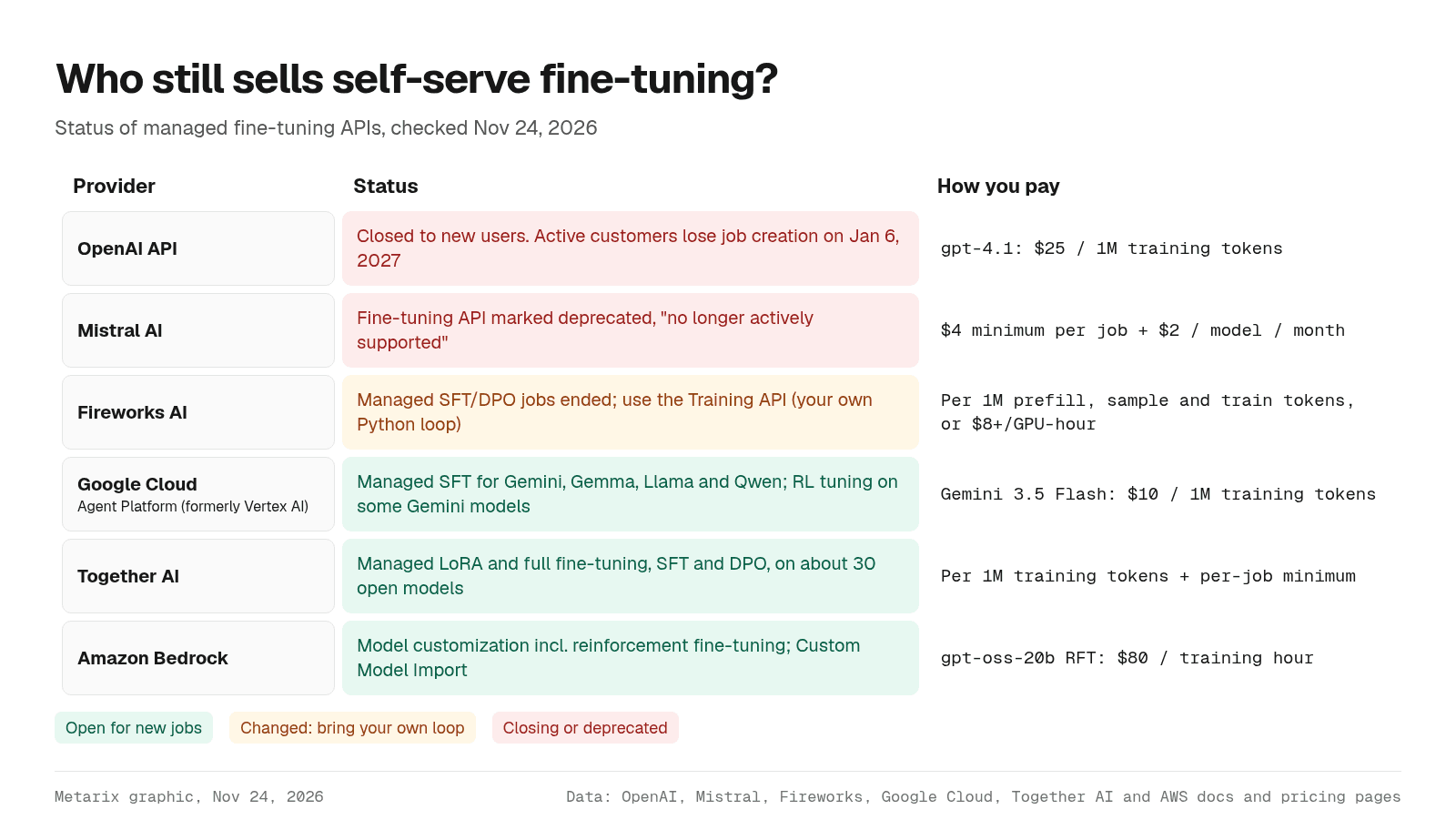
The OpenAI deprecations page sets out the wind-down in three steps. From May 7, 2026, organizations that had never run fine-tuning could no longer create jobs. From July 2, 2026, organizations that had not run inference on a fine-tuned model in the previous 60 days lost job creation too. On Jan 6, 2027, active customers lose it as well. Fine-tuned models keep serving until their base model is deprecated, and the pricing page now lists only gpt-4.1 and gpt-4.1-mini, both marked deprecated, under fine-tuning.
Mistral's fine-tuning docs now sit under Deprecated features with a warning that the feature "is no longer actively supported". The same page still describes a $4 minimum fee per job and $2 a month to store each model, but we would not start a new project on it.
Fireworks stopped accepting managed SFT and DPO jobs in November after it stopped storing customer datasets; we covered the reasons in Fireworks pauses Batch API, ends managed fine-tuning. Its replacement, the Training API, is real fine-tuning, but you write the loop.
Fine-tuning API prices side by side
The cleanest comparison is the same base model on two platforms. Llama 3.3 70B is listed by both Together AI and Google Cloud, so it anchors the table; the other rows show each provider's typical range.
Scroll the table horizontally on smaller screens.
| Model | Together AI | Google Cloud | Fireworks (Serverless Training, train meter) | OpenAI |
|---|---|---|---|---|
| Llama 3.3 70B | $2.03 LoRA / $2.24 full | $6.72 | Not on serverless list | n/a |
| Small open model | $0.34 (Qwen3.5 9B, Llama 3.1 8B LoRA) | $0.67 (Llama 3.1 8B) | $2.14 (Qwen 3.6 35B A3B, lowest listed) | n/a |
| Mid-size open model | $1.05 (Qwen3.6 27B, Gemma 4 31B LoRA) | $6.57 (Qwen 3 32B) | $4.10 (Qwen 3.8 27B) | n/a |
| Large open model | $15.00 (Kimi K2.6 LoRA) | n/a | $32.55 (Kimi K3) | n/a |
| Closed model | n/a | $3 (Gemini 3.5 Flash Lite) to $25 (Gemini 2.5 Pro) | n/a | $5 (gpt-4.1-mini) / $25 (gpt-4.1), existing customers only |
Two caveats before you read too much into the table. First, methods differ: Together's prices are for LoRA or full fine-tuning on open weights, Google's are for its managed tuning service, and Fireworks bills a separate train meter plus prefill and sample meters. Second, the cheapest training run is not the cheapest project, because serving the tuned model usually costs more over its life than training it.
What one fine-tuning job costs
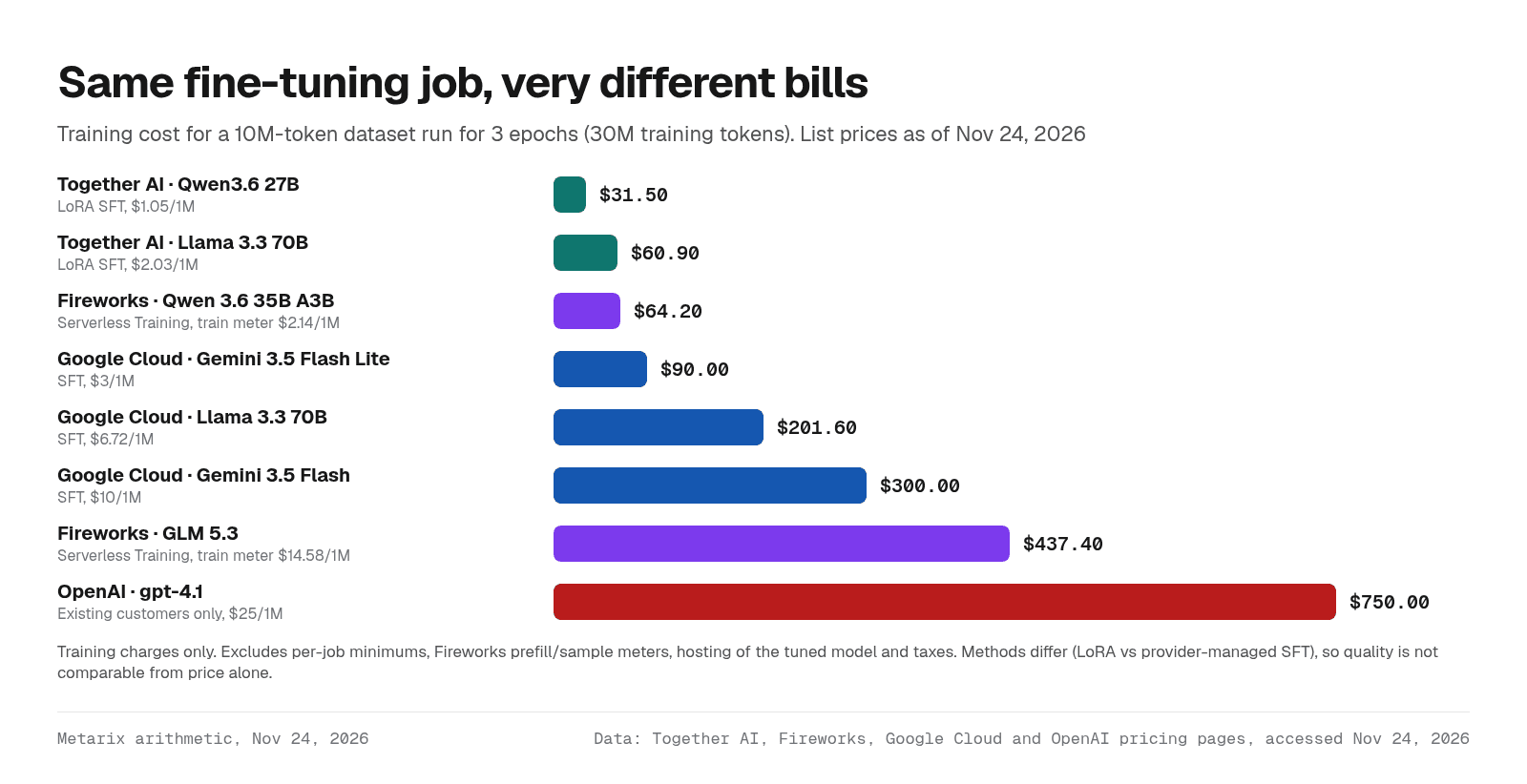
To make the rates concrete, take an illustrative job: a 10-million-token dataset trained for three epochs, or 30 million training tokens. That is a mid-sized instruction dataset, for example tens of thousands of support conversations.
Scroll the table horizontally on smaller screens.
| Provider and model | Rate per 1M | Training cost |
|---|---|---|
| Together AI, Qwen3.6 27B (LoRA SFT) | $1.05 | $31.50 |
| Together AI, Llama 3.3 70B (LoRA SFT) | $2.03 | $60.90 |
| Fireworks, Qwen 3.6 35B A3B (train meter) | $2.14 | $64.20 |
| Google Cloud, Gemini 3.5 Flash Lite | $3.00 | $90.00 |
| Google Cloud, Llama 3.3 70B | $6.72 | $201.60 |
| Google Cloud, Gemini 3.5 Flash | $10.00 | $300.00 |
| Fireworks, GLM 5.3 (train meter) | $14.58 | $437.40 |
| OpenAI, gpt-4.1 (existing customers only) | $25.00 | $750.00 |
Most first fine-tunes are smaller than this, so at Together's rates the per-job minimum can be what you actually pay: a 1-million-token test run on Qwen3.6 27B works out to $1.05 of training but is billed at the $4 minimum. Plan several runs, not one. Real projects iterate on data, epochs and hyperparameters, and an eval set decides which run ships; our guide to building LLM evals covers how to set one up before you train.
Google Cloud Agent Platform: managed tuning for Gemini
Google Cloud's Agent Platform pricing page (it still lives under the Vertex AI URL) lists supervised fine-tuning for Gemini 3.8 Flash, 3.5 Flash, 3.5 Flash Lite, 3.1 Flash Lite, 2.5 Pro, 2.5 Flash and 2.5 Flash Lite, with reinforcement learning fine-tuning on Gemini 3.5 Flash and 3.1 Flash Lite and preference tuning on the 2.5 Flash models. It also tunes open models, including Gemma 3, Llama 3.x and 4 Scout, and Qwen 3, priced per 1M tokens.
The catch is in a footnote. For Gemini 3.1 Flash Lite, 3.5 Flash and 3.5 Flash Lite, a tuned model's endpoint costs 1.5 times the base model's prediction price outside the global region, and the same price as the base model in the global region. If data residency forces you into a specific region, budget for that premium. For the trade-offs between Google's platform and AWS more broadly, see our Bedrock vs Vertex AI comparison.
Together AI: the widest open-model menu
Together AI lists fine-tuning prices for about 30 open models on its pricing page, from Qwen3.5 0.8B to GLM-5.2, with separate prices for supervised fine-tuning and Direct Preference Optimization (DPO costs about 2.5 times the SFT rate). Billing counts training tokens times epochs plus any evaluation-set tokens, and every job has a minimum charge, from $4 on small models to $60 on Kimi K2.6, Kimi K2.7 Code and GLM-5.x.
Its fine-tuning page offers both LoRA and full fine-tuning and deployment of the result on Together's infrastructure. For teams that want to write their own reinforcement learning or SFT loop, Together also sells Post-Training compute by the GPU-hour; B200 capacity lists at $11.00, discounted to $9.00 in a promotion that runs until Dec 14, 2026. If you are weighing where to host the tuned model afterwards, our open-model API providers comparison covers Together's serving prices against Fireworks, Groq and DeepInfra.
Fireworks Training API: you write the loop
The Fireworks Training API has two modes on the pricing page. Serverless Training runs on shared GPUs with nothing to provision and bills per 1M tokens across three meters: prefill (prompt tokens the sampler reads, with repeated prefixes at 80% off), sample (generated tokens) and train. Dedicated Training bills by the GPU-hour at Fireworks' standard rates, from $8.00 for H100 and H200 GPUs, and supports full-parameter training and the largest MoE models.
The serverless docs are explicit about the limits: serverless supports LoRA training only, you run supervised fine-tuning, DPO, reinforcement learning or distillation from your own Python script, and you promote a sampler checkpoint to a deployable LoRA model when you are done. On Kimi K3 and K3.1 Pro, a serverless LoRA trains the attention layers and the shared expert, while routed experts stay frozen. Fireworks is also running a promotion with free SFT on Muse Glimmer 30B through Nov 30, 2026.
An illustrative shape of the loop, simplified from Fireworks' serverless quickstart (check the docs for the exact SDK and arguments):
# Illustrative, simplified from Fireworks' serverless quickstartfrom fireworks.training.sdk import FiretitanServiceClient, AdamParamsservice = FiretitanServiceClient(api_key=KEY, base_url="https://api.fireworks.ai/training/v1/serverless")trainer = service.create_lora_training_client(base_model=BASE, rank=8)for datums in my_batches(): # your data stays on your machine trainer.forward_backward(datums, LOSS).result() # remote GPUs trainer.optim_step(AdamParams(learning_rate=2.5e-5)).result()# save a sampler checkpoint, then promote it to a deployable LoRA model
That design is the point after Fireworks' October security incident: datasets stay on your machine or in your own Google Cloud Storage. The cost is engineering time, since retries, data loading and evaluation are now your code.
Amazon Bedrock: customization inside AWS
Amazon Bedrock prices customization per model family on its pricing page. Reinforcement fine-tuning, where Bedrock generates responses to your prompts, scores them with your reward function and trains on the result, is billed per training hour: $80 an hour for gpt-oss-20b in US East (N. Virginia) and US West (Oregon). The tuned model then runs on demand at $0.09 per 1M input tokens and $0.39 per 1M output, plus $1.95 a month to store it. AWS says on-demand inference for custom Nova models is priced the same as the base Nova model.
Bedrock's other route is Custom Model Import: train an open model anywhere, then import the weights and pay per Custom Model Unit per minute ($0.05718 in US East and US West, $0.07144 in Frankfurt) plus $1.95 a month per unit for storage. AWS's own example, a Llama 3.1 8B model with 128K context, needs two units. That pairs well with cheap training elsewhere if your production stack has to stay on AWS.
If you are leaving OpenAI fine-tuning
- Inventory first. List every fine-tuned model in use and its base model. Inference keeps working until the base model is deprecated, and gpt-4.1 and gpt-4.1-mini are already marked deprecated on the pricing page, so check the deprecations page for dates.
- Ask whether you still need a fine-tune. Newer base models with a few examples in the prompt, structured outputs and prompt caching cover many jobs that needed fine-tuning two years ago. Our prompt caching break-even guide shows when a long prompt is cheaper than a tuned model.
- Keep your training data portable. Store the master copy in your own storage in a provider-neutral format, such as chat-style JSONL, and expect to convert it for each provider's required fields.
- Re-run your evals on the replacement. A tuned open model can match a tuned gpt-4.1-mini on a narrow task, but only your eval set can tell you that.
- Price serving, not just training. A LoRA adapter on a shared serverless model is usually far cheaper than a dedicated endpoint; our self-hosted LLM vs API cost piece covers the break-even for running your own.
Verdict
For most teams starting a fine-tune today, Together AI is the default: the broadest list of open models, managed LoRA and full fine-tuning, DPO, and the lowest per-token training prices on the open models it shares with Google and Fireworks, with a small per-job minimum. Pick Google Cloud's Agent Platform if you specifically need a tuned Gemini model, and watch the regional serving premium. Pick the Fireworks Training API if you want reinforcement learning or a custom loop without renting GPUs. Pick Bedrock if everything must stay in AWS. Do not plan new work on OpenAI or Mistral fine-tuning; treat existing OpenAI fine-tunes as a migration project with a Jan 6, 2027 deadline for retraining.
Sources
- OpenAI API deprecations: update to self-serve fine-tuning and OpenAI API pricing, accessed Nov 24, 2026
- Google Cloud generative AI pricing, Model Tuning, accessed Nov 24, 2026
- Together AI pricing and Together AI Fine-Tuning, accessed Nov 24, 2026
- Fireworks AI pricing and Serverless Training docs, accessed Nov 24, 2026
- Amazon Bedrock pricing, accessed Nov 24, 2026
- Mistral AI fine-tuning docs (deprecated), accessed Nov 24, 2026
Tools covered in this guide
Frequently asked questions
- Can I still fine-tune models on the OpenAI API?
- Only if your organization already fine-tunes there. OpenAI closed fine-tuning to new organizations on May 7, 2026, to inactive ones on July 2, 2026, and will stop new jobs for all remaining customers on Jan 6, 2027. Existing fine-tuned models keep serving until their base model is deprecated.
- What is the cheapest fine-tuning API?
- Among the providers we compared on Nov 24, 2026, Together AI had the lowest per-token training prices on open models listed by more than one provider: LoRA supervised fine-tuning from $0.34 per 1M tokens on small open models and $2.03 on Llama 3.3 70B, subject to a per-job minimum of $4 or more.
- Can I fine-tune Gemini models?
- Yes, through Google Cloud's Agent Platform (formerly Vertex AI). Supervised fine-tuning runs from $0.003 per 1,000 training tokens on Gemini 3.5 Flash Lite to $0.025 on Gemini 2.5 Pro, and some Gemini models also support reinforcement learning or preference tuning.
- How are fine-tuning costs calculated?
- Most providers charge per training token, which is the number of tokens in your training dataset multiplied by the number of epochs, sometimes plus evaluation tokens. Fireworks' serverless Training API bills separate prefill, sample and train meters, and Amazon Bedrock bills reinforcement fine-tuning per training hour. Serving the tuned model is billed separately.
- Is Mistral fine-tuning still available?
- Mistral's documentation lists its fine-tuning API under deprecated features and says it is no longer actively supported. The docs still mention a $4 minimum per job and $2 a month per stored model, but new projects should use another provider.