Comparison · RAG & retrieval
RAG Evaluation Tools: Ragas, DeepEval, TruLens, Phoenix
Ragas, DeepEval, TruLens and Arize Phoenix all check retrieval, grounding and answer relevance, but score them differently. Here's how they compare on metrics, CI fit, production monitoring and price.
Pavel Holmgren · Nov 21, 2026 · 10 min read
Documentation-based research
On this page
RAG evaluation tools all promise to tell you whether your retrieval-augmented app is hallucinating, but they measure it differently. Ragas, DeepEval, TruLens and Arize Phoenix share the same three core checks under different names, and the same "faithfulness" score can mean a claim ratio in one tool and a yes-or-no label in another.
This comparison maps the four open-source options side by side: what each one measures, how it runs, what it costs once you outgrow the free tier, and which fits a CI pipeline versus production monitoring. Versions and prices as of Nov 21, 2026. If you're new to the architecture itself, start with our RAG explainer.
Quick verdict
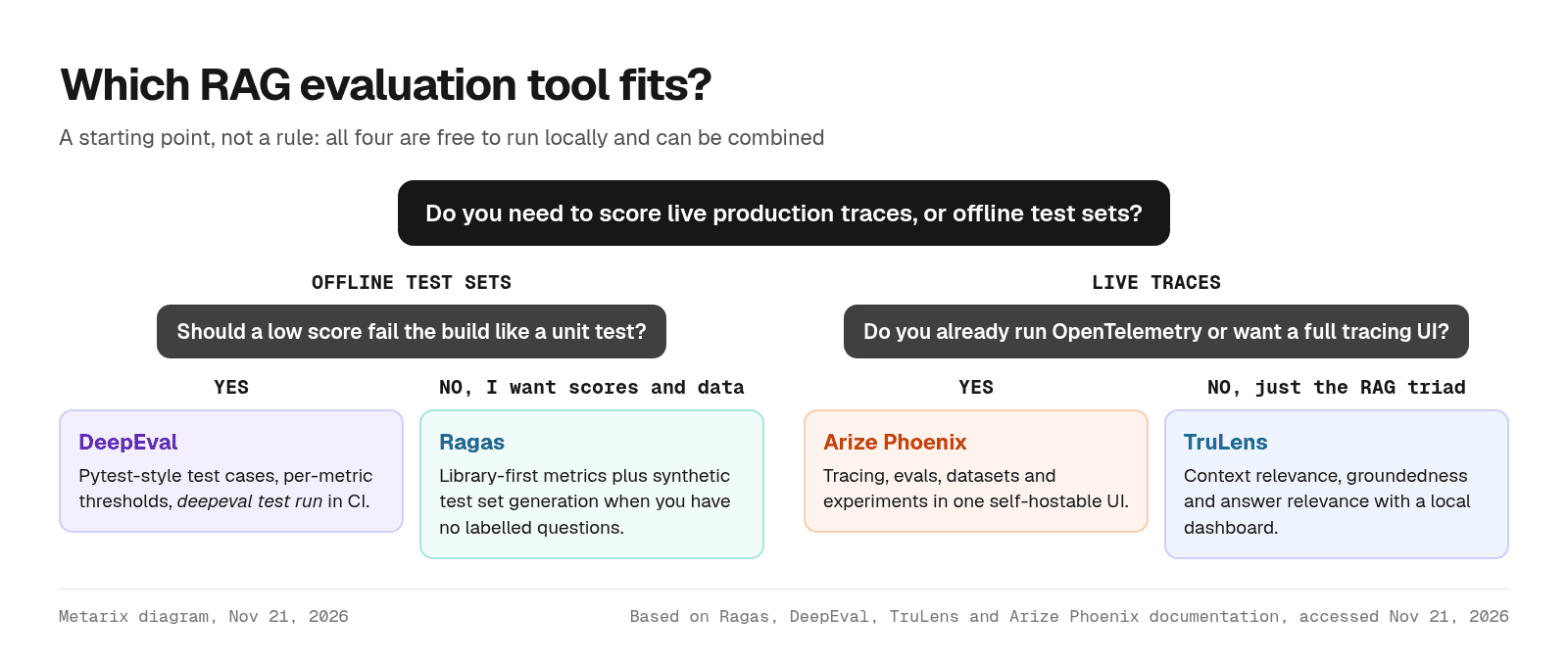
Pick DeepEval if you want RAG checks to fail a build like unit tests. Pick Ragas if you want a lightweight metrics library and help generating a test set from your own documents. Pick Arize Phoenix if you also need tracing and want to score real production requests on infrastructure you control. TruLens is the simplest way to get the "RAG triad" with a local dashboard. All four are free to run; you pay for the judge model calls.
Scroll the table horizontally on smaller screens.
| Feature | Ragas | DeepEval | TruLens | Arize Phoenix |
|---|---|---|---|---|
| Shape | Python metrics library | Pytest-style test framework | Instrumentation plus feedback functions | Tracing and eval platform with web UI |
| License | Apache 2.0 | Apache 2.0 | MIT | Elastic License 2.0 (source-available) |
| Latest release | v0.4.4 (Nov 14, 2026) | python-v4.2.4 (Sep 22, 2026) | 2.16.0 (Oct 19, 2026) | 22.0.0 (Nov 20, 2026) |
| Core RAG metrics | Context Precision, Context Recall, Faithfulness, Response Relevancy, Noise Sensitivity | Contextual Precision, Recall, Relevancy; Answer Relevancy; Faithfulness | Context Relevance, Groundedness, Answer Relevance | Retrieval Relevance, Faithfulness, Correctness, Hallucination |
| Faithfulness output | 0–1 share of supported claims | 0–1 score with a reason and pass threshold | Groundedness score with reasons | faithful / unfaithful (1.0 or 0.0) with explanation |
| Best at | Offline scoring, synthetic test sets | CI gates on prompt and retriever changes | Quick RAG triad with a dashboard | Scoring live traces, experiments |
| Paid layer | None required | Confident AI: free, $200/mo, $2,000/mo, Enterprise | None required | Arize AX: free, $50/mo Pro, Enterprise; Phoenix self-host free |
What a RAG evaluation actually checks
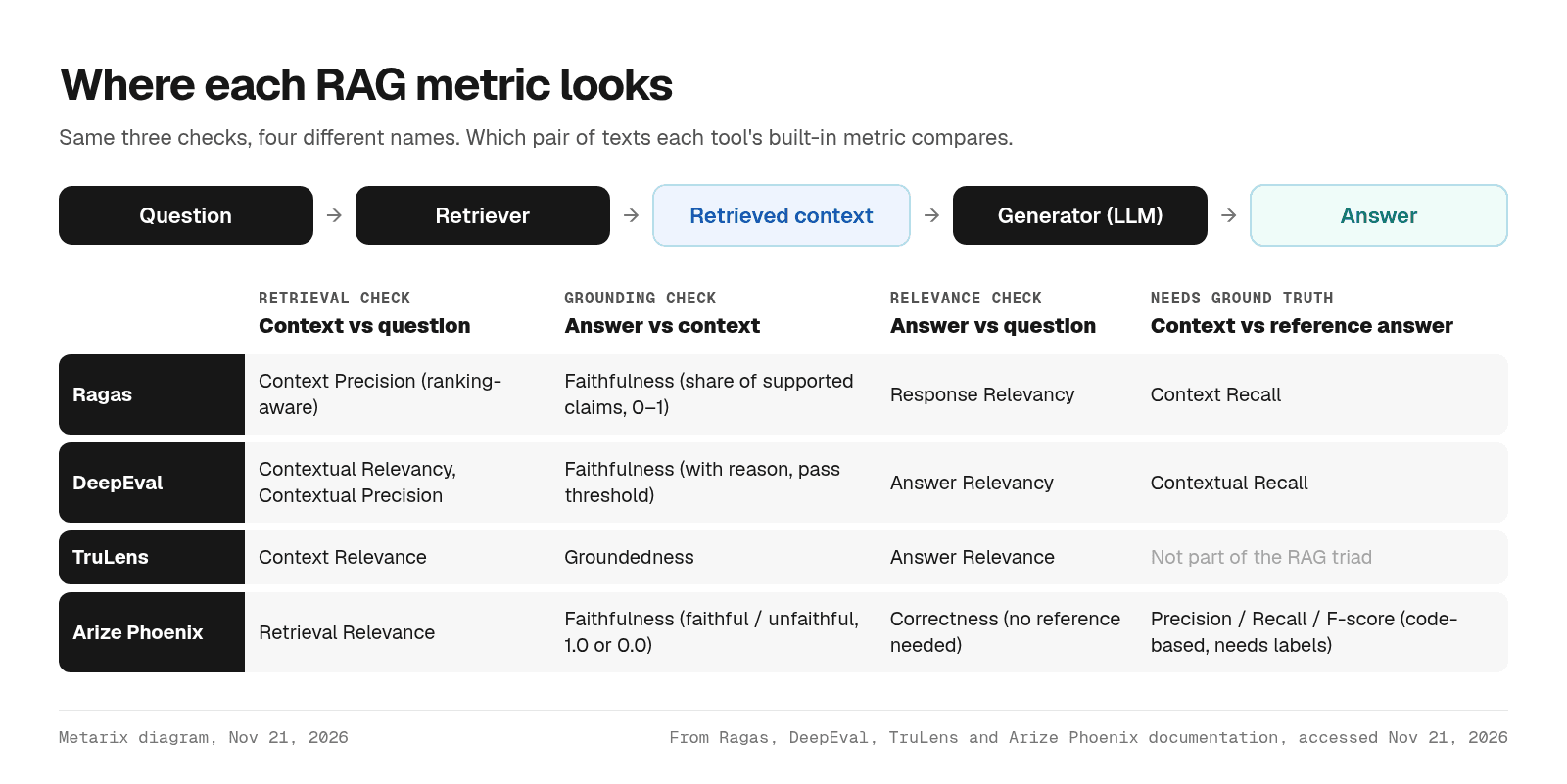
Every tool here splits a RAG pipeline into a retriever and a generator and checks the links between four pieces of text: the question, the retrieved context, the generated answer and, optionally, a reference answer you wrote. DeepEval's RAG guide puts it plainly: evaluate the retriever and generator separately so you can tell which half broke.
- Retrieval check (context vs question). Did the retriever bring back chunks that are relevant, and were the relevant ones ranked first? This catches bad chunk sizes, a weak embedding model or a missing reranker.
- Grounding check (answer vs context). Is every claim in the answer supported by the retrieved text? This is the hallucination check most teams care about first.
- Relevance check (answer vs question). Did the answer actually address what was asked, rather than summarising whatever was retrieved?
- Recall check (context vs reference). Did retrieval contain everything a correct answer needs? This one needs a human-written ground truth, so it belongs in offline test sets, not live monitoring.
Most of these metrics are LLM-as-a-judge scores: a second model reads the texts and decides. That makes them cheap to write and expensive to trust. Our guide to building an LLM judge you can trust covers how to calibrate one against human labels before you rely on its numbers.
Ragas: the metrics library
Ragas is an Apache 2.0 Python library and the project that popularised named RAG metrics. Its metric catalogue covers retrieval (Context Precision, Context Recall, Context Entities Recall, Noise Sensitivity), generation (Faithfulness, Response Relevancy), agent behaviour (Tool Call Accuracy, Tool Call F1, Agent Goal Accuracy, Topic Adherence), and classic non-LLM scores such as BLEU, ROUGE and exact match.
Two details matter in practice. First, Ragas defines Faithfulness as the number of claims in the response supported by the context divided by the total number of claims, so a score of 0.5 means half the claims checked out. Second, Context Precision is ranking-aware: it rewards putting relevant chunks at the top, which is what you want to measure when tuning a reranker.
Ragas also generates synthetic test questions by building a knowledge graph from your documents, which is useful when you have a corpus but no labelled question set. Note that the project moved from the explodinggradients GitHub organisation to vibrantlabsai, and its docs mark the older sample-based metrics API for removal in 1.0, so pin your version and use the collections API for new code.
An illustrative faithfulness check, adapted from the Ragas docs (not run by Metarix; requires an OpenAI key):
from openai import AsyncOpenAIfrom ragas.llms import llm_factoryfrom ragas.metrics.collections import Faithfulnessllm = llm_factory("gpt-4o-mini", client=AsyncOpenAI())scorer = Faithfulness(llm=llm)result = scorer.score( user_input="How long is the refund window?", response="You can get a full refund within 30 days.", retrieved_contexts=["All customers are eligible for a 30-day full refund."],)print(result.value) # share of supported claims, 0 to 1
Pros: broad metric set, test set generation, no platform lock-in. Cons: no built-in pass/fail test runner or UI, and the API has shifted between minor versions.
DeepEval: evals as unit tests
DeepEval, from Confident AI, is also Apache 2.0, but it is built around tests rather than scores. You write LLMTestCase objects, attach metrics with thresholds, and run deepeval test run, which plugs into Pytest, per the quickstart. A metric below its threshold fails the test, so it slots straight into the CI job you already have.
For RAG, the metrics overview lists three retrieval metrics (Contextual Precision for reranker ordering, Contextual Recall for embedding coverage, Contextual Relevancy for chunk size and top-K) and two generation metrics (Answer Relevancy and Faithfulness). Its Faithfulness metric focuses on contradictions between the output and the retrieval context and returns a written reason alongside the score, which makes failed CI runs easier to debug. G-Eval lets you add custom criteria in plain English.
An illustrative CI test, adapted from DeepEval's docs (not run by Metarix):
# test_rag.py -> deepeval test run test_rag.pyfrom deepeval import assert_testfrom deepeval.metrics import FaithfulnessMetric, AnswerRelevancyMetricfrom deepeval.test_case import LLMTestCasedef test_refund_answer(): case = LLMTestCase( input="What if these shoes don't fit?", actual_output=my_rag_app("What if these shoes don't fit?"), retrieval_context=retrieved_chunks, # from your retriever ) assert_test(case, [FaithfulnessMetric(threshold=0.7), AnswerRelevancyMetric(threshold=0.7)])
The framework runs locally for free. If you want a hosted dashboard, Confident AI pricing has a free tier (2 seats, 1 project, 5 test runs per week, 1 GB-month of traces), Starter at $200 a month, Team at $2,000 a month and custom Enterprise. Prices as of Nov 21, 2026.
Pros: the most natural fit for CI gating, reasons on failures, strong agent metrics. Cons: the paid platform jumps steeply from free to $200, and reference-based metrics need ground truth you have to write.
TruLens: the RAG triad
TruLens is MIT-licensed and maintained by Snowflake. Its framing is the RAG triad: Context Relevance (is each retrieved chunk relevant to the query), Groundedness (split the answer into claims and look for evidence for each in the context) and Answer Relevance (does the answer address the question). The project's argument is that passing all three means the app is hallucination-free up to the accuracy of its knowledge base.
In the quickstart you instrument your app's retrieve and generate functions with OpenTelemetry-style decorators, define the three feedback metrics with a provider such as OpenAI, LiteLLM, Bedrock or Snowflake Cortex, and open a local dashboard with run_dashboard(session) to compare app versions on a leaderboard.
Pros: a clear mental model, a dashboard out of the box, many judge providers. Cons: a narrower metric set than Ragas or DeepEval and no built-in ground-truth recall metric in the triad.
Arize Phoenix: tracing plus evals
Phoenix is the only one of the four that is primarily an observability platform. It traces every retrieval, LLM and tool span via OpenTelemetry, then lets you run evaluations either client-side with Python and TypeScript SDKs or server-side from the UI against datasets, with no code. Pre-built evaluators include Faithfulness, Retrieval Relevance, Correctness, Hallucination, Refusal and tool-calling checks, plus code-based ones such as regex, JSON distance and precision/recall/F-score.
The key difference for comparisons: Phoenix's Faithfulness evaluator is a classifier. It labels each response faithful (1.0) or unfaithful (0.0) with an explanation, rather than returning a fraction of supported claims. A Phoenix faithfulness rate of 0.9 means 90% of responses passed, while a Ragas average of 0.9 means responses averaged 90% supported claims. Those are not the same number.
Phoenix is free to self-host with no feature limits via CLI, Docker, Kubernetes or Helm. Arize's managed Arize AX has a free tier (25,000 spans and 1 GB a month, 15-day retention), Pro at $50 a month and custom Enterprise. Prices as of Nov 21, 2026. The Elastic License 2.0 is source-available rather than OSI open source; it mainly matters if you plan to resell Phoenix as a hosted service.
Pros: scores real traffic, not just test sets; datasets and experiments in one UI; self-hostable for data privacy. Cons: heavier to run than a library, and its binary scores need care when compared with other tools.
Head-to-head: which tool for which job
Scroll the table horizontally on smaller screens.
| Job | Best fit | Why |
|---|---|---|
| Fail a pull request when retrieval or prompts regress | DeepEval | Pytest integration and per-metric thresholds |
| Score a new chunking or embedding strategy offline | Ragas | Ranking-aware Context Precision, Context Recall, synthetic test sets |
| Watch hallucinations on production traffic | Arize Phoenix | Evaluators run on OpenTelemetry traces, self-hostable |
| Compare two app versions on the RAG triad quickly | TruLens | Three feedback metrics and a local leaderboard dashboard |
| Config-only evals across many models | Promptfoo (not RAG-specific) | YAML test cases and CI runners |
Mistakes that make RAG scores meaningless
- Comparing scores across tools. Ragas and DeepEval faithfulness are claim-level averages; Phoenix's is a per-response pass rate. Pick one definition and track it over time.
- Changing the judge model mid-stream. LLM-judged scores move when the judge changes. Pin the judge model and version alongside your eval results.
- Only testing the happy path. Add questions your corpus cannot answer and check that the app declines. Our AI app evaluation walkthrough covers negative and boundary cases.
- Skipping retrieval metrics. A perfect faithfulness score on irrelevant context just means the model faithfully repeated the wrong document. Measure retrieval separately, and revisit your embedding model choice if context scores are low.
- Running reference-based metrics in production. Context Recall and similar metrics need a ground-truth answer, which live traffic doesn't have. Use referenceless metrics for monitoring.
Verdict
For most teams shipping a RAG feature, start with DeepEval in CI: a dozen hand-written test cases with Faithfulness and Answer Relevancy thresholds will catch most regressions from prompt, model or retriever changes. Add Ragas when you need ranking-aware retrieval metrics or synthetic questions to widen the test set. Once the app has real users, put Phoenix in front of production traffic so you evaluate what people actually ask, and keep its binary scores on a separate chart from your offline numbers. TruLens is a good pick for a quick, dashboard-first evaluation if you don't need CI gating.
Whatever you pick, the tool matters less than the test set and the judge. Calibrate the judge against a few dozen human labels, keep the questions versioned, and treat any single score as a trend line, not a grade. If you're also evaluating non-RAG prompts, our Promptfoo vs Inspect eval guide covers general-purpose eval harnesses.
Sources
- Ragas documentation: available metrics
- Ragas documentation: Faithfulness
- Ragas on GitHub
- DeepEval documentation: metrics introduction
- DeepEval guide: RAG evaluation
- DeepEval documentation: Faithfulness
- Confident AI pricing
- TruLens: the RAG triad
- TruLens quickstart
- Arize Phoenix documentation: evaluation
- Arize Phoenix documentation: Faithfulness evaluator
- Arize Phoenix self-hosting
- Arize pricing
Tools covered in this guide
Frequently asked questions
- What is the best tool for RAG evaluation?
- It depends on where you evaluate. DeepEval is the best fit for CI tests with pass thresholds, Ragas for offline metrics and synthetic test sets, Arize Phoenix for scoring production traces, and TruLens for a quick RAG triad dashboard. All four are free to run locally.
- What is the difference between Ragas and DeepEval?
- Both are Apache 2.0 Python projects with similar RAG metrics. Ragas is a metrics library that returns scores and can generate synthetic test sets. DeepEval is a test framework built on Pytest, where metrics have thresholds that pass or fail a test run, and it offers an optional hosted platform from Confident AI.
- What does faithfulness mean in RAG evaluation?
- Faithfulness checks whether the generated answer is supported by the retrieved context. Ragas scores it as the share of claims the context supports, from 0 to 1; DeepEval returns a 0 to 1 score with a reason; Arize Phoenix labels each response faithful or unfaithful.
- Do RAG evaluation metrics need ground-truth answers?
- Some do. Context Recall in Ragas and Contextual Recall in DeepEval compare retrieval with a reference answer, so they need labelled data. Faithfulness, answer relevancy and context relevance are referenceless and can run on live traffic.
- Is Arize Phoenix free?
- Yes. Phoenix is free to self-host with no feature limits under the Elastic License 2.0. Arize separately sells a managed platform, Arize AX, with a free tier, a $50 per month Pro plan and custom Enterprise pricing as of November 2026.