Comparison · Cloud AI platforms
AWS Bedrock vs Google Vertex AI: Cloud AI Platforms Compared
Google folded Vertex AI into Gemini Enterprise Agent Platform in April 2026. Here is how it compares with Amazon Bedrock on models, pricing tiers, RAG, agents and guardrails, with list prices as of Nov 11.
Metarix Editorial · Nov 10, 2026 · 13 min read
Documentation-based research
On this page
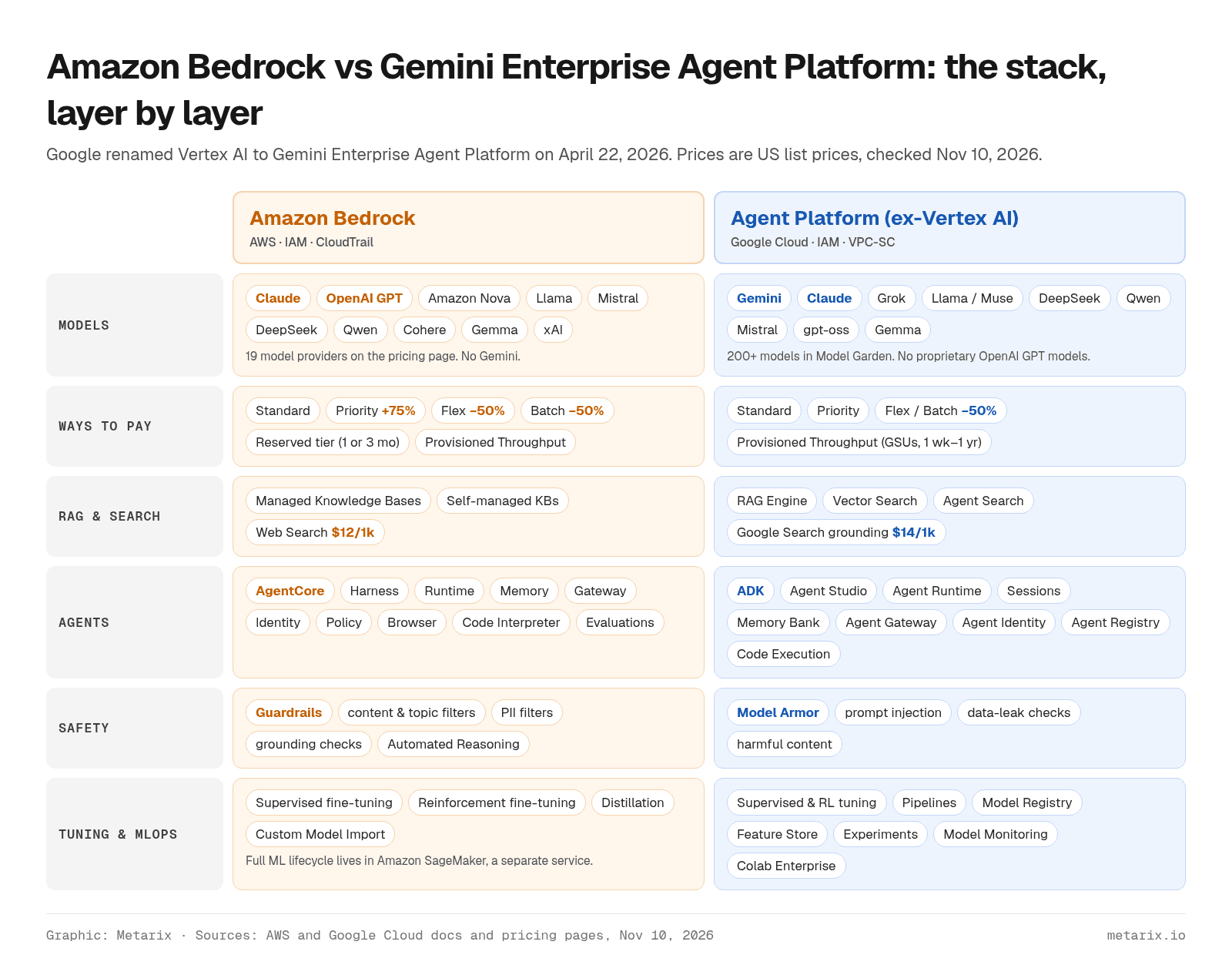
Amazon Bedrock and Google's Vertex AI do the same basic job: they give you managed access to foundation models inside a cloud account, with that cloud's identity, logging and billing. The real differences are which models each one carries, how you pay for capacity, and how much of the RAG, agent and safety stack comes built in.
One thing changed this year that many comparisons miss. On April 22, 2026, Google folded Vertex AI into Gemini Enterprise Agent Platform and renamed most of its parts (release notes). This guide uses the new names, with the old ones alongside. All prices are US list prices as of Nov 11, 2026, taken from AWS and Google Cloud pricing pages and linked inline.
Quick verdict
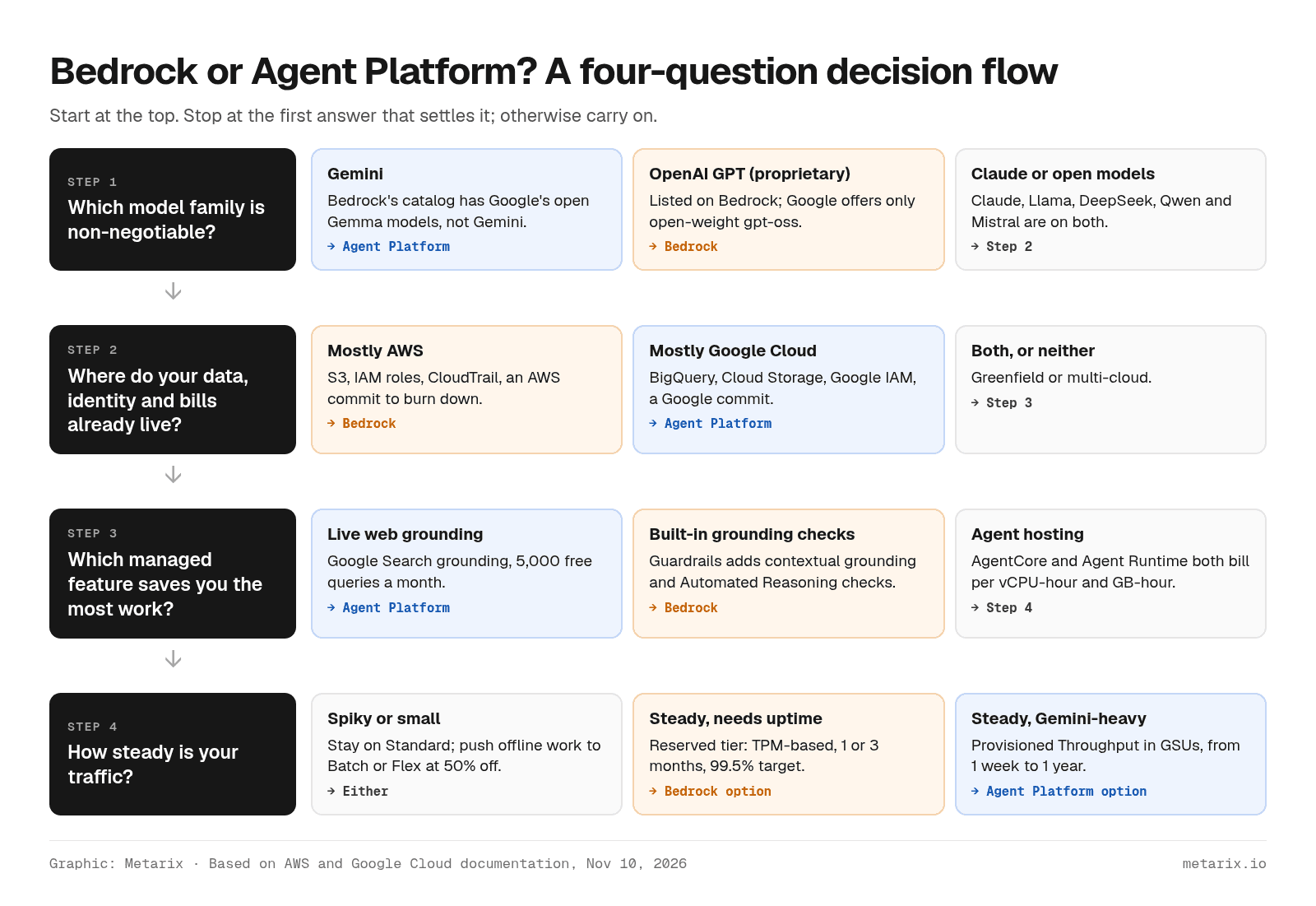
Pick the platform that already holds your data, identity and cloud commit. That rule settles most decisions. When it doesn't, the model you need comes next. Gemini is only on Google's platform, and OpenAI's proprietary GPT models are on Bedrock but not Google's. Claude costs the same per token on both.
Scroll the table horizontally on smaller screens.
| Area | Amazon Bedrock | Gemini Enterprise Agent Platform (ex-Vertex AI) |
|---|---|---|
| Exclusive model family | OpenAI GPT models (proprietary), Amazon Nova | Gemini |
| Shared models | Claude, Llama, DeepSeek, Qwen, Mistral, Gemma | Claude, Llama, DeepSeek, Qwen, Mistral, Gemma |
| Catalog size | 19 model providers listed on the pricing page | 200+ models in Model Garden |
| Claude Sonnet 5.5 (global) | $2 input / $10 output per 1M tokens | $2 input / $10 output per 1M tokens |
| Discount tiers | Flex and Batch at 50% off Standard; Priority at a 75% premium | Batch (and Flex for Gemini 3) at 50% off; Priority at a premium |
| Reserved capacity | Reserved tier (1 or 3 months, per 1K TPM) and Provisioned Throughput (model units) | Provisioned Throughput in GSUs (1 week to 1 year) |
| Managed RAG | Managed Knowledge Bases: $5 per GB-month, $1 per 1,000 retrievals | RAG Engine, Vector Search, Agent Search |
| Web grounding | Web Search tool: $12 per 1,000 calls; AgentCore Web Search: $7 per 1,000 queries | Google Search grounding: 5,000 free queries a month, then $14 per 1,000 |
| Agent platform | AgentCore (Runtime, Memory, Gateway, Identity, Policy and more) | Agent Runtime, Sessions, Memory Bank, Agent Gateway, ADK |
| Safety layer | Guardrails, billed per 1,000 text units per filter | Model Armor: 2M tokens a month free, then $0.10 per 1M tokens |
First, the name: Vertex AI is now Agent Platform
Google's April 22 release notes say Vertex AI "is now part of Gemini Enterprise Agent Platform," and the old Agent Builder moved in with it (release notes). The Vertex AI API is now called the Agent Platform API, though Google's RAG Engine docs still point Python users to the Vertex AI SDK. Docs and pricing pages now use the new names, so it helps to know the mapping.
Scroll the table horizontally on smaller screens.
| Old Vertex AI name | New name on Agent Platform |
|---|---|
| Vertex AI Platform | Agent Platform |
| Vertex AI Studio | Agent Studio |
| Vertex AI Model Garden | Model Garden |
| Vertex AI Agent Engine | Agent Runtime |
| Agent Engine Sessions / Memory Bank | Agent Platform Sessions / Memory Bank |
| Vertex AI Search | Agent Search |
| Vertex AI RAG Engine | RAG Engine |
| Vertex AI Vector Search 2.0 | Agent Retrieval |
| Vertex AI Pipelines / Model Registry / Feature Store | Agent Platform Pipelines / Model Registry / Feature Store |
On AWS, the naming is more stable. Bedrock is the model and inference service. Amazon Bedrock AgentCore is the agent platform that sits beside it, and it works with models from inside or outside Bedrock.
Model catalog: who has what
Both platforms are multi-vendor now. The catalogs overlap more than older comparisons suggest. Claude is on both, and Bedrock lists 19 providers on its pricing page, from AI21 Labs to Z AI. Google says Model Garden offers "over 200 foundation models" (overview). The table shows where each major family is served as a managed API.
Scroll the table horizontally on smaller screens.
| Model family | Amazon Bedrock | Agent Platform |
|---|---|---|
| Gemini (Google) | No. Only Google's open Gemma models | Yes, first-party (Gemini 4 Argon, Gemini 4 Carbon, Gemini 3.x Flash) |
| OpenAI GPT (proprietary) | Yes, e.g. GPT-6.1 Sol | No. Only open-weight gpt-oss-120b and gpt-oss-20b |
| Claude (Anthropic) | Yes, incl. Opus 5.5, Sonnet 5.5, Haiku 5.5, Fable 5.2 | Yes, incl. Opus 5.5, Sonnet 5.5, Haiku 5.5, Fable 5.2 |
| Amazon Nova | Yes, first-party (Nova 2.0 Pro, Lite, Omni, Sonic) | No |
| xAI Grok | Listed as a provider | Yes (Grok 4.7, 4.6, 4.3 and others) |
| Meta | Llama 4, 3.3, 3.2, 3.1 | Llama 4, 3.3 plus Muse models |
| Open-weight others | DeepSeek, Qwen, Mistral, MiniMax, Moonshot, Z AI | DeepSeek, Qwen, Mistral, MiniMax, Moonshot (Kimi), GLM |
| Bring your own weights | Custom Model Import | Deploy open models from Model Garden to your own endpoints |
If Claude is your main model, the platform choice barely changes the token bill, but features do differ between Anthropic's own API and the cloud versions. Our Claude API vs Bedrock vs Vertex AI comparison covers those gaps, rate limits and data handling in detail.
Pricing compared
Both clouds bill per million tokens and split input from output. Both also charge about 10% more for regional or data-residency endpoints than for the global endpoint. For Claude Sonnet 5.5 on Bedrock in us-east-1, the Price List shows $2 / $10 at global and $2.20 / $11 in-region. Google charges $4.40 / $22 for Gemini 4 Argon at non-global endpoints, against $4 / $20 global.
Token prices for headline models
Scroll the table horizontally on smaller screens.
| Model | Platform | Input | Output |
|---|---|---|---|
| Claude Opus 5.5 | Bedrock and Agent Platform | $4.00 | $20.00 |
| Claude Sonnet 5.5 | Bedrock and Agent Platform | $2.00 | $10.00 |
| Claude Haiku 5.5 | Bedrock and Agent Platform | $0.10 ($0.50 for long-context prompts) | $0.50 ($2.50 for long-context prompts) |
| Gemini 4 Argon | Agent Platform | $4.00 from Dec 1 ($2.00 effective until Nov 30) | $20.00 from Dec 1 ($10.00 effective until Nov 30) |
| Gemini 4 Carbon | Agent Platform | $4.00 from Dec 1 ($2.00 effective until Nov 30) | $20.00 from Dec 1 ($10.00 effective until Nov 30) |
| Gemini 3.5 Flash | Agent Platform | $1.50 | $9.00 |
| Gemini 3.5 Flash-Lite | Agent Platform | $0.30 | $2.50 |
| Amazon Nova 2.0 Pro | Bedrock | $1.25 | $10.00 |
| Amazon Nova 2.0 Lite | Bedrock | $0.30 | $2.50 |
| OpenAI GPT-6.1 Sol | Bedrock | $2.00 | $10.00 |
Two Google details are worth noting. First, Gemini 4 Argon and Gemini 4 Carbon share the same per-token price: $2 input and $10 output per million tokens until Nov 30, then $4 and $20 from Dec 1. The lower November price isn't a list price. Google applies it as 50% credits back, and standard pricing starts on December 1 (pricing). Carbon became generally available on Nov 10, 2026. Our Gemini 4 Carbon pricing piece covers why the same rate can still produce a higher bill per task. Second, from November 13, 2026, Gemini 4 completions longer than 32K tokens are billed for retrievable tokens even if the request fails on a client or server timeout. Set sensible max-output limits on long-running jobs.
Service tiers and discounts
Bedrock now has four inference tiers, chosen per request with a service_tier parameter (AWS docs). Google sells the same idea through Standard, Priority and Flex/Batch options on its pricing tables.
Scroll the table horizontally on smaller screens.
| Option | Amazon Bedrock | Agent Platform |
|---|---|---|
| Standard | Default on-demand price | Default pay-as-you-go price |
| Priority | 75% premium; requests jump ahead of Standard and Flex | Priority tables, e.g. Gemini 4 Argon and Carbon at $7.20 / $36 per 1M tokens from Dec 1 |
| Flex | 50% discount for work that can wait | Flex/Batch tables for Gemini 3 models |
| Batch | 50% lower than on-demand for select models | 50% off, e.g. Gemini 4 Argon and Carbon at $2 / $10 from Dec 1; Claude Sonnet 5.5 at $1 / $5 |
| Reserved capacity | Reserved tier: 1 or 3 months, fixed price per 1K tokens-per-minute, 99.5% uptime target | Provisioned Throughput (below) |
On Bedrock, Priority, Standard and Flex share one on-demand quota, while a Reserved tier booking sits outside it. Traffic above the reservation overflows to Standard instead of failing. Reserved tier needs at least 100,000 input and 10,000 output tokens per minute, and AWS says you arrange it through your account team.
Provisioned Throughput
Bedrock's older Provisioned Throughput still exists for some models. It is sold in model units per hour with no commitment, a 1-month term or a 6-month term. Cohere Command, for example, costs $49.50, $39.60 or $23.77 per model-unit-hour. For Anthropic models, the pricing page tells you to contact your account team. Google sells Provisioned Throughput in generative AI scale units (GSUs). Each GSU gives a fixed amount of per-second throughput, and the price falls with longer terms.
Scroll the table horizontally on smaller screens.
| Commitment | Per hour | Roughly per month |
|---|---|---|
| 1 week | $7.14 | about $1,200 per week |
| 1 month | $3.70 | about $2,700 |
| 3 months | $3.29 | about $2,400 |
| 1 year | $2.74 | about $2,000 |
A worked monthly bill
To make the list prices concrete, here is one monthly workload priced on each platform: 1 billion input tokens and 200 million output tokens, Standard tier, global endpoint, no caching. These models are not equal in quality, so treat this as a price map, not a recommendation. Our guide to cost per successful task explains why the cheapest token isn't always the cheapest answer.
Scroll the table horizontally on smaller screens.
| Model | Where | Input cost | Output cost | Monthly total |
|---|---|---|---|---|
| Claude Opus 5.5 | Either | $4,000 | $4,000 | $8,000 |
| Gemini 4 Argon (from Dec 1) | Agent Platform | $4,000 | $4,000 | $8,000 |
| Gemini 4 Carbon (from Dec 1) | Agent Platform | $4,000 | $4,000 | $8,000 |
| Claude Sonnet 5.5 | Either | $2,000 | $2,000 | $4,000 |
| Gemini 3.5 Flash | Agent Platform | $1,500 | $1,800 | $3,300 |
| Amazon Nova 2.0 Pro | Bedrock | $1,250 | $2,000 | $3,250 |
| Gemini 3.5 Flash-Lite | Agent Platform | $300 | $500 | $800 |
| Amazon Nova 2.0 Lite | Bedrock | $300 | $500 | $800 |
| Claude Haiku 5.5 (short prompts) | Either | $100 | $100 | $200 |
Caching usually changes this picture more than the choice of platform. A Claude Sonnet 5.5 cache hit costs $0.10 per million tokens on both clouds, a twentieth of the normal input price. See our prompt caching break-even guide for the math.
RAG and grounding
Both platforms will host retrieval for you, but they charge for it differently. Bedrock's Managed Knowledge Bases are the fully managed option. You pay $5 per GB of raw data a month for the index and $1 per 1,000 Retrieve calls. Parsing, embeddings and reranking with AWS's managed models cost nothing extra, and connectors cover S3, SharePoint, Confluence and more. Self-managed Knowledge Bases, where you bring your own vector store, are still available.
On Google, RAG Engine ingests from sources such as Cloud Storage and Google Drive, builds a corpus and retrieves context for Gemini. It supports VPC Service Controls and CMEK, but Google's docs say data residency and AXT security controls aren't supported. Several US and EU regions also need allowlist access for new projects. Agent Search (the old Vertex AI Search) and Vector Search are the other managed retrieval options.
Scroll the table horizontally on smaller screens.
| Feature | Amazon Bedrock | Agent Platform |
|---|---|---|
| Managed RAG | Managed Knowledge Bases: $5 per GB-month index, $1 per 1,000 Retrieve calls | RAG Engine; grounding with your data at $2.50 per 1,000 requests |
| Multi-step retrieval | Agentic Retrieval: $4 per 1,000 calls plus underlying Retrieve calls | Agent Search and Vector Search, priced separately |
| Web grounding | Web Search tool: $12 per 1,000 calls (OpenAI GPT-5.4 and later). AgentCore Web Search: $7 per 1,000 queries | Grounding with Google Search: 5,000 free queries a month, then $14 per 1,000 |
| Maps grounding | No equivalent on the pricing page | Grounding with Google Maps: 5,000 free, then $14 per 1,000 |
| Connectors and controls | Native connectors for S3, SharePoint, Confluence and more | Cloud Storage and Google Drive ingestion; VPC-SC and CMEK supported; no data residency |
Web grounding looks close on price at moderate volume, but AWS now sells two different search products. At 100,000 grounded prompts a month with one search each, Google would bill about $1,330 after the free 5,000. The Bedrock Web Search tool, at $12 per 1,000 calls, would cost about $1,200. AgentCore Web Search, priced at $7 per 1,000 queries, would cost about $700; AWS made a direct InvokeWebSearch API generally available on Nov 10, 2026, at that same $7 rate. Google counts every query a prompt triggers, so prompts that fire several searches cost more. The $12 Bedrock tool is a server-side feature on OpenAI GPT-5.4 and later, while AgentCore Web Search can be called from agents on any model. Bedrock's domain controls for web search are covered in our Bedrock web search filtering piece.
Agents: AgentCore vs Agent Runtime
This is where the two platforms look most alike. AgentCore is a set of modular services: Harness (a managed agent loop), Runtime, Memory, Gateway, Identity, Code Interpreter, Browser, Observability, Evaluations, Policy, Registry and Payments. AWS says it works with any framework, including LangGraph, CrewAI, Strands, Google ADK and the OpenAI Agents SDK, and with models outside Bedrock.
Google's equivalent is split into Build, Scale, Govern and Optimize pillars (overview). It includes the Agent Development Kit, Agent Studio, Agent Runtime with Sessions and Memory Bank, plus Agent Identity, Agent Gateway, Agent Registry and agent evaluation. The release notes say Agent Runtime supports sub-second cold starts and long-running operations of up to 7 days.
Scroll the table horizontally on smaller screens.
| Item | AgentCore (us-east-1) | Agent Platform |
|---|---|---|
| Runtime compute | $0.0895 per vCPU-hour | $0.085 per vCPU-hour |
| Runtime memory | $0.00945 per GB-hour | $0.009 per GiB-hour |
| Idle time | CPU not billed during I/O wait; idle memory reclaimed after 120 s in Runtime v2 | Idle time between turns not billed |
| Tool gateway | $0.005 per 1,000 Gateway invocations | 1 vCPU-hour ($0.085) per 15,000 Gateway calls, about $0.0057 per 1,000 |
| Code sandbox / browser | Code Interpreter and Browser at $0.0895 per vCPU-hour | Code Execution billed as Agent Compute |
| Memory storage | Priced per memory record stored and retrieved | Memory Bank: $0.30 per GiB-month, plus read/write operations |
At these rates, hosting will rarely decide the choice. Model tokens and tool calls will dominate most agent bills. Pick the runtime that matches your identity provider, observability stack and framework. Both run open frameworks, so you aren't locked into one SDK. If you are already on AWS, our AgentCore tool page collects our related coverage.
Guardrails and safety
Bedrock Guardrails is a configurable filter layer for model inputs and outputs. Each filter is billed separately per 1,000 text units, and a text unit is up to 1,000 characters (pricing). Google's Model Armor screens prompts, responses and agent interactions for prompt injection, data leaks and harmful content. It is billed per token across Agent Platform, Google's MCP servers, Apigee and other integrations.
Scroll the table horizontally on smaller screens.
| Check | Bedrock Guardrails | Model Armor |
|---|---|---|
| Harmful content | Content filters: $0.15 per 1,000 text units | Included in Model Armor screening |
| Prompt attacks | Prompt attack filter: $0.08 per 1,000 text units (InvokeGuardrailChecks API) | Prompt injection and jailbreak detection |
| Sensitive data | PII filters: $0.10 per 1,000 text units; regex filters free | Sensitive data leak detection |
| Off-limits topics | Denied topics: $0.15 per 1,000 text units | Not listed as a separate filter |
| Grounding / logic checks | Contextual grounding: $0.10; Automated Reasoning: $0.17 per 1,000 text units per policy | Not offered as a separate check |
| Free allowance | Word and regex filters free | 2M tokens a month free, then $0.10 per 1M tokens |
The units make a direct comparison hard, so here is a rough one. Take 1 million requests a month, each with about 1,000 characters of prompt and 1,000 of response. That is 2 million text units per filter, so running content and PII filters on Bedrock would cost about $500. On Model Armor, assuming about 4 characters per token, the same traffic is roughly 500 million tokens, or about $50. Bedrock's extra grounding and Automated Reasoning checks have no direct Model Armor equivalent, so price the checks you actually need.
Fine-tuning and MLOps
Bedrock lists three customization methods (AWS docs). Supervised fine-tuning uses labeled examples. Reinforcement fine-tuning uses reward functions written in AWS Lambda. Distillation fine-tunes a smaller student model on a larger teacher model's outputs. You pay for tokens processed in training plus monthly model storage. Serving depends on the model: custom Nova models cost the same on demand as base Nova, while some other customized models are served through Provisioned Throughput. Custom Model Import lets you bring your own weights. AWS says a Llama 3.1 70B model with 128K context needs 8 Custom Model Units.
Google tunes Gemini directly. Gemini 3.5 Flash supports supervised and reinforcement fine-tuning at $0.01 per 1,000 training tokens, and Gemini 3.5 Flash-Lite supports supervised tuning at $0.003 per 1,000 (pricing). A tuned Gemini 3 or later model costs the same as its base model at the global endpoint and 1.5 times as much at non-global endpoints. Open models such as Llama 3.3 70B and Qwen 3 can be tuned too.
Scroll the table horizontally on smaller screens.
| Capability | Amazon Bedrock | Agent Platform |
|---|---|---|
| Supervised fine-tuning | Yes, on supported models | Yes, Gemini 3.5 Flash and Flash-Lite, Gemini 2.5, Gemma, Llama, Qwen |
| Reinforcement fine-tuning | Yes, with Lambda reward functions | Yes, Gemini 3.5 Flash |
| Distillation | Yes, teacher to student | Not listed on the pricing page |
| Bring your own weights | Custom Model Import, billed per Custom Model Unit-minute | Deploy open models to endpoints from Model Garden |
| Classic ML lifecycle | In Amazon SageMaker, a separate service | Built in: Pipelines, Model Registry, Feature Store, Experiments, Model Monitoring |
| Notebooks | Via SageMaker | Colab Enterprise and Workbench, integrated with BigQuery |
That last row matters for teams with predictive ML as well as generative AI. Google keeps training, pipelines, monitoring and notebooks on one platform, close to BigQuery (product page). On AWS, the same work spans Bedrock and SageMaker. For evaluating either platform's outputs, our LLM-as-a-judge guide covers grader design.
How to choose
Choose Amazon Bedrock when
- Your workloads, data in S3 and identity already run on AWS, and you want model calls in CloudTrail under the same IAM roles.
- You need OpenAI's proprietary GPT models or Amazon Nova through your cloud account.
- You want built-in contextual grounding or Automated Reasoning checks on model output.
- You need capacity guarantees on Claude and prefer a token-per-minute Reserved tier to a unit-based commitment.
- Your agents need ready-made browser, code interpreter, payments and policy services under one AWS bill.
Choose Gemini Enterprise Agent Platform when
- Your data and analytics live in BigQuery and Cloud Storage, and your team already uses Google Cloud IAM.
- You want Gemini, or you want to run Gemini and Claude side by side on one bill.
- Live Google Search or Google Maps grounding is part of the product.
- You run classic ML too and want pipelines, a feature store and model monitoring on the same platform.
- You want a cheap safety layer billed per token, with a free monthly allowance.
When either is fine
If Claude or an open-weight model is your main model, and you aren't already committed to one cloud, the token price is identical or close. In that case, decide on the surrounding services and on which cloud's credits and discounts you already have. Teams that need the best price on steady traffic should also compare reserved options, as in our spot vs reserved GPUs guide. For bursty jobs where you want a GPU without a reservation, our serverless GPU inference comparison covers list prices and cold starts.
Verdict
For most teams this isn't a model-quality contest. Claude costs the same on both clouds, both offer 50% batch discounts and a roughly 10% regional premium, and their agent runtimes charge nearly the same per vCPU-hour. The real differences are exclusive models (Gemini on Google; OpenAI GPT and Nova on AWS), how reserved capacity is sold, and how safety checks are billed.
Start with your cloud. Use Amazon Bedrock if you live on AWS or need OpenAI's GPT models in your account. Use Gemini Enterprise Agent Platform if your data is in BigQuery, you want Gemini, or you need Google Search grounding. Then run the same evaluation set on your top two models, at Batch prices where you can, before you sign any capacity commitment.
Sources
- Amazon Bedrock pricing (service tiers, Batch, Provisioned Throughput, Knowledge Bases, Guardrails, Web Search; accessed Nov 11, 2026)
- AWS Price List API: Amazon Bedrock foundation models, us-east-1 (published Nov 9, 2026; accessed Nov 11, 2026)
- Amazon Bedrock: Service tiers for optimizing performance and cost (accessed Nov 10, 2026)
- Amazon Bedrock: Model customization (accessed Nov 10, 2026)
- What is Amazon Bedrock AgentCore? and AgentCore pricing (accessed Nov 11, 2026)
- Google Cloud: Agent Platform generative AI pricing (Gemini, grounding, Provisioned Throughput, tuning; accessed Nov 11, 2026)
- Google Cloud: Partner models pricing (Claude, Grok, Llama, DeepSeek and others; accessed Nov 11, 2026)
- Google Cloud: Gemini Enterprise Agent Platform pricing (Agent Runtime, Sessions, Memory Bank; accessed Nov 10, 2026)
- Gemini Enterprise Agent Platform release notes (April 22, 2026 naming changes; accessed Nov 10, 2026)
- Gemini Enterprise Agent Platform overview and RAG Engine overview (accessed Nov 10, 2026)
- Google Cloud: Model Armor (accessed Nov 10, 2026)
- AWS Price List API: Amazon Bedrock, us-east-1 (Web Search tool, $12.00 per 1K Tool Calls; published Nov 11, 2026; accessed Nov 11, 2026)
- AWS Price List API: Amazon Bedrock AgentCore, us-east-1 (Web Search, $0.007 per query / $7 per 1,000; published Nov 10, 2026; accessed Nov 11, 2026)
- Amazon Bedrock AgentCore now offers a Web Search API (GA of InvokeWebSearch API at $7 per 1,000 queries; posted Nov 10, 2026; accessed Nov 11, 2026)
- Web Search on Amazon Bedrock (supported on OpenAI GPT-5.4 and later; accessed Nov 11, 2026)
- Gemini 4 Carbon is now available (general availability and introductory price; published Nov 10, 2026; accessed Nov 11, 2026)
Tools covered in this guide
Frequently asked questions
- Is Vertex AI still called Vertex AI?
- Not officially. On April 22, 2026, Google made Vertex AI part of Gemini Enterprise Agent Platform and renamed most features: Agent Engine became Agent Runtime, Vertex AI Studio became Agent Studio and Vertex AI Search became Agent Search. Model Garden and RAG Engine kept their names without the Vertex AI prefix.
- Is Claude cheaper on Amazon Bedrock or Google Cloud?
- Neither. As of Nov 11, 2026, Claude's list prices at the global endpoint are the same on both, for example $2 input and $10 output per million tokens for Claude Sonnet 5.5. Regional endpoints cost about 10% more on both clouds.
- Can I use Gemini on Amazon Bedrock?
- No. Bedrock's catalog includes Google's open Gemma models but not Gemini. Gemini runs on Google's Agent Platform and Google's own Gemini API. Bedrock AgentCore can call Gemini as an external model if you bring your own access.
- Does Bedrock or Vertex AI have a batch discount?
- Both do. Bedrock prices batch inference 50% below on-demand for select models and also offers a Flex tier at 50% off. Google's Agent Platform lists batch prices at about half of standard, for example Gemini 4 Argon and Gemini 4 Carbon at $2 input and $10 output per million tokens from Dec 1, 2026.
- Which is cheaper for AI agents, AgentCore or Agent Runtime?
- They are close. AgentCore Runtime lists $0.0895 per vCPU-hour and $0.00945 per GB-hour in us-east-1, while Google's Agent Runtime lists $0.085 per vCPU-hour and $0.009 per GiB-hour. Neither bills idle time between turns. For most agents, model tokens cost far more than hosting.