SaaS · Analysis
Gemini 4 Carbon Pricing: Argon's Rate, Not Argon's Bill
Google priced Gemini 4 Carbon exactly like Argon: $2/$10 per million tokens until Nov 30, then $4/$20. But Carbon thinks longer, so cost per task differs. Here is the math, the Claude comparison and when to route to Carbon.
Metarix Editorial · Nov 11, 2026 · Updated Nov 15, 2026 · 10 min read
- Gemini 4 Carbon
- CursorBench
- Antigravity CLI
- Google Cloud
- SaaS Ecosystem & Business
- Benchmarks & Deep Dives
Documentation-based research
On this page
Google made Gemini 4 Carbon generally available on November 10, 2026, and priced it exactly like Gemini 4 Argon: $2 per million input tokens and $10 per million output tokens until November 30, then $4 and $20 from December 1. Same rate card, but not the same bill. Carbon is built to think longer, and Google's own docs say it spends more thinking tokens per turn than Argon, all billed as output.
Here is what Carbon actually costs, how it compares with Claude on price and cost per task, and which requests are worth routing to it before the introductory price ends.
Quick verdict
Use Carbon for the hard, open-ended steps where it finishes more tasks: planning, cross-system debugging, security review and verification. Keep Argon as the default for interactive work. Use November's half-price window to run your evals at all three thinking levels, and budget for the December 1 doubling, when Carbon's list price matches Claude Opus 5.5 token for token.
Scroll the table horizontally on smaller screens.
| Item | Detail |
|---|---|
| Model ID | gemini-4-carbon |
| Generally available | Nov 10, 2026 (announced Oct 28 for vetted cyber defenders) |
| Price through Nov 30, 2026 | $2 input / $10 output per 1M tokens (same as Argon) |
| Price from Dec 1, 2026 | $4 input / $20 output per 1M tokens |
| Thinking tokens | Billed as output tokens |
| Context window | 1,048,576 tokens shared by input, thinking and output |
| Thinking levels | low, medium (default), high, all at the same per-token price |
| Caching | Implicit only, 95% off cached input; explicit caching not supported |
| Free tier | Not available |
What Google shipped on November 10
Google first announced Carbon on October 28 and gave it to a small group of cyber defenders through its Fairwind Program. The November 10 launch post opened it up to everyone else. The model card says Carbon is based on Gemini 4 Argon, which Google released in October. The difference is in how the two behave. Google describes Carbon as the model that uses "more tokens than Argon to explore thoroughly, reason deeply, and run extended verification loops."
- Developers: the Gemini API paid tier in Google AI Studio and Android Studio. Carbon is not on the free tier.
- Enterprises: Gemini for business, plus Gemini Enterprise Agent Platform on Google Cloud, which lists the same global token prices.
- Subscribers: Google AI Ultra in the Gemini app, AI Mode in Search and Google Antigravity.
- Agent tooling: a preview of /swarm in Antigravity, which runs a coordinator, parallel workers and adversarial verifiers. Each agent can be pinned to a different model.
- Third parties on day one: GitHub Copilot, Cursor, Perplexity and Vercel AI Gateway.
The price list: November rates vs December rates
Google's Gemini API pricing page lists four ways to buy Carbon. Every tier doubles on December 1. On Google Cloud, the Agent Platform pricing page shows the same global prices, with a 10% premium on non-global endpoints. It also says the November discount is paid as 50% credits back on net spend, so it is not a lower list price.
Scroll the table horizontally on smaller screens.
| Tier | Input (to Nov 30) | Output (to Nov 30) | Input (from Dec 1) | Output (from Dec 1) | Cached input (to Nov 30 / from Dec 1) |
|---|---|---|---|---|---|
| Standard | $2.00 | $10.00 | $4.00 | $20.00 | $0.10 / $0.20 |
| Batch | $1.00 | $5.00 | $2.00 | $10.00 | $0.05 / $0.10 |
| Flex | $1.00 | $5.00 | $2.00 | $10.00 | $0.05 / $0.10 |
| Priority | $3.60 | $18.00 | $7.20 | $36.00 | $0.18 / $0.36 |
Three billing details matter more than the headline rate:
- Thinking is output. Google says every token the model processes is billed, including thinking tokens and the internal tool instructions and function declarations added when you use grounding.
- Caching is implicit only. Cached input is 95% off, but only on automatic cache hits for prompts of at least 4,096 tokens. You can't pin a cache with explicit caching on Carbon.
- Failed long completions can still cost money. From November 13, 2026, if a Gemini 4 completion runs past 32K tokens and then fails on a client or server timeout, you are billed for the retrievable tokens, according to the Agent Platform pricing page.
Same price per token, different cost per task
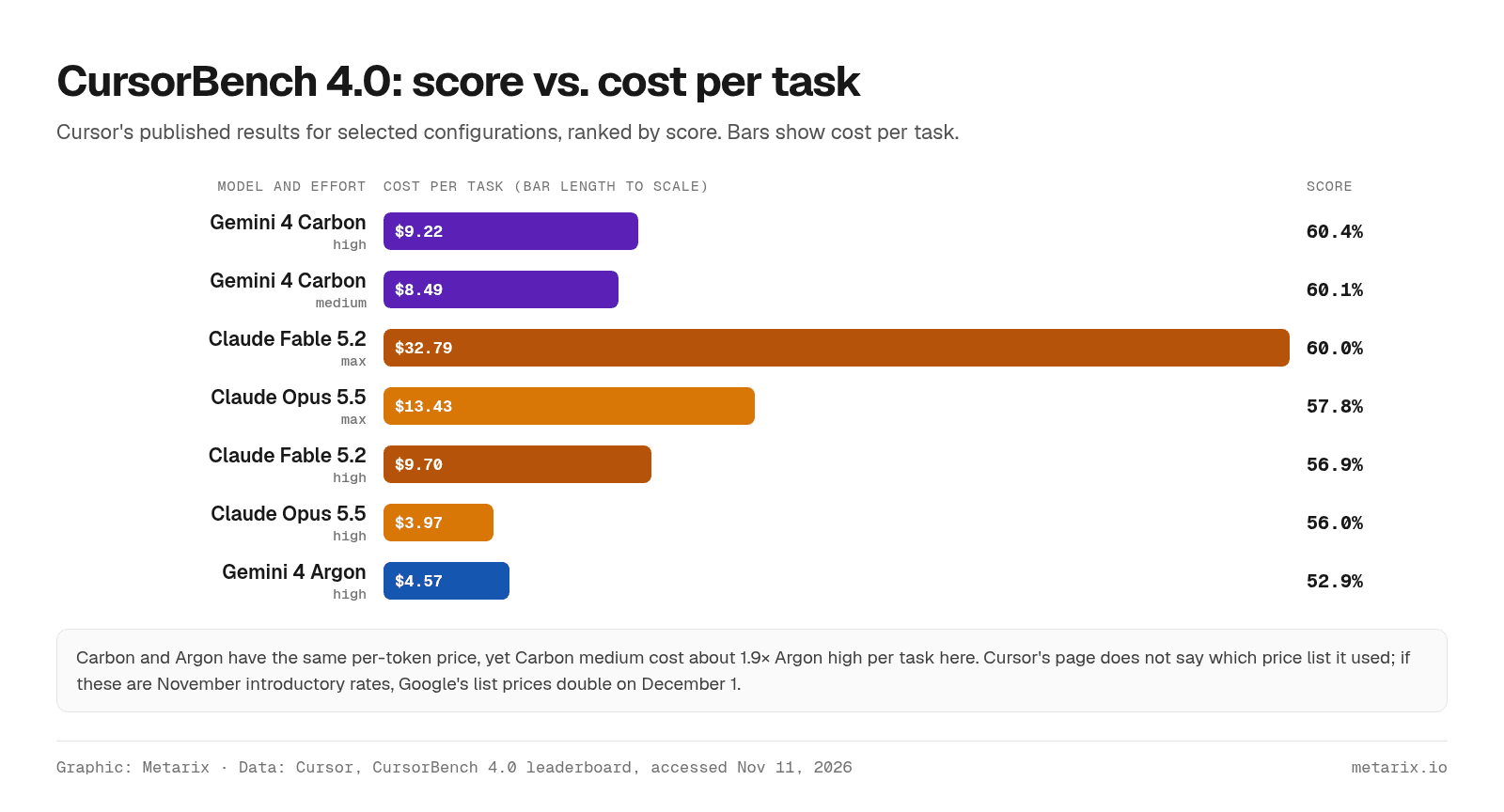
Per-token prices only tell you so much. The useful number is what a finished task costs. Two independent leaderboards that publish cost per task have already tested Carbon.
Scroll the table horizontally on smaller screens.
| Benchmark | Configuration | Score | Cost per task |
|---|---|---|---|
| CursorBench 4.0 | Gemini 4 Carbon, high | 60.4% | $9.22 |
| CursorBench 4.0 | Gemini 4 Carbon, medium | 60.1% | $8.49 |
| CursorBench 4.0 | Claude Fable 5.2, max | 60.0% | $32.79 |
| CursorBench 4.0 | Claude Opus 5.5, max | 57.8% | $13.43 |
| CursorBench 4.0 | Gemini 4 Argon, high | 52.9% | $4.57 |
| AutomationBench 1.0.6 | Gemini 4 Carbon, high | 53.88% | $2.12 |
| AutomationBench 1.0.6 | Gemini 4 Carbon, medium | 52.97% | $1.65 |
| AutomationBench 1.0.6 | Claude Fable 5.2, max | 51.45% | $4.64 |
| AutomationBench 1.0.6 | Gemini 4 Argon, medium | 50.08% | $1.54 |
Three things stand out. First, Carbon tops both boards and costs well under Fable 5.2 at max effort. That supports Google's claim of "more than 2X lower cost per task" than the next best external model. Second, the gap with Argon depends on the workload. On CursorBench, Carbon at medium cost about 1.9 times as much per task as Argon at high, for about 7 points more. On AutomationBench, Carbon at medium cost only about 7% more than Argon at medium. Third, medium effort was the sweet spot on both boards, nearly matching high for less money.
One caveat matters a lot for budgets. Cursor's page doesn't say whether its Carbon costs use November's introductory rate. If they do, the same tasks would cost about twice as much from December 1. Carbon at medium would then be roughly $17 per CursorBench task, still about half of Fable 5.2 at max but above Opus 5.5 at max. Artificial Analysis' changelog adds a broader view: it scored Carbon at 60 on its Intelligence Index at high effort on October 28, and Fable 5.2 at 65 at max effort on November 9, so Carbon no longer holds the top spot there. Our guide to measuring cost per successful task explains how to run the same comparison on your own workload.
A third independent board now points the same way. On MathArena, the ETH Zurich and INSAIT math benchmark, Carbon (high) took first place in its November 13, 2026 update with 85.4% expected performance at an expected cost of $15.70 per problem, against 80.6% and $1.07 per problem for GPT-6.1 Sol (max), which currently has the same per-token list price (MathArena models page, accessed Nov 15, 2026). We break that result down in our MathArena leaderboard analysis.
Carbon vs Claude: list prices side by side
From December 1, Carbon and Claude Opus 5.5 have the same list prices. During November, Carbon costs half as much. Claude Fable 5.2, which we covered in our Fable 5.2 pricing analysis, costs twice Carbon's December rate.
Scroll the table horizontally on smaller screens.
| Model | Input | Output | Cache hit |
|---|---|---|---|
| Gemini 4 Carbon (to Nov 30) | $2 | $10 | $0.10 |
| Gemini 4 Carbon (from Dec 1) | $4 | $20 | $0.20 |
| Gemini 4 Argon (to Nov 30 / from Dec 1) | $2 / $4 | $10 / $20 | $0.10 / $0.20 |
| Claude Opus 5.5 | $4 | $20 | $0.20 |
| Claude Fable 5.2 | $8 | $40 | $0.20 |
Scroll the table horizontally on smaller screens.
| Workload | Carbon (Nov) | Carbon (Dec) | Opus 5.5 | Fable 5.2 |
|---|---|---|---|---|
| Big one-shot job: 200K input, 20K output | $0.60 | $1.20 | $1.20 | $2.40 |
| Agent turn: 150K cached prefix, 10K new input, 5K output | $0.085 | $0.17 | $0.17 | $0.31 |
The table shows that token prices alone don't separate Carbon from Opus after November. What will separate them is how many thinking tokens and retries each model needs on your tasks. Teams buying through a cloud should also check our Bedrock vs Vertex AI comparison for regional premiums and capacity options.
Where you can use Carbon, and how it's billed
Scroll the table horizontally on smaller screens.
| Surface | Who gets it | How it's billed |
|---|---|---|
| Gemini API / Google AI Studio | Paid-tier developers | Per token, $2 / $10 to Nov 30, then $4 / $20 |
| Gemini Enterprise Agent Platform | Google Cloud customers | Same global prices; non-global endpoints 10% higher |
| GitHub Copilot | Pro+, Max, Business and Enterprise | Provider list pricing under usage-based billing; admins can disable it by policy |
| Vercel AI Gateway | Gateway users | 50% off through Nov 30, 2026 |
| Google Antigravity | Google AI Ultra subscribers; enterprises | Subscription quotas; Google warns swarms use quota fast |
| Gemini app and AI Mode | Google AI Ultra subscribers | Subscription |
For Copilot Business and Enterprise admins, the default matters. GitHub says new models are enabled automatically unless an administrator has turned off the global default or disabled this model. If you meter Copilot spend, check the model policy now.
Argon or Carbon: how to route requests
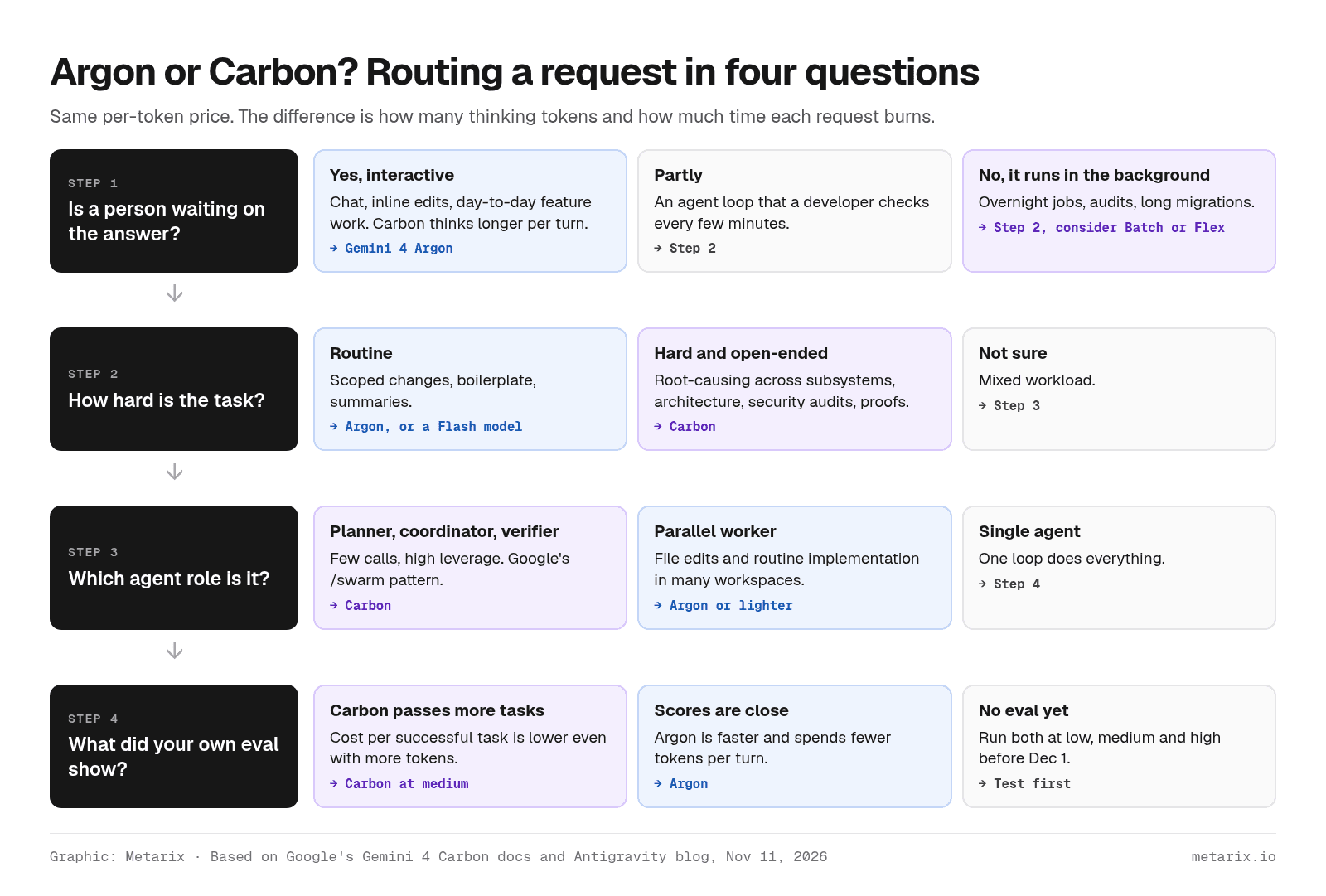
Google's own guidance is clear. Its migration docs say Argon gives "faster responses and lower token spend per turn" for interactive coding and day-to-day work. Carbon is for complex root-cause debugging, architecture, dense multimodal synthesis and security auditing. The Antigravity team goes further and suggests pinning Carbon to the coordinator and verifier roles while lighter models do the parallel edits.
Scroll the table horizontally on smaller screens.
| Situation | Start with | Why |
|---|---|---|
| Interactive coding and chat | Gemini 4 Argon | Same price per token, fewer thinking tokens, faster replies |
| Hard debugging across subsystems | Gemini 4 Carbon, medium | Medium nearly matched high on CursorBench for less money |
| Multi-agent planner or verifier | Gemini 4 Carbon | Few calls, high leverage; workers stay on Argon or Flash |
| Overnight audits and batch evals | Gemini 4 Carbon via Batch or Flex | Half the standard price |
| Latency-critical production traffic | Argon, or Carbon on Priority if quality demands it | Priority costs 1.8 times standard |
| Vulnerability research and exploit validation | Carbon for cyber, via the Fairwind Program | Public Carbon ships with stronger cyber-misuse safeguards; the cyber version is for verified defenders |
Migration checklist
Moving from Argon to Carbon needs no schema change, only a new model ID. Moving from Gemini 3 or earlier involves more work. These points come from Google's What's new in Gemini 4 Carbon guide:
- Raise `max_output_tokens` to at least 32,768. The limit covers thinking plus output, and Carbon can spend more of it on thinking. To save tokens, lower the thinking level instead.
- Pick a thinking level per workload. Medium is the default. Google suggests testing low, medium and high and keeping the lowest one that meets your quality bar.
- Remove explicit caching calls.
cachedContentsandcaches.createare not supported. Rely on implicit caching for long, stable prefixes. - Drop sampling parameters.
temperature,top_pandtop_kare ignored. - Lengthen timeouts. Google recommends HTTP timeouts of at least 15 minutes, or background execution for long jobs.
- Cap runaway outputs. Since failed completions over 32K tokens are billable from November 13, set output limits that reflect what the task is worth.
Here is an illustrative request using Google's Gen AI Python SDK. It was not run for this article.
# Illustrative only: route a hard task to Carbon at the default thinking levelfrom google import genaiclient = genai.Client() # reads GEMINI_API_KEY from the environmentinteraction = client.interactions.create( model="gemini-4-carbon", input="Find the race condition in our payment retry logic and propose a fix.", generation_config={"thinking_level": "medium", "max_output_tokens": 32768},)print(interaction.usage) # compare thinking and output tokens with your Argon baseline
Verdict
Gemini 4 Carbon's price is easy to read and easy to misread. It costs the same per token as Argon, but it isn't the same per task. Carbon thinks longer, and every thinking token is billed as output. On one coding benchmark that made it nearly twice Argon's cost per task. On a business-automation benchmark the gap was only a few percent. Against Claude it looks strong: it topped both leaderboards at a fraction of Fable 5.2's cost per task.
Our advice: keep Argon as your default, send the hard planning, debugging and verification steps to Gemini 4 Carbon at medium, and use the rest of November to measure cost per successful task on your own workload. Then plan for December 1, when every Carbon price doubles and its list price matches Claude Opus 5.5.
Sources
- Google: Gemini 4 Carbon is now available (Nov 10, 2026)
- Google: Introducing Gemini 4 Carbon (Oct 28, 2026)
- Google AI Studio: What's new in Gemini 4 Carbon (accessed Nov 11, 2026)
- Google: Gemini Developer API pricing (accessed Nov 11, 2026)
- Google Cloud: Agent Platform generative AI pricing (accessed Nov 11, 2026)
- Google DeepMind: Gemini 4 Carbon model card (November 2026)
- Google Antigravity: Gemini 4 Carbon and /swarm (Nov 10, 2026)
- Cursor: CursorBench 4.0 leaderboard (accessed Nov 11, 2026)
- Zapier: AutomationBench leaderboard (version 1.0.6, accessed Nov 11, 2026)
- Artificial Analysis: Changelog (entries dated Oct 28 and Nov 9, 2026)
- GitHub Changelog: Gemini 4 Carbon in GitHub Copilot (Nov 10, 2026)
- Vercel Changelog: Gemini 4 Carbon now available on AI Gateway (Nov 10, 2026)
- Anthropic: Claude API pricing documentation (accessed Nov 11, 2026)
Tools covered in this article
Frequently asked questions
- How much does Gemini 4 Carbon cost?
- On the Gemini API paid tier, Gemini 4 Carbon costs $2 per million input tokens and $10 per million output tokens through November 30, 2026, and $4 and $20 from December 1, 2026. Output includes thinking tokens. Cached input is 95% off, and Batch and Flex cost half of the standard price.
- Is Gemini 4 Carbon more expensive than Gemini 4 Argon?
- Not per token: both have identical prices. Per task it usually costs more, because Google says Carbon spends more thinking tokens per turn. On CursorBench 4.0, Carbon at medium cost $8.49 per task against $4.57 for Argon at high, while on Zapier's AutomationBench the gap was about 7%.
- Is Gemini 4 Carbon available on the free tier?
- No. Google lists Gemini 4 Carbon as not available on the Gemini API free tier. You need a paid-tier API key, Gemini for business or Google Cloud's Agent Platform, or a Google AI Ultra subscription for the Gemini app and Antigravity.
- How does Gemini 4 Carbon pricing compare with Claude Opus 5.5?
- From December 1, 2026, the list prices match: $4 per million input tokens and $20 per million output tokens for both. During November, Carbon costs half that. Claude Fable 5.2 lists at $8 and $40. Real costs depend on how many tokens each model uses on your tasks.
- Does Gemini 4 Carbon support context caching?
- Only implicit caching. Prompts of at least 4,096 tokens can get automatic cache hits at 95% off input, $0.10 per million tokens in November and $0.20 from December 1. Explicit caching with cachedContents is not supported on Carbon.