SaaS · Analysis
Gemini 4 Hydrogen Pricing: Twice Flash's Rate, Less per Task
Gemini 4 Hydrogen costs $1.50 per million input tokens and $7.50 per million output, double Gemini 3.8 Flash's rate until Flash matches it on January 1, 2027. Artificial Analysis estimates it costs far less per task. Here are the tiers, the numbers and the migration traps.
Metarix Editorial · Nov 13, 2026 · 10 min read
- Gemini 4 Hydrogen
- Gemini 4 Carbon
- Terminal-Bench
- Claude
- Google DeepMind
- Artificial Analysis
- Anthropic
- SaaS Ecosystem & Business
- Benchmarks & Deep Dives
Documentation-based research
On this page
Google made Gemini 4 Hydrogen generally available on November 12, 2026, as the fast model in the Gemini 4 family and the recommended upgrade from Gemini 3.8 Flash. It costs $1.50 per million input tokens and $7.50 per million output tokens, twice Flash's current rate. That is also exactly what Flash will cost from January 1, 2027.
So the per-token price goes up, but the bill per finished task may go down. Below: the full price sheet, what Artificial Analysis measured per task, what breaks when you swap the model string, and who should move now.
Quick verdict
If you run Gemini 3.8 Flash in production, plan the move to Hydrogen before January 1. After that date Flash has no per-token price advantage, and on Artificial Analysis's suite Hydrogen at its default high setting scored 51 against Flash's 31 at an estimated $1.87 per task against $7.77. Before you switch, budget a day for migration: explicit caching, the minimal thinking level and sampling parameters are gone. For high-volume classification or extraction where quality is already fine, Claude Haiku 5.5, Gemini 3.5 Flash-Lite or Hydrogen at low or medium will usually cost less.
Scroll the table horizontally on smaller screens.
| Item | Detail |
|---|---|
| Released | Nov 12, 2026, generally available (GA) |
| Model ID | gemini-4-hydrogen |
| Standard paid price | $1.50 input, $0.075 cached input, $7.50 output per 1M tokens, flat across the context window |
| Free tier | Yes, rate-limited, in the Gemini API and Google AI Studio |
| Context window | 1,048,576 tokens shared by input, thinking and output; long decode beyond 64K |
| Thinking levels | low, medium, high (default), xhigh; minimal is rejected |
| Caching | Implicit only, prompts of 4,096+ tokens; explicit caching not supported |
| Where | Gemini API, AI Studio, Android Studio, Google Cloud, Gemini for business, Gemini app, Search, Antigravity (paid) |
What Google shipped
Google DeepMind's launch post pitches Hydrogen as the execution model of the Gemini 4 family. Carbon and Argon handle deep, long-horizon reasoning, and Hydrogen handles fast coding, tool calls and document work. The Gemini API release notes list it as GA on November 12, two days after Gemini 4 Carbon went GA and one day after the Gemini Decisions API launched.
Four thinking levels, and a new default
Hydrogen adds an xhigh level above low, medium and high, and it defaults to high. Gemini 3.8 Flash defaulted to medium, so an unchanged request now does more reasoning and bills more thinking tokens. Google's migration guide says to run your evals at all four levels and pick the lowest one that meets your quality bar.
Built to pair with Carbon
In Google Antigravity, a new Orchestrator option switches between Carbon and Hydrogen in one session. Google says that on Terminal-Bench 4.0 Orchestrator got close to Carbon's task success while using 24% less quota and finishing 19% faster on average. In the API you can do the same by hand: send planning turns to gemini-4-carbon and execution turns to gemini-4-hydrogen in one Interactions session. The Antigravity agent in Gemini Managed Agents now uses Hydrogen by default.
Gemini 4 Hydrogen pricing, tier by tier
All prices below come from Google's Gemini Developer API pricing page. Prices as of Nov 13, 2026. Every token the model processes is billed, including thinking tokens and the internal instructions added when you use grounding.
Scroll the table horizontally on smaller screens.
| Tier | Input | Cached input | Output (incl. thinking) | Notes |
|---|---|---|---|---|
| Standard | $1.50 | $0.075 | $7.50 | Flat to 1M tokens; no introductory promo |
| Batch | $0.75 | $0.0375 | $3.75 | Background jobs |
| Flex | $0.75 | $0.0375 | $3.75 | Lower-priority individual requests |
| Priority | $2.70 | $0.135 | $13.50 | Higher-reliability serving |
| Contributor | $0.75 | $0.0375 | $3.75 | Invite-only private preview; Google may use the data |
The January 1 Flash price rise
The same pricing page shows Gemini 3.8 Flash's standard rates doubling on January 1, 2027: input from $0.75 to $1.50, output from $3.75 to $7.50, and cached input from $0.075 to $0.15. Batch and Flex double too. In other words, Flash's current price is an introductory rate that runs out at the end of December, and after that it costs the same per token as Hydrogen. Hydrogen's cached input is half of Flash's post-January rate, which matters for agents that resend long prompts.
Scroll the table horizontally on smaller screens.
| Price | 3.8 Flash to Dec 31 | 3.8 Flash from Jan 1, 2027 | 4 Hydrogen |
|---|---|---|---|
| Input | $0.75 | $1.50 | $1.50 |
| Cached input | $0.075 | $0.15 | $0.075 |
| Output | $3.75 | $7.50 | $7.50 |
| Explicit cache storage | $0.50 per 1M tokens/hour | $1.00 per 1M tokens/hour | Not offered |
| Batch / Flex input and output | $0.375 / $1.875 | $0.75 / $3.75 | $0.75 / $3.75 |
What a month looks like at list price
To show the effect at list price, take one illustrative monthly workload: 500 million input tokens, 60% of them cache hits, and 50 million output tokens including thinking. This is arithmetic, not a test, and it assumes both models use the same number of tokens, which the next section shows they don't.
Scroll the table horizontally on smaller screens.
| Model and tier | Uncached input | Cached input | Output | Total |
|---|---|---|---|---|
| 3.8 Flash, standard, to Dec 31 | $150.00 | $22.50 | $187.50 | $360.00 |
| 3.8 Flash, standard, from Jan 1 | $300.00 | $45.00 | $375.00 | $720.00 |
| 4 Hydrogen, standard | $300.00 | $22.50 | $375.00 | $697.50 |
| 4 Hydrogen, Batch or Flex | $150.00 | $11.25 | $187.50 | $348.75 |
At equal token counts Hydrogen roughly doubles today's Flash bill. If a workload can wait, Flex or Batch brings it back to about where Flash is now. For a deeper look at when cache discounts pay off, see our prompt caching break-even guide.
Cost per task: where Hydrogen wins it back
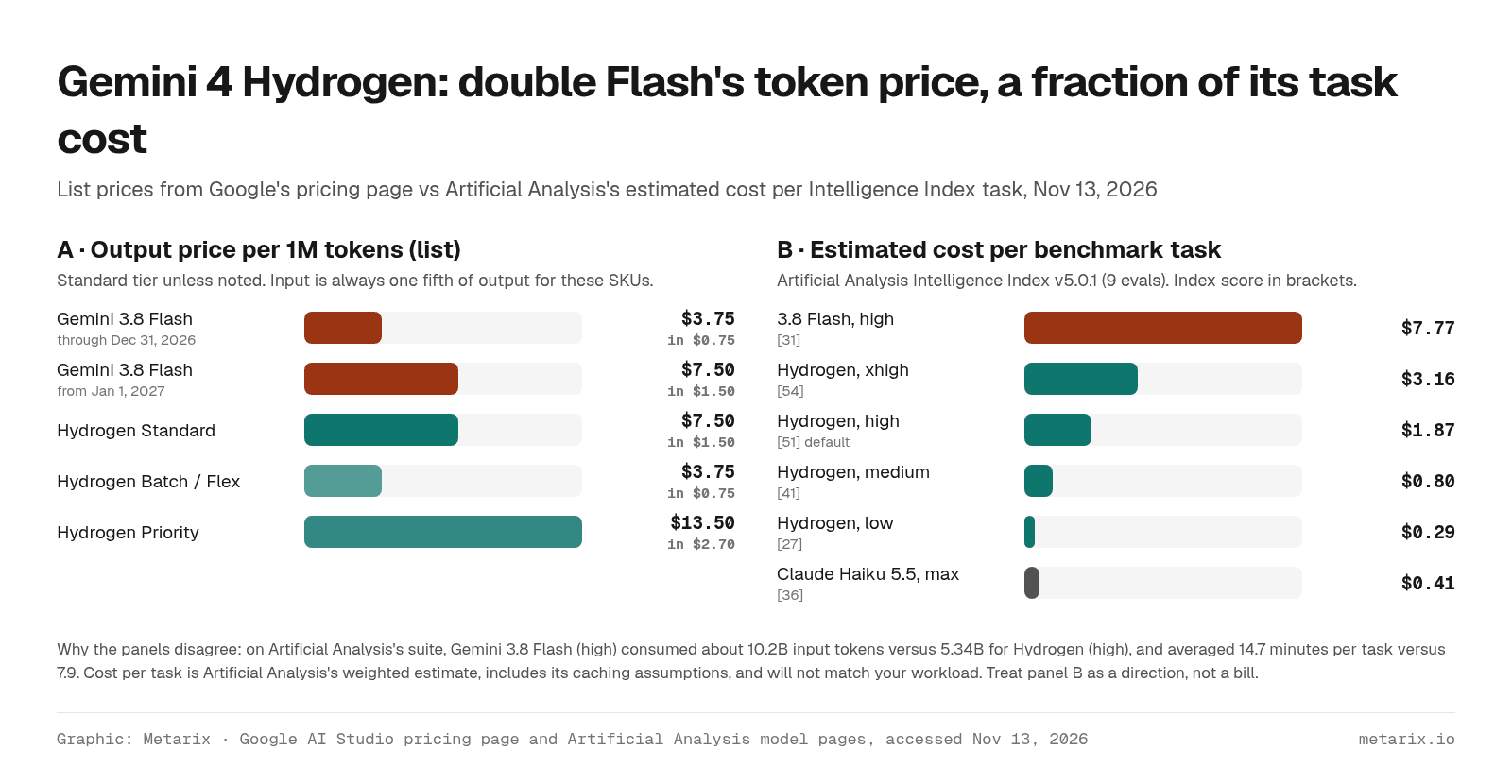
Token prices don't tell you what a finished task costs, because models differ in how many tokens they burn. Artificial Analysis runs every model through the same nine-evaluation Intelligence Index v5.0.1 and estimates a weighted cost per task. Its numbers, from the firm's model pages accessed Nov 13, 2026:
Scroll the table horizontally on smaller screens.
| Model and setting | Index score | Est. cost per task | Time per task | Input / output tokens used |
|---|---|---|---|---|
| Gemini 4 Hydrogen, xhigh | 54 | $3.16 | 13.7 min | 11.3B / 304M |
| Gemini 4 Hydrogen, high (default) | 51 | $1.87 | 7.9 min | 5.34B / 110M |
| Gemini 4 Hydrogen, medium | 41 | $0.80 | 3.7 min | 2.07B / 54.4M |
| Gemini 4 Hydrogen, low | 27 | $0.29 | 1.3 min | 606M / 20.3M |
| Gemini 3.8 Flash, high | 31 | $7.77 | 14.7 min | 10.2B / 126M |
| Claude Haiku 5.5, max | 36 | $0.41 | 14.7 min | 14.6B / 298M |
The pattern is clear even with those caveats. On this suite Flash at high used nearly twice the input tokens of Hydrogen at high and took almost twice as long, so its lower token price didn't help. Hydrogen at high scored 20 points more at about a quarter of the estimated cost per task. Hydrogen at medium beat Flash's score at roughly a tenth of the cost.
Claude Haiku 5.5 is the counterpoint. At $0.10 input and $0.50 output per million tokens for prompts up to 100,000 tokens, per Anthropic's pricing page, it scored 36 at an estimated $0.41 per task. If Haiku already passes your evals, Hydrogen at high will cost several times more. This is the trade our cost per successful task guide is about: pay for the bigger model only where it saves retries.
Caveats on these numbers
- One suite, not your workload. The Intelligence Index mixes coding, document analysis, science and other tasks. A customer-support or extraction pipeline may look very different.
- Cost per task depends on caching. Hydrogen only does implicit caching, at 4,096 tokens and up, and your hit rate is unlikely to match the benchmark's.
- Settings aren't equal. Haiku is shown at its max setting and Hydrogen at four settings, so compare like with like when you run your own tests.
Google's own benchmark claims
These figures come from Google's launch post and are vendor-reported. We haven't reproduced them, and the benchmarks aren't directly comparable with each other or with the Artificial Analysis suite above.
Scroll the table horizontally on smaller screens.
| Benchmark or claim | Hydrogen | Comparison |
|---|---|---|
| Terminal-Bench 4.1 | 57% | 18.2% for Gemini 3.8 Flash; VentureBeat reports 63.9% for Claude Sonnet 5.5 in Google's table |
| HLE-Diamond | 58.8% | Google says it leads its class |
| Vals Tax Agent Bench | 52.3% | Ranked #1 overall, per Google |
| Vals Legal Research Bench | 55.8% | Tied for #1, per Google |
| Multimodal Knowledge Agent (MKA) | 53.4% | New benchmark; Google says it outperforms other models |
| Agents' Last Exam v1.1 | 71.6% | End-to-end professional workflows |
| Speed vs 3.8 Flash | 2.5x faster at high | Google's figure |
| Fabricated claims vs 3.8 Flash | More than 5x fewer | Google's figure |
The Terminal-Bench jump is the one to watch for coding agents. Our SWE-bench vs Terminal-Bench explainer covers what Terminal-Bench does and doesn't measure. VentureBeat also cites an early-access result from Box, whose agent went from 74% to 79% accuracy on Box's internal eval when it switched from Flash to Hydrogen. That is one customer's internal test, not a public benchmark.
Migrating from Gemini 3.8 Flash: what breaks
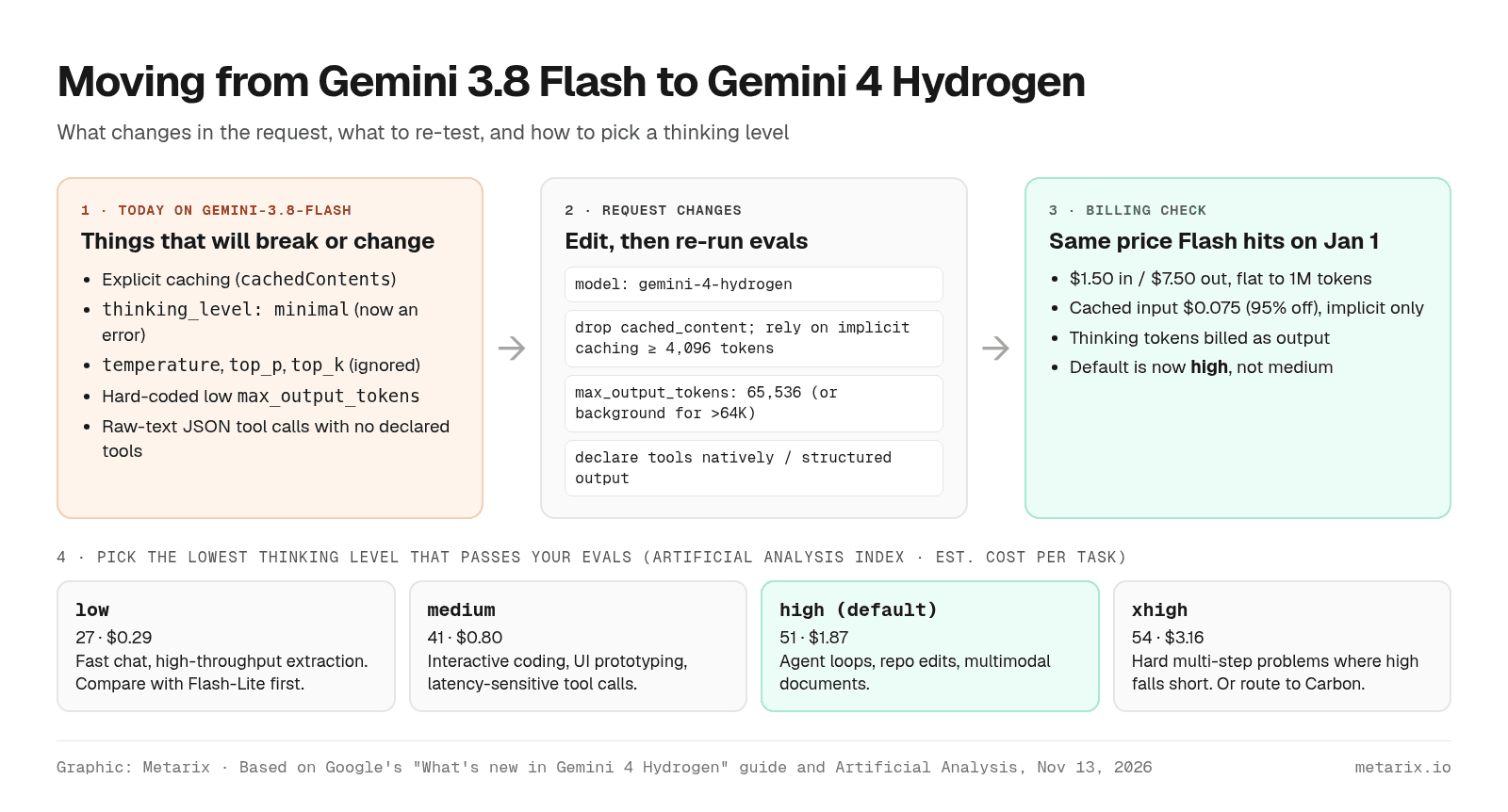
Google's migration checklist is longer than a model-string swap. The changes that most often break a working Flash integration:
Scroll the table horizontally on smaller screens.
| Area | Gemini 3.8 Flash | Gemini 4 Hydrogen | What to do |
|---|---|---|---|
| Thinking | Default medium; minimal allowed | Default high; adds xhigh; minimal returns an error | Set thinking_level explicitly and re-test |
| Caching | Explicit (cachedContents) and implicit | Implicit only, prompts of 4,096+ tokens | Remove cached_content; put stable content first |
| Sampling | temperature, top_p, top_k accepted | Ignored by the server | Remove them; don't rely on them for variety |
| Context | 1M input and 64K output, separate | One 1,048,576-token window for everything | Raise low max_output_tokens caps to 65,536 |
| Long output | Capped at 64K | Up to 1M with background execution or continuation | Use background=true for very long outputs |
| Tool calls | Some apps prompt for raw-text JSON tool calls | Raw-text tool calls with no declared tools can return MALFORMED_FUNCTION_CALL | Declare tools natively or use structured output |
An illustrative request with the thinking level pinned, based on Google's documented Interactions API shape. It was not run for this article.
# Illustrative only: pin the thinking level instead of inheriting the new defaultfrom google import genaiclient = genai.Client()interaction = client.interactions.create( model="gemini-4-hydrogen", # was gemini-3.8-flash input=task_prompt, generation_config={ "thinking_level": "medium", # Flash's old default; try high next "max_output_tokens": 65536, }, # no temperature/top_p/top_k, no cached_content)print(interaction.output_text)
On Google Cloud, the Gemini Enterprise Agent Platform guide calls Hydrogen a short-term GA release with at least 45 days' notice before retirement. If you pin model versions on Google Cloud, put a check on that notice period in your runbook.
Who should switch, and when
Scroll the table horizontally on smaller screens.
| Your situation | Recommendation | Why |
|---|---|---|
| Coding or tool-using agents on 3.8 Flash | Switch now, at high | Large reported gains on Terminal-Bench, and Artificial Analysis estimates a lower cost per task than Flash |
| Cost-sensitive Flash workloads that can wait | Switch to Hydrogen on Flex or Batch | About today's Flash price per token, with the newer model |
| Flash workloads that already pass evals | Switch before Jan 1 or compare Haiku 5.5 | Flash's price doubles on Jan 1, 2027 |
| High-volume classification or extraction | Test Hydrogen low, Flash-Lite, Haiku 5.5 | Cheapest option that passes your evals wins |
| Closed yes/no or routing decisions | Use the Decisions API | Zero output tokens at $0.10 per 1M input |
| Hard architecture, debugging or security work | Keep Carbon or Argon, delegate execution to Hydrogen | Google's own recommended pairing |
Hydrogen also changes the case for Carbon. Carbon's introductory $2 input and $10 output rate ends on November 30, when it moves to $4 and $20, as we covered in our Gemini 4 Carbon pricing analysis. Routing execution turns to Hydrogen keeps more of an agent's tokens at the lower price.
Verdict
Gemini 4 Hydrogen looks like a price rise but is really a deadline. Gemini 3.8 Flash's current rates end on December 31, and from January 1 it costs the same per token as a model that scores 20 points higher on Artificial Analysis's index and, by that firm's estimate, costs about a quarter as much per task at its default setting.
Our advice: move Flash-based agents to Gemini 4 Hydrogen in December, not January, and re-run your evals at medium and high before taking the high default. Use Flex or Batch for anything that can wait. Keep Claude Haiku 5.5 or Flash-Lite where a small model already passes, and send closed decisions to the Decisions API. For the hardest turns, let Carbon plan and Hydrogen execute. For more on Google DeepMind's November releases, see our Gemini Decisions API analysis.
Sources
- Google: Introducing Gemini 4 Hydrogen (Nov 12, 2026)
- Google: Gemini 4 Hydrogen for developers (Nov 12, 2026)
- Google AI Studio: What's new in Gemini 4 Hydrogen (accessed Nov 13, 2026)
- Google AI Studio: Gemini Developer API pricing (accessed Nov 13, 2026)
- Google AI Studio: Gemini API release notes (Nov 12, 2026 entry)
- Google Cloud: Gemini 4 Hydrogen on Gemini Enterprise Agent Platform (accessed Nov 13, 2026)
- Google Antigravity: Gemini 4 Hydrogen and Orchestrator (Nov 12, 2026)
- Google AI Studio on X: Gemini 4 Hydrogen launch post (Nov 12, 2026)
- Artificial Analysis: Gemini 4 Hydrogen (High), Gemini 4 Hydrogen (Xhigh), Gemini 3.8 Flash and Claude Haiku 5.5 model pages (accessed Nov 13, 2026)
- Anthropic: Claude API pricing (accessed Nov 13, 2026)
- VentureBeat: Google launches Gemini 4 Hydrogen (Nov 12, 2026)
Tools covered in this article
Frequently asked questions
- How much does Gemini 4 Hydrogen cost?
- On the Gemini API paid tier, Gemini 4 Hydrogen costs $1.50 per million input tokens, $0.075 per million cached input tokens and $7.50 per million output tokens including thinking tokens, flat across its 1M-token context window. Batch and Flex are half price, Priority is $2.70 input and $13.50 output, and there is a rate-limited free tier.
- Is Gemini 4 Hydrogen more expensive than Gemini 3.8 Flash?
- Per token, yes until December 31, 2026: Hydrogen is twice Flash's current $0.75 input and $3.75 output rate. From January 1, 2027, Flash rises to $1.50 and $7.50, the same as Hydrogen. Per task, Artificial Analysis estimates Hydrogen at high costs $1.87 against $7.77 for Flash at high on its Intelligence Index, because Hydrogen uses fewer tokens.
- What thinking levels does Gemini 4 Hydrogen support?
- Hydrogen supports low, medium, high and a new xhigh level, and it defaults to high. The minimal level available on Gemini 3.8 Flash returns an error. Google recommends evaluating all four levels and choosing the lowest one that meets your quality bar.
- Does Gemini 4 Hydrogen support context caching?
- Only implicit caching. It applies automatically to prompts of 4,096 tokens or more and discounts cached input by 95%, to $0.075 per million tokens. Explicit context caching with cachedContents is not supported, so remove cached_content fields when migrating.
- Is Gemini 4 Hydrogen available on the free tier?
- Yes. Google lists Gemini 4 Hydrogen on both the free and paid tiers of the Gemini API and Google AI Studio. Free-tier use is rate-limited, and Google says free-tier data may be used to improve its products.