Productivity · Comparison
Best AI Code Review Tools in 2026: Pricing and Verdict
Seven AI code reviewers compared on official pricing, Git host support and what they do with a finding, from CodeRabbit and Copilot to Bugbot, Greptile and Claude Code Review.
Wajid Ali · Oct 26, 2026 · 9 min read
On this page
AI code review stopped being a novelty the moment coding agents started opening more pull requests than humans can read. In 2026 the real question isn't whether a bot should look at your PRs, it's which one fits your Git host, your budget model and how much noise your team will tolerate. This guide compares seven tools on official pricing and documented features, then gives a straight verdict.
How we compared them
Nothing here comes from a private benchmark. Every price and feature below is taken from the vendor's own pricing page or documentation, linked inline and in Sources at the end. Where a number is a vendor's own claim, it's labeled as theirs. Prices as of October 26, 2026, in US dollars, and they change often, so check the linked page before you buy.
We looked at five things that actually decide whether a reviewer sticks:
- Git host support. Some tools only work on GitHub; others cover GitLab, Bitbucket and Azure DevOps too.
- Billing model. Per-seat, per-review credits, or token usage. This matters more than the headline price once agents start opening PRs.
- Context. Whether the reviewer reads only the diff or the wider repository.
- Customization. Rule files, learned preferences and how you teach it your standards.
- What happens after a finding. A comment, a suggested patch, or an agent that pushes a fix.
The short list
- CodeRabbit: the most host-agnostic, seat-priced option, with a real free tier.
- GitHub Copilot code review: the default if you already pay for Copilot and live on GitHub.
- Cursor Bugbot: usage-priced, strong on fixes, best for teams already on Cursor.
- Greptile: whole-codebase context with no seat fees, billed per review.
- Claude Code Review: Anthropic's multi-agent reviewer for Claude Team and Enterprise on GitHub.
- Qodo: credit-based review with enterprise deployment options, plus the separate open-source PR-Agent.
- Graphite: AI review bundled into a stacked-PR workflow on GitHub.
CodeRabbit
CodeRabbit reviews pull requests on GitHub, GitLab, Azure DevOps and Bitbucket, according to its documentation, and it also reviews code before a PR exists through VS Code, Cursor and Windsurf extensions and a command-line tool. That breadth is its biggest selling point: if your company runs more than one Git host, it's one of the few tools that covers all of them.
CodeRabbit pricing
The CodeRabbit pricing page lists a Free plan with PR summaries and reviews in the IDE extension and CLI. Paid plans are Essentials at $24 per developer per month billed annually ($30 monthly), Team at $48 ($60 monthly) and Advanced at $72 ($90 monthly, per its plans docs), with Enterprise on custom pricing. You're only charged for developers who create pull requests, and public repositories get free reviews. There's a 14-day trial of Advanced. Past each plan's hourly review allowance, usage-based reviews cost $0.25 per reviewed file.
- Best for: teams on GitLab, Bitbucket or Azure DevOps, or mixed setups.
- Watch out for: per-seat pricing adds up on large orgs, and the per-file overage can surprise teams whose agents push many large PRs.
GitHub Copilot code review
GitHub Copilot can be requested as a reviewer on any pull request, and GitHub's code review docs say it gathers full-project context by running on GitHub Actions runners. It follows your custom instructions and AGENTS.md files, can use skills and MCP servers, and can hand a suggestion to the Copilot cloud agent to implement (in preview). You can't pick the model it uses. We covered the newer Copilot code review API separately.
Copilot code review pricing
Code review is included in Copilot Pro ($10/month), Pro+ ($39), Max ($100), Business ($19 per granted seat) and Enterprise ($39 per seat), per GitHub's plans page. Copilot Free only gets "Review selection" in VS Code. Each review consumes GitHub AI Credits, which cost $0.01 each beyond your plan's allowance. GitHub's own estimates put a review at $0.05 to $1 on the Lite setting and $0.25 to $5 on the default Balanced setting, and the Actions minutes it uses are billed separately. On Business and Enterprise, org members without a Copilot license can still get reviews if admins enable it, billed to the organization.
- Best for: GitHub-first teams already paying for Copilot.
- Watch out for: it's effectively GitHub-only (Azure DevOps support is in public preview), and cost per review varies more than the seat price suggests.
Cursor Bugbot
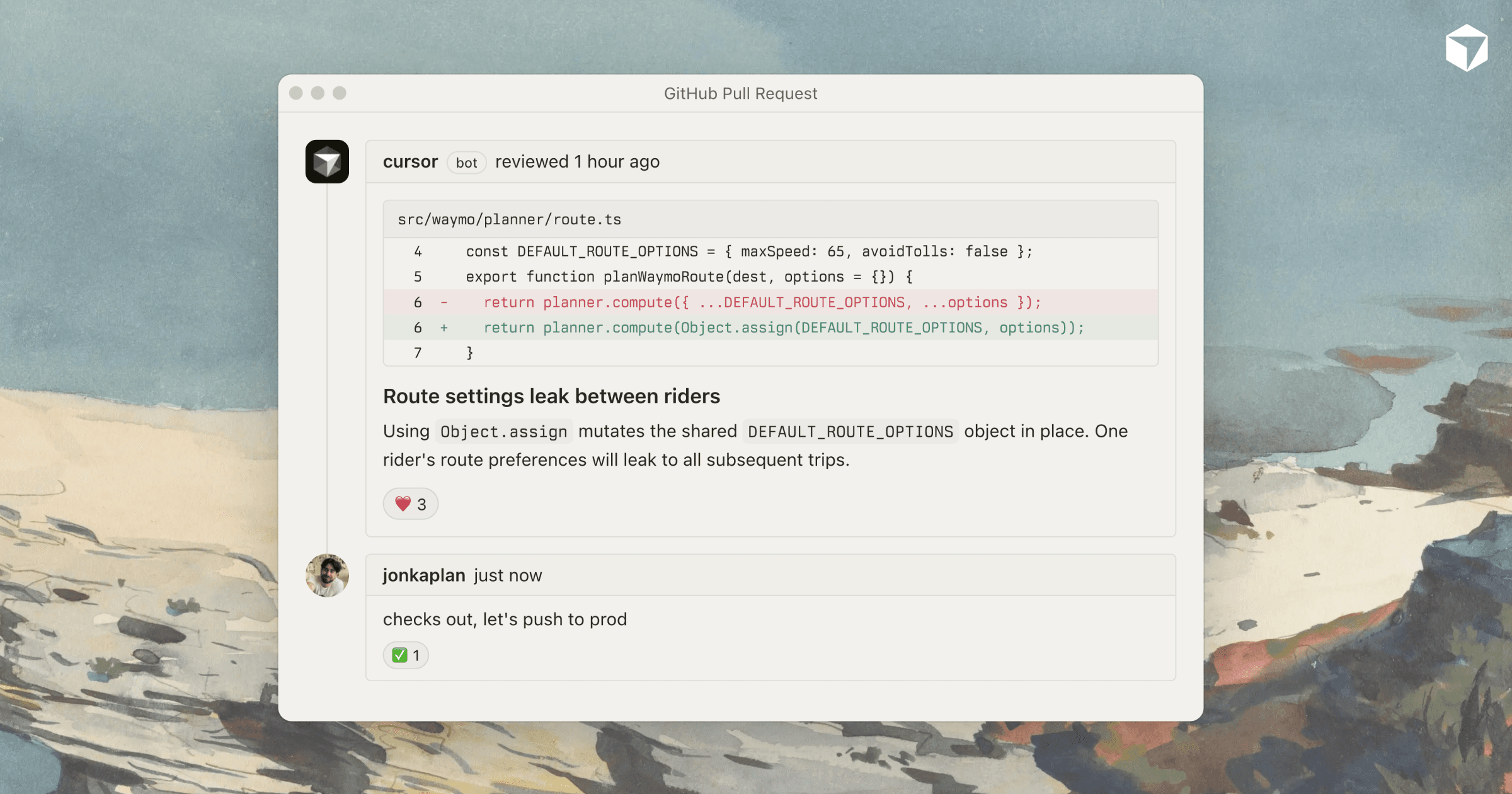
Cursor Bugbot reviews every PR update or runs when someone comments cursor review or bugbot run. Cursor's Bugbot docs list support for GitHub (including Enterprise Server), GitLab (including self-hosted), Bitbucket (including Data Center), Azure DevOps and Cursor's own Origin. It reads existing PR comments to avoid repeating feedback, and you steer it with .cursor/BUGBOT.md files, team rules and rules it learns from merged PRs. Effort levels (Low, Default, High and Smart) trade cost against depth.
Its standout is what happens next: Autofix can spawn a Cursor cloud agent that pushes a fix to a new branch or the existing one, and "Fix in Cursor" links open the issue straight in the editor. Cursor's Bugbot page claims more than 70% of its flags get resolved before merge; that's Cursor's figure, not an independent one.
Bugbot pricing
Bugbot is usage-based on paid Cursor plans, with no separate Bugbot subscription. Cursor says the average review costs $1.00 to $1.50, drawn first from included usage and then from prepaid or on-demand credit. Autofix runs bill separately as cloud agent usage.
- Best for: teams already living in Cursor who want findings turned into patches.
- Watch out for: usage pricing is harder to budget than seats, and High effort reviews cost more.
Greptile
Greptile pitches itself as a reviewer with context from your whole codebase rather than only the diff. Its pricing page is unusual: there are no seat fees. Starter is free for one active developer with 50 credits a month. Pro charges $1 per credit, prepaid and shared across the org, with a Base review costing 1 credit, Plus 3 and Apex 10. Enterprise adds self-hosting, SSO and support for GitHub Enterprise Server, GitLab Self-Managed, Bitbucket Data Center, Gitea and Perforce. Qualified open-source projects are free, and pre-Series A startups can get 500 free credits a month for six months.
- Best for: teams with many occasional contributors, where per-seat pricing would be wasteful.
- Watch out for: credit pricing rewards discipline; an agent that opens dozens of PRs a day burns credits quickly at the Apex tier.
Claude Code Review
Anthropic's Code Review runs inside Claude Code for organizations on Claude Team and Enterprise plans. Its documentation describes a multi-agent flow that finds candidate issues, verifies them, ranks them and posts the survivors as PR comments, at Quick, Standard or Deep levels. It works with GitHub, including GitHub Enterprise Server, and you customize it with REVIEW.md and CLAUDE.md. It never approves or blocks a PR, so humans keep that call. Developers can also run /code-review locally in any Claude Code session.
Claude Code Review pricing
There's no flat price. Per Anthropic's cost docs, reviews are billed on token usage through usage credits, and admins can set a monthly organization spend limit. It isn't available on zero data retention, HIPAA or customer-managed encryption key setups.
- Best for: Claude Enterprise shops on GitHub that want deep reviews on high-risk PRs.
- Watch out for: Deep reviews on big diffs can get expensive, so set the spend limit before turning it on everywhere.
Qodo and PR-Agent
Qodo sells review on pooled credits. Its pricing page lists the Pro Team plan at $0.012 per credit, with a 14-day trial rather than a permanent free tier, and an Enterprise plan with bring-your-own-key models, single-tenant or on-prem deployment and SSO. Developers whose code is reviewed don't need Qodo accounts. The older open-source PR-Agent still exists as a self-run reviewer, and its repository notes it is not the Qodo free tier.
- Best for: regulated teams that need on-prem or their own model keys; PR-Agent suits teams that want to self-host and pay only for model calls.
- Watch out for: credits are harder to translate into "reviews per month" than seats.
Graphite
Graphite bundles AI review into its stacked pull request workflow on GitHub. Its pricing page lists Starter at $20 per user per month billed annually and Team at $40 per user per month, which it lists with unlimited AI reviews. If your team already likes stacking small PRs, which GitHub now supports natively, Graphite's review fits that rhythm well.
- Best for: GitHub teams who want stacking, a merge queue and review in one tool.
- Watch out for: you're buying a workflow, not just a reviewer.
How to choose
Start with your Git host
If you're on GitLab, Bitbucket or Azure DevOps, your realistic shortlist is CodeRabbit and Bugbot, plus Greptile or Qodo on enterprise plans. On GitHub, everything here works.
Match the billing model to who opens PRs
Seat pricing (CodeRabbit, Graphite) is predictable when a stable team of humans opens most PRs. Per-review or usage pricing (Bugbot, Greptile, Copilot's credits, Claude) is cheaper for small or bursty teams but scales with every agent-generated PR. If coding agents already open a large share of your pull requests, model the per-review cost before you sign.
Write your standards down once
Every serious tool now reads a rules file: AGENTS.md and custom instructions for Copilot, .cursor/BUGBOT.md for Bugbot, REVIEW.md for Claude. Keep one source of truth for your conventions and point each tool at it. Treat those files like code, too; our piece on the AGENTS.md Downloads folder attack shows why instruction files deserve review.
Pilot two, not five
Run two candidates on the same repositories for two weeks and compare how many comments your team actually acts on. Comment volume is not quality; a reviewer people learn to ignore is worse than none.
Verdict
For most teams on GitHub that already pay for Copilot, start with Copilot code review: it's included, it reads your AGENTS.md, and the per-review credit cost is modest on the default setting. If you need GitLab, Bitbucket or Azure DevOps, or you want the most mature standalone reviewer, CodeRabbit is the safest pick, and its free tier and free public-repo reviews make it easy to trial. Teams already on Cursor should turn on Bugbot, because Autofix closes the loop from finding to patch better than anything else here. Choose Greptile when seat fees don't make sense, Claude Code Review for deep reviews on critical GitHub repos in Claude Enterprise orgs, Qodo when on-prem is a hard requirement, and Graphite if you want stacked PRs and review in one package.
Sources
- CodeRabbit: Pricing
- CodeRabbit docs: Plans
- CodeRabbit docs: Overview and supported platforms
- GitHub Docs: About GitHub Copilot code review
- GitHub Docs: Plans for GitHub Copilot
- Cursor: Bugbot
- Cursor docs: Bugbot
- Greptile: Pricing
- Claude Code docs: Code Review
- Claude Code docs: Code Review costs
- Qodo: Pricing
- Qodo: PR-Agent repository
- Graphite: Pricing
Frequently asked questions
- What is the best AI code review tool in 2026?
- There's no single winner. GitHub Copilot code review is the easiest start for GitHub teams already paying for Copilot, CodeRabbit is the strongest choice across GitHub, GitLab, Bitbucket and Azure DevOps, and Cursor Bugbot is best for teams already on Cursor.
- Is there a free AI code review tool?
- Yes, with limits. As of October 26, 2026, CodeRabbit has a free plan and reviews public repositories for free, Greptile's Starter tier is free for one developer with 50 credits a month, and the open-source PR-Agent can be self-hosted with your own model keys.
- How much does AI code review cost per pull request?
- It depends on the billing model. Cursor says an average Bugbot review costs $1.00 to $1.50, GitHub estimates $0.25 to $5 per Copilot review on the default setting, and Greptile charges 1 to 10 credits at $1 each. Seat-based tools like CodeRabbit charge per developer instead.
- Which AI code review tools work with GitLab or Bitbucket?
- CodeRabbit and Cursor Bugbot both support GitLab, Bitbucket and Azure DevOps. Greptile and Qodo add self-managed GitLab and Bitbucket Data Center on enterprise plans. Copilot code review, Claude Code Review and Graphite are built around GitHub.
- Can AI code review replace human reviewers?
- Not yet. These tools catch bugs and enforce standards, but none should be the only approval on risky changes. Claude Code Review, for example, never approves or blocks a PR, leaving the merge decision with people.