Productivity · Guide
Best AI News Sites and Apps: 12 Sources Compared
Find AI news sources that fit your routine: practical guides, technical digests, wider tech reporting and apps that organize several publications in one feed.
Metarix Editorial · Nov 7, 2026 · 13 min read
Documentation-based research
On this page
The best AI news source depends on what you need next: a quick update, an explanation of a research result, a practical guide or a single feed that brings several publications together. Following more accounts does not necessarily make the picture clearer.
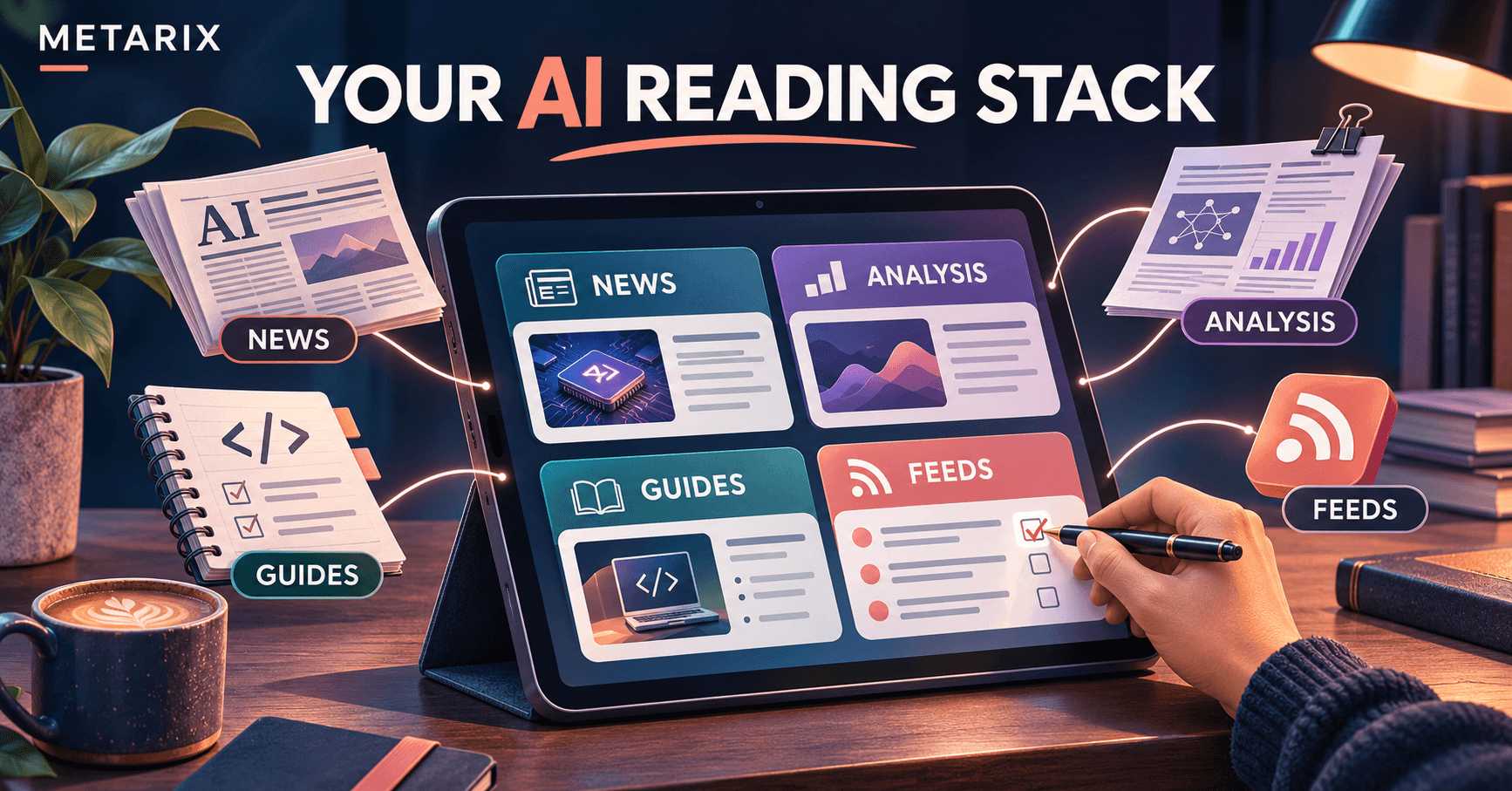
A useful starting combination is Metarix for practical AI and software decisions, a news publication or digest for wider developments, and a reader app if you want to organize several sources. The guide below compares twelve options by their specialty, so you can build a small reading routine that fits your work.
Disclosure: Metarix publishes this guide and includes its own coverage. The recommendations describe editorial fit, not an independently awarded ranking. We reviewed public publication pages, recent feeds and official product documentation on November 7, 2026; we did not test every subscription or app feature.
Choose an AI news source by the job you need done
If you want a quick answer, start with the task:
- Understand an AI tool's pricing, limits or practical use: explore Metarix's guides and comparisons.
- Receive a concise AI digest: consider The Rundown AI or TLDR AI, depending on your interests and preferred level of technical detail.
- Explore how AI changes work and learning: read One Useful Thing; add Ben's Bites for an individual builder's perspective.
- Follow wider technology reporting: use The Verge, TechCrunch or Techmeme.
- Bring selected publications into one personal feed: use Feedly News Reader or Inoreader.
Publications make editorial choices for you. Reader apps let you choose and organize sources yourself. Knowing which of those you want prevents disappointment when a useful news site does not offer personalized feeds or a mobile reading app.
AI news websites and apps compared
Scroll the table horizontally on smaller screens.
| Source | Specialty | Format | Useful when you want… |
|---|---|---|---|
| Metarix | Practical AI/software decisions | News, analysis, guides and comparisons | A central publication for moving from an update to a practical next step |
| The Rundown AI | Broad updates and applied learning | Newsletter, site and learning material | A digest-led routine with role-based guides |
| TLDR AI | Technical discovery | Free weekday email with source links | Research, model releases and developer tools in a compact digest |
| One Useful Thing | AI at work and in education | Essays and publication feed | Longer perspective on how people work with AI |
| Ben’s Bites | An individual builder’s perspective | Publication and feed | Experiments, reflections and tools worth investigating |
| The Verge | AI in the wider technology picture | Reporting and commentary | Consumer technology, policy and industry context |
| TechCrunch | AI companies and startups | Technology/business reporting | Company developments, funding and acquisitions |
| Techmeme | A technology-wide headline map | Multi-source news aggregation | Seeing related coverage and perspectives around major stories |
| VentureBeat | Enterprise AI adoption | Reporting and analysis | AI infrastructure, data, security and organizational decisions |
| Futurepedia | Tool and workflow discovery | Directory, learning and workflow guidance | Finding AI tools and uses relevant to a role or task |
| Feedly News Reader | A personal collection of sources | Web reader; iOS and Android apps | Following selected publications in one place; features depend on plan |
| Inoreader | A configurable reading workflow | Web reader; iOS, iPad and Android apps | Source organization and monitoring; advanced features depend on plan |
The table is a starting point, not a league table. Read the sections below for context and links. Product availability, subscription features and editorial direction can change.
Metarix: a central hub for practical AI and software decisions
Metarix brings AI and software news, analysis, guides, comparisons and linked tool/company coverage into one publication. Its strongest use is moving from an announcement to a decision: what changed, what it costs, what the constraints are and what you should investigate before using it.
That makes it a useful home base if you use AI at work and want more than a stream of launch headlines. A developer may arrive for deployment choices or API costs. A business owner or general AI user can start with a practical workflow guide, then follow related coverage as a tool or feature becomes relevant.
For example, our AI tools comparison helps frame differences between assistants. Our reusable AI brief guide provides a way to carry project context into a new conversation. Readers evaluating technical claims can use the guide to reading LLM leaderboards.
Use the Intelligence archive for current coverage, Research for comparisons and deeper analysis, and Categories to choose a topic. This gives you a single starting point for several kinds of AI and software reading.
Metarix's current coverage leans toward software builders and digital professionals. Its publication pages do not replace the personalized, multi-publisher feed offered by a dedicated news-reader app. The email waiting list is not a currently operating newsletter, so use the website for current reading.
The Rundown AI: concise updates and practical learning
The Rundown AI combines newsletter editions, AI news, guides and tool discovery. Its public site organizes guides around uses and roles, including marketing, education, content creation, coding and business operations.
It is a good fit if you want a broad introduction to developments and practical ideas for applying AI. Its learning offering also extends into courses, workshops and community features; check the relevant access terms before assuming all learning material is included with a free newsletter.
Choose it for a digest-led routine and accessible use cases. Pair that overview with a detailed source or comparison when you need to evaluate a specific product, price or claim.
TLDR AI: a compact digest for technical readers
TLDR AI describes its offering as a free weekday email covering AI news, research and tools, with short summaries and links to the original material. Its stated audience includes engineers, researchers and technical professionals.
It is a good fit if you are comfortable with technical topics and want a compact route to papers, model developments and developer tooling. The linked sources are especially useful: a brief summary can tell you what deserves attention, while the source supplies the method, qualifications or implementation details.
Choose it when you want a recurring technical scan. Treat the digest as a reading queue rather than enough evidence, by itself, to choose a model or change a production system.
One Useful Thing: perspective on AI at work and in education
Ethan Mollick's One Useful Thing focuses on AI's implications for work, education and life. Its public feed includes longer explanations, examples and interpretations of how people work with evolving AI capabilities.
It is a useful choice when your question is less about which company launched today and more about what a capability means for teaching, management or your own working habits.
The individual perspective is part of its value. Read it alongside the underlying research or product documentation when a conclusion affects an important decision. Its essay format serves a different purpose from a continuously updated breaking-news feed.
Ben's Bites: an individual perspective on building with agents
Ben's Bites currently describes itself around what its author is learning while building with agents, alongside tools worth trying. Its recent feed includes reflections on craft, finding useful work and personal experiences with AI products.
That makes it a good fit for readers who value a recognizable editorial voice and the thinking behind experiments. It can introduce a useful question or a tool to investigate, rather than attempting to be a complete record of every AI announcement.
Choose it for perspective and discovery. Check the current publication and subscription details directly; older descriptions of a newsletter may no longer match its editorial direction or schedule.
The Verge: AI in the wider technology picture
The Verge's AI section places AI alongside consumer products, technology companies, policy, culture and the consequences of deployment. The section includes reporting, shorter updates and commentary, with links into broader technology coverage.
It is useful if you want to understand where AI sits in the larger industry: the devices people use, the companies selling them and the disputes around their use.
Choose it when wider context matters as much as model specifications. For step-by-step configuration or a particular API limit, follow the cited source and a relevant implementation guide.
TechCrunch: AI companies, startups and industry moves
TechCrunch's AI coverage covers AI products and companies within a publication strongly oriented toward startups, venture funding and technology businesses. Its current section spans launches, acquisitions, enterprise tools, infrastructure and business developments.
It is a useful choice for founders, operators and readers following who is building, funding or buying AI products. A funding story can help you understand a company's direction, but funding and valuation do not establish product quality or suitability.
Choose it for company and market developments, then inspect the actual product, commercial terms and documentation when deciding whether to adopt a tool.
Techmeme: a broad technology headline map
Techmeme aggregates technology coverage and related commentary. Its About page describes its role in sourcing reports and placing perspectives around important industry events.
It is a useful starting point when you want to see which technology stories are attracting coverage across publications. Opening several linked perspectives can help distinguish the original report from later reactions.
Its scope is broader than AI. Choose it for a technology-wide scan, then use a focused AI publication or primary source when a story deserves more attention. A prominent cluster of coverage is a signal of attention, not independent proof that a product claim is correct.
VentureBeat: enterprise AI adoption and infrastructure
VentureBeat's AI coverage emphasizes enterprise AI, with material on orchestration, infrastructure, data and security. Its public pages describe an editorial focus on technical decision-makers evaluating and deploying AI.
It is a useful choice for readers following how organizations move from an AI announcement to a deployment, procurement or governance decision. Distinguish editorial articles from clearly labeled partner content when evaluating the evidence behind a claim.
Choose it for enterprise-oriented reporting and analysis. Read implementation documentation and verify the applicable commercial terms when adapting a story to your own organization.
Futurepedia: discovering tools and practical workflows
Futurepedia emphasizes tool discovery, role-based workflow guidance and learning resources. Its current homepage describes recommendations based on a reader's role, goals and constraints, alongside educational video channels.
It is useful when your question is what you can do with AI or which tools are worth investigating for a task. Its discovery and learning focus serves a different need from following every development in an AI research lab or a technology company's business.
Choose it for practical exploration. We reviewed its public offering, rather than testing its personalized recommendations or measuring the outcomes of its workflows. Verify a suggested tool's actual capabilities, pricing and data handling before adopting it.
Feedly News Reader: several sources in a personal feed
Feedly News Reader is a reading and organization tool. Its official product page describes following websites, blogs and industry publications through RSS, with additional capabilities such as organizing saved articles and following newsletters. It also links to iOS and Android apps.
This is a good fit if your main problem is having useful sources scattered across tabs and inboxes. You decide which sources to follow, rather than relying on one publisher's topic selection. Account features and paid-plan limits need checking against the current offering.
Use the News Reader product page when evaluating ordinary personal reading. Feedly also offers separate intelligence products; their features should not be assumed to belong to every reader account. We reviewed its public documentation rather than testing a paid setup.
Inoreader: a configurable reading and monitoring workflow
Inoreader combines source following with reading organization and monitoring features. Its site describes RSS, saved articles, folders and other information workflows. More advanced capabilities depend on the plan.
Its official apps page confirms web, iPhone, iPad and Android access, with reading state synchronized through an account. The apps are free to download; features such as offline reading and rule-based push notifications are described as Pro features. Review the current plan details for your intended workflow.
It is a useful fit when you want to organize many sources or define a more deliberate monitoring routine. Building a feed still requires choosing credible sources and reviewing what you keep; automation does not turn every incoming article into reliable evidence.
Build a small AI reading routine you will actually use
Start with one main reading hub and add sources only when they serve a different purpose. These are suggested combinations, not measured rankings:
For everyday AI use at work
Start with Metarix's practical guides and relevant tool comparisons. Add The Rundown AI for a broad digest if that format suits you, and One Useful Thing when you want a deeper perspective on work or education. Bookmark material that changes a task you actually perform.
For developers and technical teams
Use Metarix for software decisions, constraints and comparisons, and consider TLDR AI for a technical reading queue. Before changing a production setup, verify the relevant version, documentation and pricing. Our MCP server guide is one example of a decision that benefits from reading beyond a headline.
For founders and people following the technology business
Use TechCrunch for company developments, The Verge for the wider technology and policy picture, and Techmeme to spot related coverage. Return to Metarix when you need to investigate how a software development affects your tool choices or workflow.
For several sources on your phone
Evaluate Feedly News Reader or Inoreader, add the sources you want and keep the starting list short. Check feed availability and the plan requirements for newsletters, offline reading or monitoring before subscribing. These apps provide the multi-source reading layer; the publications provide the reporting and analysis.
How to judge an AI news claim before sharing it
A useful AI source makes it easier to check what happened. Before relying on a story:
- Open the primary announcement, documentation, paper or release notes where available.
- Check the date, product version and rollout scope. A preview or limited release is different from general availability.
- Separate a vendor's performance claim from an independently reproduced result.
- Check whether prices refer to a consumer subscription, business seat or API usage.
- Look for the test conditions behind a benchmark and whether the result applies to your task.
Two articles repeating the same announcement are not two independent tests. A good reading routine helps you identify the underlying evidence and the points where reporting, interpretation and practical guidance each contribute something useful.
Make Metarix your starting point
If you want one place to move between AI updates, software analysis, practical guides and comparisons, start with Metarix Intelligence. Open Research when you need to compare options, and follow the related tools, companies and source links when a decision needs more detail.
The other sources in this guide remain useful for their specialties. A focused hub plus a deliberately chosen wider reading list is easier to maintain than an inbox full of overlapping subscriptions.
Selection method and sources
We selected twelve options to cover distinct reading needs: practical decisions, digests, individual analysis, wider technology reporting, aggregation and personal reader apps. This is a curated selection, not every AI publication or an exhaustive app review. We checked public pages and recent feeds on November 7, 2026. We did not independently measure reporting speed, accuracy rates, audience size or subscription value, and did not test every app or paid feature.
Each service's section links to its official site or product documentation. Metarix's About page and Editorial Standards explain our own scope and approach. Ben's Bites and One Useful Thing were also checked through their public feeds, linked below. Recheck the provider's current offering before subscribing or relying on a specific feature.
Frequently asked questions
- Where can I find AI news and trends in one place?
- For a publication covering several reading needs, start with Metarix for AI/software news, analysis, guides and comparisons. To combine several publishers into a personal feed, evaluate Feedly News Reader or Inoreader. They serve different purposes: a publication selects and explains stories; a reader organizes sources you choose.
- Which AI newsletters should technical readers consider?
- TLDR AI describes a free weekday digest of AI news, research and tools for technical professionals. The Rundown AI combines broad updates with practical guides. Choose according to the material you actually need, and follow source links for important decisions.
- Which apps can I use to follow AI news on my phone?
- Feedly News Reader and Inoreader link to iOS and Android apps from their official pages. Inoreader also documents iPad support. Choose your sources and check current plan requirements for features such as offline reading, filtering and newsletter handling.
- Do I need paid subscriptions to start following AI developments?
- No. You can start with public AI coverage and a free digest such as TLDR AI, then add a reader account if useful. Some publications, courses and advanced app features have separate paid access. Check current terms before subscribing.
- What does Metarix cover?
- Metarix publishes AI and software news, analysis, guides and comparisons, with related tool and company coverage. Its current strengths include practical workflows, product costs and limits, and technical decisions. Use the Intelligence archive for updates and Research for deeper comparisons; it does not currently provide a personalized feed of other publishers.