Guide · RAG & retrieval
MTEB Leaderboard Explained: How to Pick Embeddings
What the MTEB embedding benchmark actually measures, why scores differ across versions, and a five-step way to turn the leaderboard into a model you can trust for search and RAG.
Pavel Holmgren · Nov 19, 2026 · Updated Nov 25, 2026 · 10 min read
Documentation-based research
On this page
The MTEB leaderboard is the standard scoreboard for embedding models, but its headline number is the wrong one to pick from. Choose the benchmark that matches your data, sort by the Retrieval column if you're building search or RAG, filter by license, price and vector size, then test two or three finalists on your own queries. A one- or two-point lead in the overall average rarely survives contact with your corpus.
This guide explains what MTEB measures, how the leaderboard ranks models, which numbers you can and can't compare, and how to turn it into a shortlist. Benchmark figures below are attributed to their source and date. Prices are as of Nov 19, 2026.
Quick verdict
Use MTEB to narrow the field, not to make the final call. For English RAG, look at Retrieval scores on MTEB(eng, v2). For multilingual products, use MTEB(Multilingual, v2). Never compare a score from one benchmark or version with a score from another, and treat vendor-reported numbers as claims until the leaderboard or your own test confirms them.
Scroll the table horizontally on smaller screens.
| What you see | What it means | How much to trust it |
|---|---|---|
| Mean (Task) | Average score over every task in the benchmark | Good first filter; hides weak spots |
| Mean (TaskType) | Average of the per-type averages, so big task types don't dominate | Better balance than Mean (Task) |
| Retrieval column | Search quality, scored mainly with nDCG@10 | The column that matters most for RAG |
| Rank | Borda count: each task votes on model order | Rewards being good everywhere, not best at your task |
| Score in a model card | Vendor-run result, often on a chosen benchmark and date | A claim until you check benchmark, version and date |
What MTEB measures
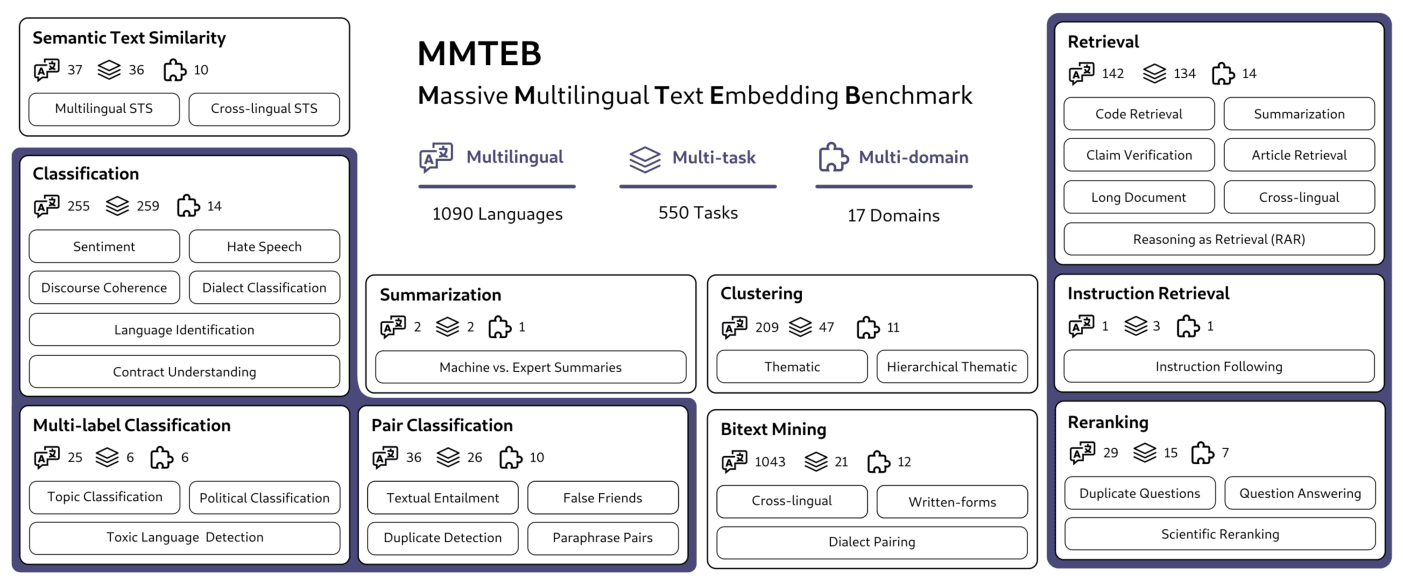
MTEB, the Massive Text Embedding Benchmark, launched in 2022 to fix a simple problem: embedding models were each tested on a handful of datasets, usually one task, so nobody could tell whether a model good at sentence similarity was also good at search. The original paper covered 8 task types, 58 datasets and 112 languages, and found that no single model won every task.
In 2025 a community effort called MMTEB expanded it to more than 500 quality-controlled tasks across 250+ languages, adding instruction following, long-document retrieval and code retrieval. The mteb package is open source under Apache 2.0, and the leaderboard is hosted on Hugging Face.
The task types
Scroll the table horizontally on smaller screens.
| Task type | What the model must do | Relevant if you build |
|---|---|---|
| Retrieval | Find the passages that answer a query in a large corpus | RAG, semantic search, agent memory |
| Reranking | Order a short candidate list by relevance | Two-stage search pipelines |
| Classification | Embeddings feed a simple classifier | Intent routing, tagging, moderation |
| Clustering | Group similar texts without labels | Topic discovery, deduplication |
| Pair classification | Decide if two texts are duplicates or paraphrases | Duplicate detection |
| STS | Score how similar two sentences are | Similarity features, matching |
| Bitext mining | Match translations across languages | Cross-lingual search |
| Summarization | Score summaries against references | Rarely a deciding factor |
MTEB is many benchmarks, not one
The leaderboard has a benchmark selector, and the number next to a model changes with it. The mteb toolkit packages dozens of named benchmarks (full list). The ones most developers need:
Scroll the table horizontally on smaller screens.
| Benchmark | Tasks | Use it for |
|---|---|---|
| MTEB(eng, v2) | 41 | English text; zero-shot design, recommended over v1 |
| MTEB(eng, v1) | 56 | Legacy English scores; older model cards quote it |
| MTEB(Multilingual, v2) | 131 | Products serving many languages |
| MTEB(Code, v1) | Code search tasks | Code search, coding agents, text-to-SQL |
| RTEB(beta) | 30 in the public list | Retrieval in legal, finance, code and health domains |
Two details matter here. First, MTEB(eng, v2) removes datasets such as MS MARCO that many models are fine-tuned on, so it's meant as a zero-shot test, and the maintainers say it also fixes a known scoring bug in v1. The MMTEB authors note that some models drop in rank on v2 because they had been trained on the removed datasets. Second, v1 and v2 scores sit on different scales. A model with 70 on one and 65 on the other hasn't necessarily got worse.
RTEB adds a twist: it was built with private test sets to resist overfitting. In January 2026 the MTEB maintainers temporarily removed the private column from the leaderboard because Voyage AI, which co-developed RTEB, had access to the private data. They said nobody had alleged misuse, but the uneven playing field undermined trust. Read RTEB results with that context.
Why the same model gets different scores
Embedding scores are only comparable inside one benchmark and version. OpenAI's text-embedding-3 models show how easily this trips people up.
Scroll the table horizontally on smaller screens.
| Model | OpenAI's guide: MTEB | Qwen team's table: MTEB(Multilingual) |
|---|---|---|
| text-embedding-3-large | 64.6% | 58.93 mean (task) |
| text-embedding-3-small | 62.3% | Not listed |
| text-embedding-ada-002 | 61.0% | Not listed |
Neither number is wrong. OpenAI's guide quotes the English benchmark as it existed when the models launched. The Qwen model card quotes the much broader multilingual benchmark, where tasks in hundreds of languages pull the average down. The lesson: when a vendor says "scores X on MTEB," ask which benchmark, which version and which date.
Bigger isn't automatically better
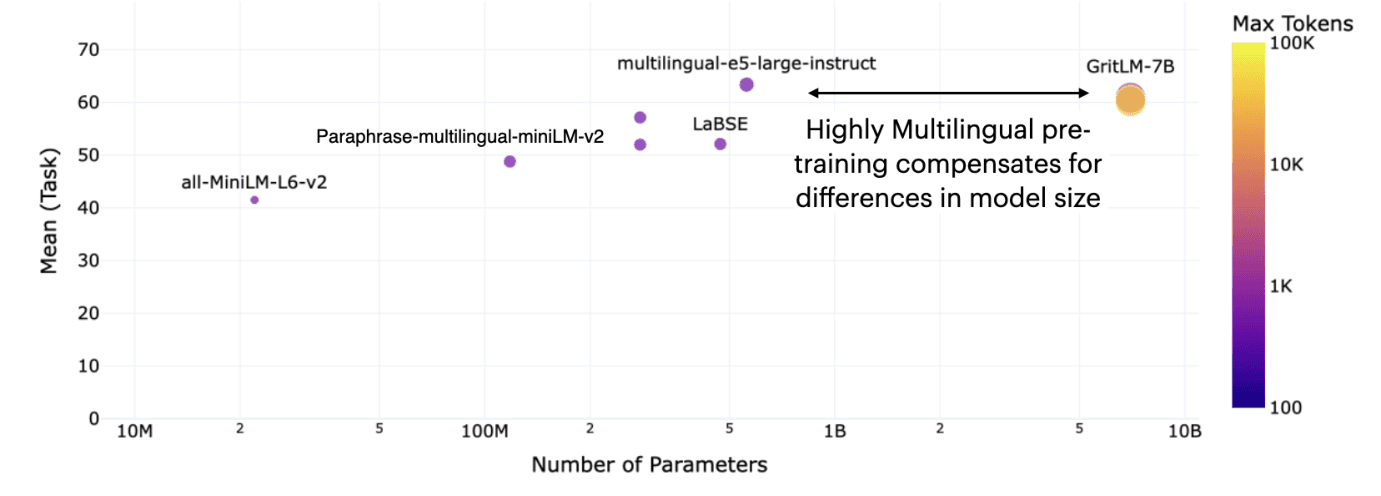
The MMTEB paper found that the best publicly available model on its multilingual benchmark at the time was multilingual-e5-large-instruct, with about 560 million parameters, ahead of several 7-billion-parameter models. Heavily multilingual training made up for size. Leaderboard leaders have changed since, but the point holds: a small model can beat a big one on the tasks you care about, at a fraction of the serving cost.
Hosted embedding models: price and specs
Price per million tokens matters less for embeddings than for chat models, because you embed a corpus once and queries are short. But it adds up when you re-embed. Prices as of Nov 19, 2026, from each provider's official page:
Scroll the table horizontally on smaller screens.
| Model | Price per 1M tokens | Notes |
|---|---|---|
| OpenAI text-embedding-3-small | $0.02 | 1,536 dims by default; 8,192-token input |
| OpenAI text-embedding-3-large | $0.13 | 3,072 dims by default; 8,192-token input |
| Google gemini-embedding-001 | $0.15 | Text only; free tier available |
| Google Gemini Embedding 2 | $0.20 text ($0.10 batch) | Multimodal: text, image, audio, video, PDF; 8,192-token input |
| Voyage voyage-4-lite | $0.02 | First 200M tokens free |
| Voyage voyage-4 | $0.06 | First 200M tokens free |
| Voyage voyage-4-large | $0.12 | First 200M tokens free; batch 33% off |
| Qwen3-Embedding (0.6B, 4B, 8B) | Free weights (Apache 2.0) | Self-host; 32K context; up to 4,096 dims |
Sources for the table: OpenAI pricing, Gemini API pricing, Voyage AI pricing and the Qwen3-Embedding-8B model card. The Qwen team reports that its 8B model ranked first on the multilingual leaderboard on June 5, 2025, with a 70.58 mean task score; that's a vendor claim at a past date, so check the live board. See our Qwen3 Embedding page for details. If you're weighing hosted against self-run models more generally, our self-hosted LLM vs API cost guide walks through the break-even math.
Dimensions: the hidden cost MTEB doesn't rank
Vector size drives your storage and search bill more than the embedding price does. A 3,072-dimension float32 vector takes about 12 KB; at 768 dimensions it's about 3 KB. Across tens of millions of chunks, that's the difference between a small and a large vector database tier.
Most current models are trained so you can truncate vectors with little loss. Google's embeddings docs publish MTEB scores for Gemini embeddings at several sizes: 68.17 at 1,536 dimensions, 67.99 at 768 and 66.19 at 256. Google doesn't name the benchmark version in that table, so compare those numbers only with each other.
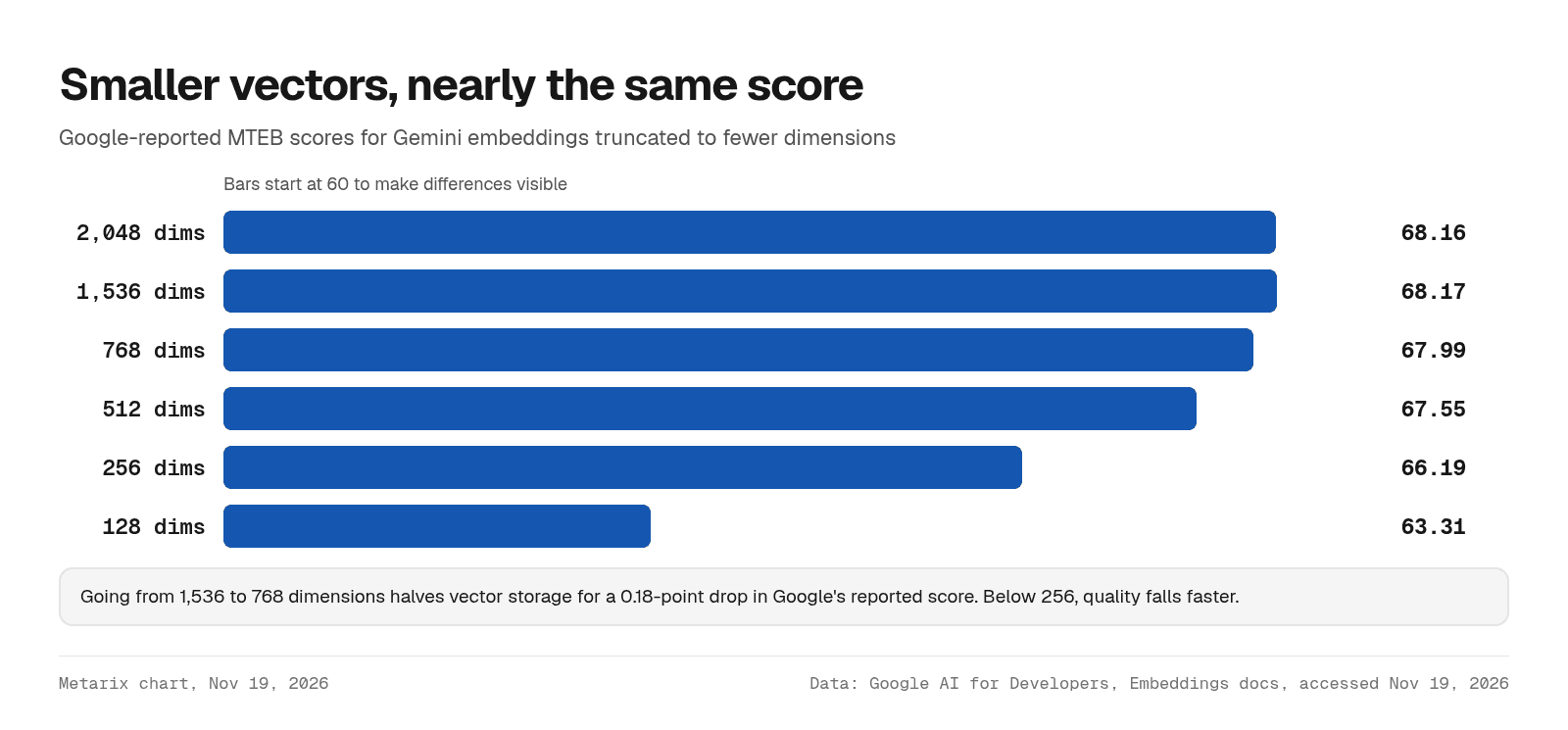
OpenAI exposes the same idea through a dimensions parameter, and Voyage and Qwen support custom sizes too. Pick your dimension before you index, because changing it later means re-embedding everything. Our vector database comparison covers how size affects cost on Pinecone, Qdrant and others.
How to pick an embedding model in five steps
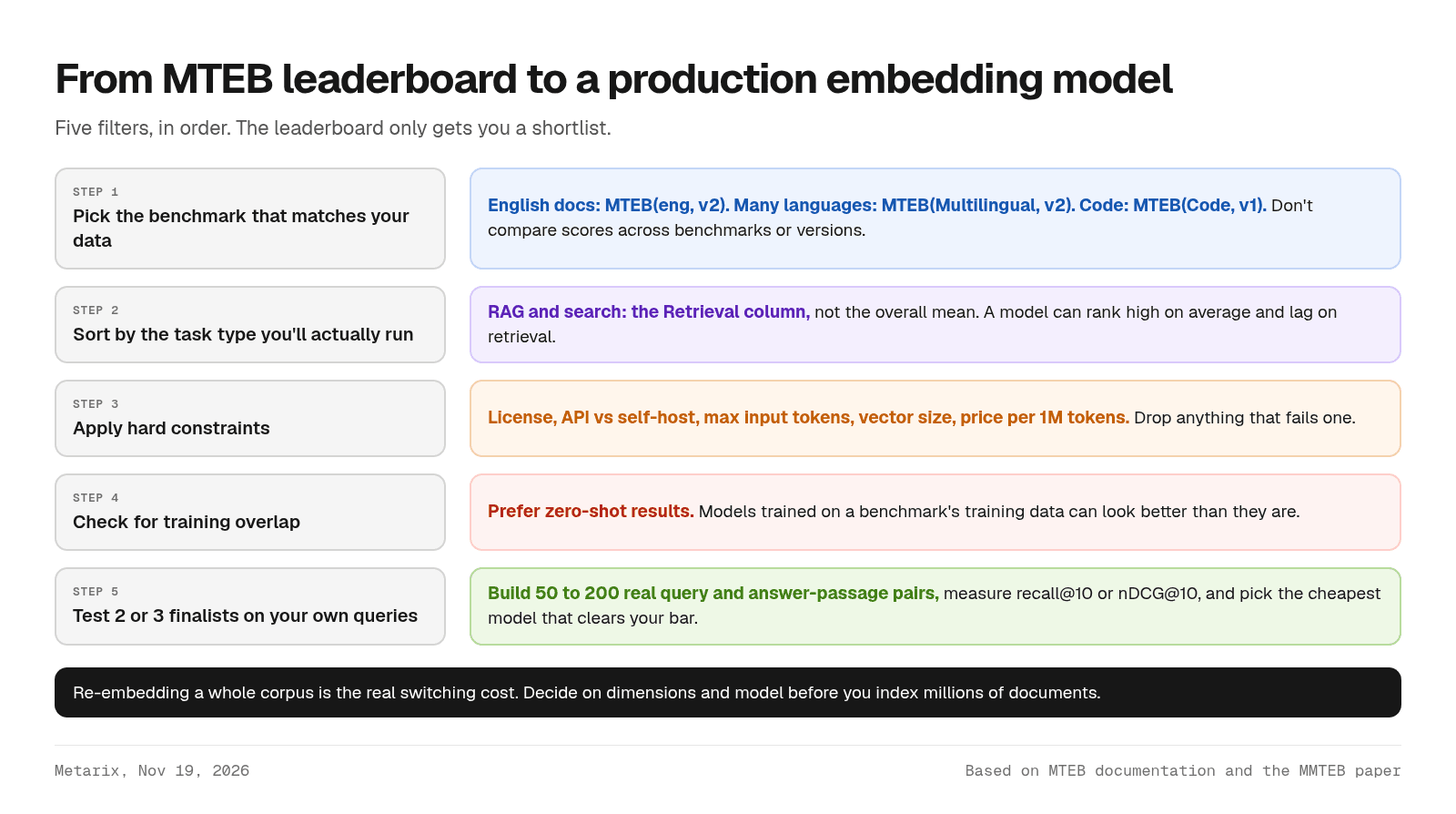
1. Pick the right benchmark. English corpus: MTEB(eng, v2). Mixed languages: MTEB(Multilingual, v2). Code: MTEB(Code, v1). Domain-heavy retrieval (legal, finance, medical): look at RTEB and domain suites.
2. Sort by your task. For RAG, sort by Retrieval, not the overall mean. If you also rerank, check Reranking.
3. Apply hard filters. License (can you self-host it commercially?), hosted or self-run, maximum input tokens (does your chunk size fit?), vector size and price.
4. Discount overfit results. Prefer zero-shot benchmarks and be wary of models whose training data overlaps the test sets. A suspiciously big jump on one benchmark is a reason to test harder.
5. Run your own eval. Collect 50 to 200 real queries with the passages that should answer them, embed your corpus with each finalist and measure recall@10 or nDCG@10. Our guide to evaluating retrieval in AI apps shows how to build that test set, and Embeddings and Retrieval covers the basics.
Run MTEB tasks yourself
You can reproduce leaderboard tasks, or score a model you're considering, with the open-source package. This illustrative snippet follows the usage in the mteb README; swap in your own model and tasks:
# pip install mtebimport mtebmodel = mteb.get_model("sentence-transformers/all-MiniLM-L6-v2")tasks = mteb.get_tasks(tasks=["Banking77Classification.v2"])results = mteb.evaluate(model, tasks=tasks)# Or from the CLI:# mteb run -m sentence-transformers/all-MiniLM-L6-v2 \# -t Banking77Classification.v2 --output-folder results
For the decision itself, a simple recall@k check on your own data is more useful than any public score. Illustrative, not a test we ran:
def recall_at_k(ranked_ids, relevant_ids, k=10): """Share of queries whose correct passage shows up in the top k.""" hits = sum(1 for ranked, rel in zip(ranked_ids, relevant_ids) if set(ranked[:k]) & set(rel)) return hits / len(relevant_ids)# ranked_ids: for each query, passage ids sorted by cosine similarity# relevant_ids: for each query, the ids a human marked as correct
The same "which benchmark, which column" problem applies to transcription models. Our speech-to-text benchmarks explainer covers word error rate, the Open ASR Leaderboard and Artificial Analysis.
Verdict
MTEB is the best public starting point for choosing an embedding model, and a poor finishing line. Use the benchmark that matches your languages and the Retrieval column if you're building RAG, then filter by license, dimensions and price. Ignore gaps of a point or two in the overall average, and never compare numbers across benchmark versions.
For most teams the winning pattern is boring: shortlist three models from the leaderboard, often one cheap hosted API, one premium hosted API and one open model you could self-host, then run a 100-query test on your own documents. Pick the cheapest model that clears your quality bar, choose your vector size before indexing, and re-run the test when a new model tops the board.
Sources
- Muennighoff et al., MTEB: Massive Text Embedding Benchmark, arXiv 2210.07316
- Enevoldsen et al., MMTEB: Massive Multilingual Text Embedding Benchmark, arXiv 2502.13595, accessed Nov 19, 2026
- MTEB, GitHub repository, Available benchmarks and leaderboard, accessed Nov 19, 2026
- MTEB maintainers, Temporary removal of the private RTEB column, GitHub issue, Jan 2026
- OpenAI, Embeddings guide and API pricing, accessed Nov 19, 2026
- Google, Gemini API embeddings docs and Gemini API pricing, accessed Nov 19, 2026
- Voyage AI, Pricing, accessed Nov 19, 2026
- Qwen, Qwen3-Embedding-8B model card, accessed Nov 19, 2026
Tools covered in this guide
Frequently asked questions
- What is the MTEB leaderboard?
- MTEB (Massive Text Embedding Benchmark) is an open-source benchmark for text embedding models with a public leaderboard on Hugging Face. It scores models across task types such as retrieval, reranking, classification, clustering and semantic similarity, in many languages, and ranks them with a Borda count across tasks.
- What is the difference between MTEB v1 and v2?
- MTEB(eng, v2) is a zero-shot English benchmark with 41 tasks. It removes datasets such as MS MARCO that many models are trained on, uses updated task versions and fixes a known scoring bug in v1, which has 56 tasks. Scores from v1 and v2 are not directly comparable.
- Which MTEB score matters for RAG?
- The Retrieval column, scored mainly with nDCG@10, is the most relevant for retrieval-augmented generation and semantic search. The overall mean blends in tasks such as classification and clustering that may not matter for your use case.
- Is the top model on the MTEB leaderboard the best embedding model?
- Not necessarily for your data. Small score gaps rarely hold on a specific corpus, some models are trained on data that overlaps the benchmark, and price, license, vector size and input length also matter. Use the leaderboard for a shortlist, then test finalists on your own queries.