Comparison · Agents, APIs & MCP
LLM API Processing Tiers: Batch vs Flex vs Priority
OpenAI, Anthropic and Google now sell the same model at several speeds: Batch and Flex tiers cut token prices up to 50%, while Fast and Priority cost about 2x. Here's what each tier costs and which workloads belong on it.
Sabeen Hartwell · Nov 20, 2026 · 12 min read
Documentation-based research
On this page
Every major LLM API now sells the same model at several speeds. Batch and Flex tiers cut token prices by up to 50% if you can wait, and Fast or Priority tiers charge about 2x for quicker, more reliable answers. Picking the right tier per workload is often worth more than switching models.
This guide maps the processing tiers at OpenAI, Anthropic and Google's Gemini API side by side: what each costs relative to Standard, how slow the cheap ones really are, what happens when capacity runs out, and which tier fits which job. Prices as of Nov 20, 2026.
Quick verdict
Anything nobody is waiting for should go through a Batch API: all three vendors charge 50% of Standard and give batch work its own rate-limit pool. Agent chains that can wait minutes fit Gemini Flex (50% off) or OpenAI's two-hour and eight-hour background windows (30% and 40% off). Pay for Fast or Priority only on live, user-facing traffic where speed shows up in conversion or retention, and watch the response fields, because every vendor quietly downgrades premium requests when you exceed their limits.
Scroll the table horizontally on smaller screens.
| Tier type | OpenAI API | Claude API (Anthropic) | Gemini API (Google) |
|---|---|---|---|
| Asynchronous bulk | Batch API: 50% off, 24h window | Message Batches: 50% off, expires after 24h (most finish within 1h) | Batch API: 50% off, 24h target |
| Cheap synchronous | Flex: Batch rates, being wound down, not on GPT-6.2 | None | Flex (preview): 50% off, 1–15 min target |
| Discounted async windows | Background mode 2h (30% off) and 8h (40% off), public beta | None | None |
| Default | Standard | Standard | Standard |
| Speed or priority premium | Fast mode (formerly Priority): 2x on current models | Fast mode: 2x on Fable 5.2, Mythos 5.2, Opus 5.5 | Priority (preview): 75–100% more |
| Top speed | Ultrafast: 3x for GPT-6.2 until Feb 28, 2027, then 6x | None | None |
| Reserved capacity | Scale Tier and Reserved capacity (enterprise) | Priority Tier is legacy, no new purchases | Not covered in this guide |
What a processing tier actually changes
A processing tier doesn't change the model. GPT-6.2 Sol on Batch, Standard or Fast mode gives the same quality of answer; what changes is how your request is scheduled and served. Google, for example, runs Flex on off-peak capacity, while premium tiers jump the queue or run on faster inference configurations.
That gives three levers, and every tier trades one for another:
- Price. Discount tiers run 30% to 50% below Standard. Premium tiers run 75% to 200% above it.
- Latency. From seconds (Standard, Fast, Priority) to minutes (Gemini Flex targets 1–15 minutes) to hours (background windows and Batch APIs).
- Reliability. Gemini calls Flex traffic "sheddable": it can be preempted when Standard traffic spikes. Priority traffic is "non-sheddable". OpenAI's Flex can return a 429 Resource Unavailable error when capacity runs short.
Most of these tiers are a single request parameter. OpenAI and Gemini use service_tier, while Anthropic uses speed: "fast" for its fast mode. On the OpenAI API and Gemini API, a tier is one field on the request. If your app already handles rate limits and 429 errors properly, adding a tier is mostly a routing decision.
How much each tier costs
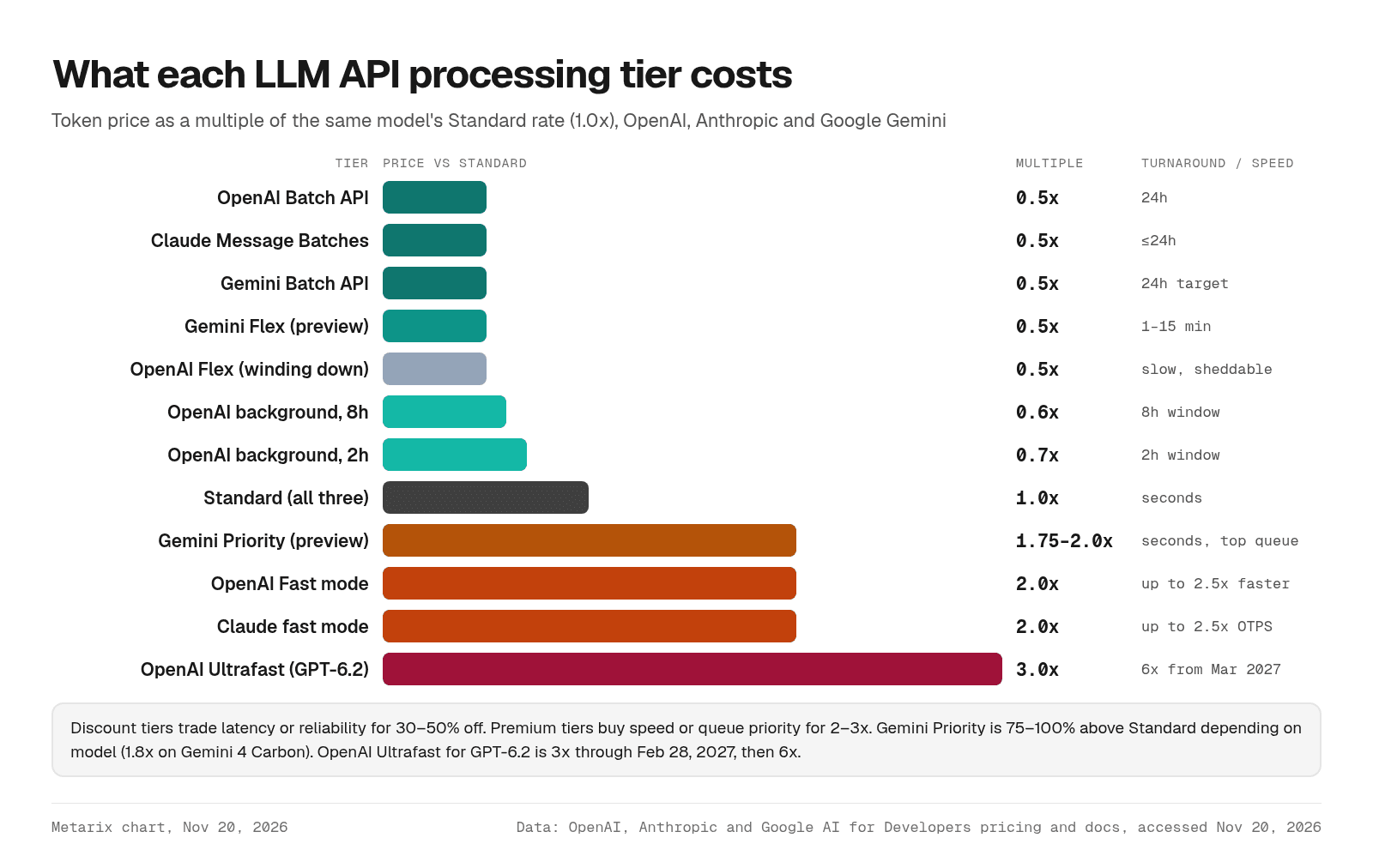
The multipliers are consistent enough to plan with. Discounts sit at 0.5x to 0.7x, Standard at 1.0x, and speed premiums at about 2x, with OpenAI's Ultrafast alone at 3x. Here's what that means in dollars for one flagship model from each vendor.
Scroll the table horizontally on smaller screens.
| Tier | GPT-6.2 Astra (OpenAI) | Claude Opus 5.5 (Anthropic) | Gemini 4 Carbon (Google) |
|---|---|---|---|
| Batch | $4 / $20 | $2 / $10 | $1 / $5 (from Dec 1: $2 / $10) |
| Flex | Not available | Not offered | $1 / $5 (from Dec 1: $2 / $10) |
| Background, 8h window | $4.80 / $24 (calculated) | Not offered | Not offered |
| Background, 2h window | $5.60 / $28 (calculated) | Not offered | Not offered |
| Standard | $8 / $40 | $4 / $20 | $2 / $10 (from Dec 1: $4 / $20) |
| Fast / Priority | $16 / $80 (Fast) | $8 / $40 (fast mode) | $3.60 / $18 (from Dec 1: $7.20 / $36) |
| Ultrafast | $24 / $120 (promo to Feb 28, 2027; $48 / $240 list) | Not offered | Not offered |
Two details matter for real bills. Prompt-caching discounts still apply on top of most tiers: OpenAI says cached-input discounts carry over to Fast mode, and Anthropic says caching multipliers stack with fast mode and with Batch. But caches don't always cross tiers, which we cover below. For the caching math itself, see our prompt caching break-even guide.
Discount tiers: Batch, Flex and background windows
Batch APIs (all three vendors)
Batch is the oldest and simplest discount. You upload many independent requests at once, collect the results later, and pay half price. It's the right home for evaluations, backfills, classification and enrichment jobs, embeddings and nightly reports.
- OpenAI Batch API. 50% off, a single
24hcompletion window, and a queued-token limit separate from your per-minute limits. Output files expire after 30 days by default (OpenAI Batch guide). - Claude Message Batches. 50% off input and output. A batch holds up to 100,000 requests or 256 MB. Anthropic says most batches finish within an hour, and requests still unprocessed after 24 hours expire and aren't billed. Results stay downloadable for 29 days (Anthropic batch docs).
- Gemini Batch API. 50% off with a 24-hour target turnaround. Submit inline requests (under 20 MB in total) or a JSONL file of up to 2 GB (Gemini Batch API).
Batch only fits work you can define up front. If request two depends on the answer to request one, as in most agent loops, a Batch API forces you to run one round per batch. Vendors can also change batch products: Fireworks paused its batch API this month, which we covered in what to migrate after Fireworks paused Batch.
Flex: cheap, synchronous, interruptible
Flex keeps the normal request-response shape but runs on spare capacity. Gemini Flex (in preview) costs 50% of Standard and targets 1 to 15 minutes per request. It counts against your normal rate limits rather than Batch's extended ones, and when capacity is short it returns 503 or 429 errors. Google won't silently upgrade a Flex request to Standard, so retries with exponential backoff are your job, and it recommends client timeouts of 10 minutes or more (Gemini Flex docs).
OpenAI Flex is on its way out. It still works on older models such as GPT-6.1 Sol, GPT-6.1 Terra and GPT-6 Luna at Batch rates, and you aren't charged when it returns 429 Resource Unavailable. But OpenAI says Flex isn't available on GPT-6.2 Astra or Sol, won't be added to future models, and will get a retirement date later (OpenAI Flex guide). Don't build anything new on it.
OpenAI background windows: the Flex replacement
OpenAI's replacement is a discount on background mode. Send a Responses API request with background: true and set background_options.completion_window to 2h or 8h, and token rates drop 30% or 40% below Standard. The window is a completion target, not a guarantee, and the API retries eligible capacity errors itself (OpenAI background mode guide).
- Standard only, no streaming. Set
service_tiertodefault. Withauto, the request only qualifies if the API picks Standard. - Shared limits. Two-hour and eight-hour requests share the Batch/Background rate limit with Batch jobs, and input tokens count at submission.
- Built for agent chains. Reuse a
continuation_idon follow-up requests, such as after a tool call, to keep higher queue priority. Each follow-up gets the same discount. - Limited models. The windows are in public beta on GPT-6.2 Astra, GPT-6.2 Sol, GPT-6.1 Terra and GPT-6 Luna.
Pick Batch when you can submit everything at once and want the full 50% off. Pick a background window when each step depends on the last, or when a two-hour turnaround matters more than the extra 10 to 20 points of discount. Our GPT-6.2 Astra pricing analysis covers the OpenAI side in more detail.
Premium tiers: Fast, Priority and Ultrafast
OpenAI Fast mode and Ultrafast
OpenAI renamed Priority processing to Fast mode on July 30, 2026; service_tier: "fast" and "priority" both work. It promises up to 2.5x faster speeds and more consistent latency, and on current GPT-6-series models it costs 2x Standard. Fast mode shares the model's Standard rate limit. If your traffic ramps too quickly, OpenAI may run some Fast requests at standard speed and bill them at standard rates, and the response then shows service_tier: "default". OpenAI's rule of thumb: above 1 million input tokens per minute, grow by no more than 50% every 15 minutes. Fast mode for GPT-6 Astra carries no latency SLA (OpenAI Fast mode guide).
Ultrafast is OpenAI's fastest tier, for GPT-6.2 Astra, GPT-6.2 Sol, GPT-6 Astra and GPT-6.1 Sol. It has separate rate limits, and OpenAI strongly recommends WebSocket mode for agents making many quick tool calls, since connection overhead eats into the gain (Ultrafast guide). For GPT-6.2 models it's 3x Standard through February 28, 2027 and 6x from March 1, 2027. GPT-6 Astra and GPT-6.1 Sol are already at 6x (OpenAI pricing). Budget for the list price, not the promotion.
Claude fast mode
Anthropic's fast mode runs the same model on a faster inference configuration. Set speed: "fast" on a Messages API request. It's available on Claude Fable 5.2, Claude Mythos 5.2 and Claude Opus 5.5, in research preview on Opus 5 and deprecated on Opus 4.8 (Claude fast mode docs).
- Throughput, not first token. Anthropic says the gain is up to 2.5x more output tokens per second. Time to first token doesn't improve, so it helps long answers and agent steps more than short chat replies.
- 2x price. Opus 5.5 goes from $4 / $20 to $8 / $40 per million tokens, and Fable 5.2 from $8 / $40 to $16 / $80. Fast mode can't be combined with Batch (Claude pricing).
- Its own rate limit. Exceeding it returns a 429 with a
retry-afterheader. Nothing falls back automatically: to drop to standard speed, catch the error and retry without thespeedparameter. The response'susage.speedfield shows which speed was used.
Anthropic's older Priority Tier, a capacity commitment that kept requests ahead of others during peaks, is now legacy. New commitments are no longer sold, and existing customers keep it until their contract ends (Anthropic service tiers).
Gemini Priority
Gemini's Priority tier (in preview) routes requests to high-criticality queues that are never preempted, for 75% to 100% more than Standard; on Gemini 4 Carbon that's 1.8x. Default Priority limits are 0.3x your Standard limit. When you exceed them, Google downgrades the overflow to Standard rather than failing it and bills it at the Standard rate. Check the x-gemini-service-tier response header to see how often that happens (Gemini Priority docs).
Note the difference in philosophy. Gemini and OpenAI degrade premium requests gracefully, while Anthropic returns an error and lets you choose. Graceful downgrades keep your app up, but you can quietly lose the speed you're paying for without noticing.
Five gotchas that cost real money
- Caches don't always cross tiers. OpenAI says Standard requests can't reuse prompt-cache entries created by two-hour or eight-hour background requests, even with identical prompts (background guide). Anthropic says requests at different speeds don't share cached prefixes, so falling back from fast to standard is a cache miss (fast mode docs).
- Downgrades are silent. Log the tier each response actually used:
service_tieron OpenAI,usage.speedon Claude, and thex-gemini-service-tierheader on Gemini. A falling hit rate means you're paying premium setup costs for standard speed. - Timeouts break cheap tiers. Official SDKs often default to 10-minute timeouts. OpenAI's Flex examples raise them to 15 minutes, and Google recommends 10 minutes or more for Gemini Flex.
- Rate limits differ by tier. Gemini Flex counts against normal limits, Batch and OpenAI background windows draw on separate pools, and Claude fast mode and OpenAI Ultrafast have their own limits. Test before you move production traffic.
- Prices move. Gemini 4 Carbon's prices double on December 1, 2026, OpenAI's Ultrafast promotion ends February 28, 2027, and OpenAI Flex is being retired. Recheck pricing pages before you commit a budget.
How to set the tier in code
The request shapes below are adapted from each vendor's documentation and are illustrative only; we didn't run them for this article. Model names and parameters follow the docs as of November 20, 2026.
# OpenAI: 8-hour background window (40% off Standard)resp = client.responses.create( model="gpt-6.2-sol", input="Review these contracts for missing approvals...", background=True, service_tier="default", background_options={"completion_window": "8h"},)# Claude: fast mode on a live requestmsg = anthropic_client.messages.create( model="claude-opus-5-5", max_tokens=4096, speed="fast", messages=[{"role": "user", "content": "Refactor this module"}],)# Gemini: Flex tier with a long client timeoutinteraction = gemini_client.interactions.create( model="gemini-4-hydrogen", input="Classify these support tickets...", service_tier="flex",)
Whatever the vendor, wrap the cheap tiers in a retry policy with a time budget, and decide in advance what happens when it runs out: wait longer, fall back to Standard, or move the job to Batch.
Which tier should you use?
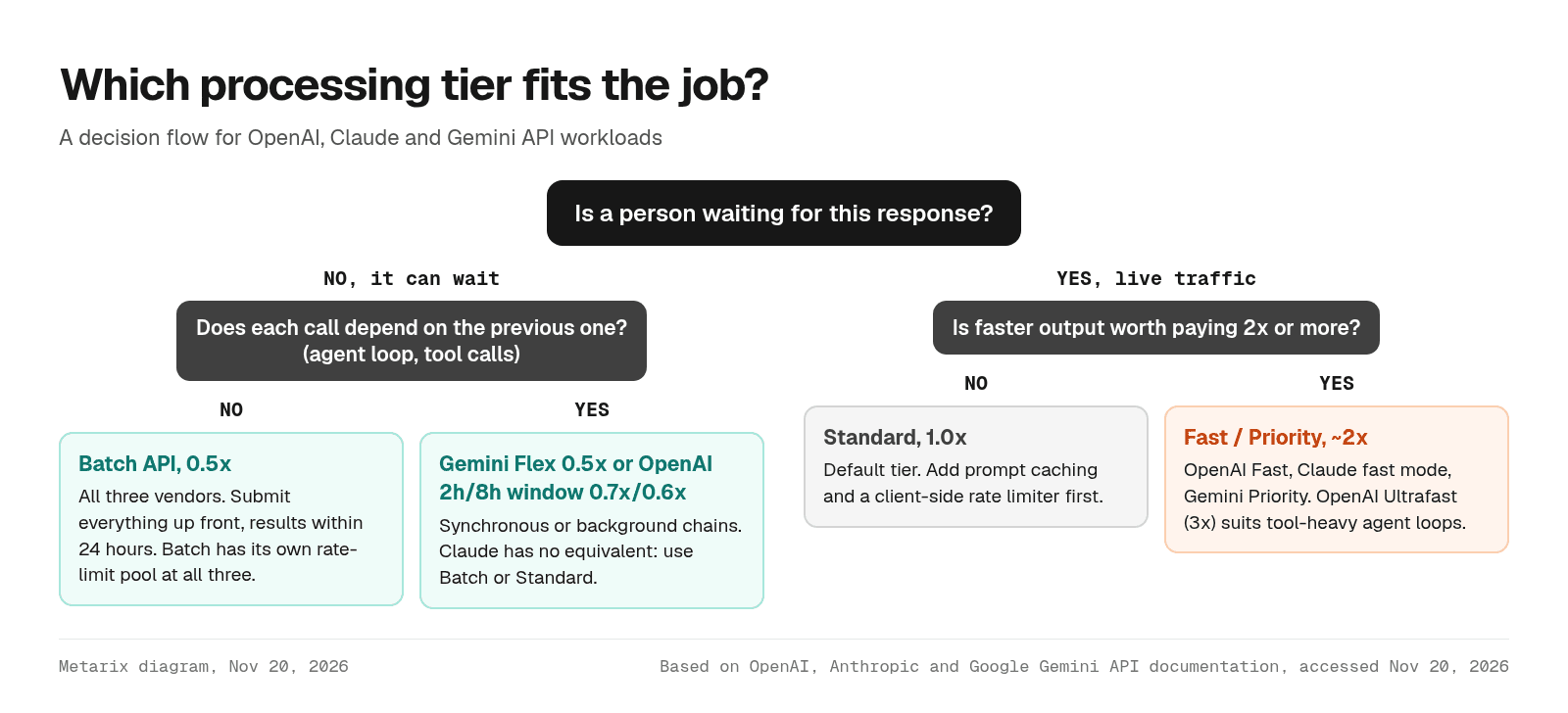
Here's a worked example. Take a workload of 50 million input and 10 million output tokens a month, with no caching. At list prices as of today:
Scroll the table horizontally on smaller screens.
| Tier | GPT-6.2 Astra | Claude Opus 5.5 | Gemini 4 Carbon (to Nov 30) |
|---|---|---|---|
| Batch | $400 | $200 | $100 |
| Flex | n/a | n/a | $100 |
| Background 8h / 2h | $480 / $560 | n/a | n/a |
| Standard | $800 | $400 | $200 |
| Fast / Priority | $1,600 | $800 | $360 |
The spread within one vendor (4x between Batch and Fast) is as large as the spread between vendors. That's why routing matters: a typical product might send chat traffic to Standard, a premium "fast answer" feature to Fast or Priority, and nightly evaluations or enrichment to Batch, all on the same model. If you're weighing whether to leave APIs altogether at this volume, see self-hosted LLM vs API cost.
Verdict
Treat processing tiers as a default part of your architecture, not an optimization for later. Tag every LLM call as live, deferrable-in-minutes or deferrable-in-hours, and route accordingly. Deferrable-in-hours work belongs on a Batch API at half price with any of the three vendors. Deferrable-in-minutes agent chains belong on Gemini Flex or OpenAI's background windows; on Claude, your choice is Batch or Standard.
Premium tiers are worth it in narrower cases than the marketing suggests. Pay 2x only where you can measure the benefit, log the tier every response actually received, and avoid planning around OpenAI's Ultrafast promotion or the old Flex tier. Both have end dates.
Sources
- OpenAI: API pricing, Background mode, Flex processing, Fast mode, Ultrafast mode and Batch API (accessed Nov 20, 2026)
- Anthropic: Claude pricing, Fast mode, Batch processing and Service tiers (accessed Nov 20, 2026)
- Google: Gemini API optimization and inference, Flex inference, Priority inference, Batch API and Gemini API pricing (accessed Nov 20, 2026)
Tools covered in this guide
Frequently asked questions
- What is the difference between Batch and Flex processing?
- Batch APIs are asynchronous: you submit many requests together and collect results within about 24 hours, at 50% off. Flex is synchronous: each request still gets a direct response, but runs on spare capacity, so it can take minutes or be rejected when busy. Gemini Flex is 50% off; OpenAI Flex is being retired.
- Is OpenAI Flex processing being discontinued?
- Yes. OpenAI says Flex is not available on GPT-6.2 Astra or GPT-6.2 Sol, won't be added to future models, and will get a retirement date later. For new long-running work it points to background mode's discounted completion windows: 30% off for a two-hour window and 40% off for eight hours.
- How much does priority or fast processing cost?
- About double. OpenAI Fast mode and Claude fast mode cost 2x Standard on current models, and Gemini Priority costs 75% to 100% more depending on the model. OpenAI Ultrafast costs 3x for GPT-6.2 models until February 28, 2027, then 6x. Prices as of November 20, 2026.
- Does Anthropic offer a Flex tier or priority tier?
- Anthropic has no Flex equivalent; its discount option is the Message Batches API at 50% off. Its Priority Tier capacity commitments are legacy and no longer sold. For speed, it offers fast mode on Claude Fable 5.2, Mythos 5.2 and Opus 5.5 at twice the standard price.