Cloud · Analysis
Fireworks Pauses Batch API, Ends Managed Fine-Tuning
Fireworks has paused its Batch API, closed managed SFT and DPO to new jobs, and retired dataset uploads and downloads after its October security incident. Here is what replaces each workload and what it costs.
Metarix Editorial · Nov 16, 2026 · 10 min read
- Fireworks Training API
- Fireworks AI
- OpenAI
- Anthropic
- Together AI
- Cloud & Architecture
- SaaS Ecosystem & Business
Documentation-based research
On this page
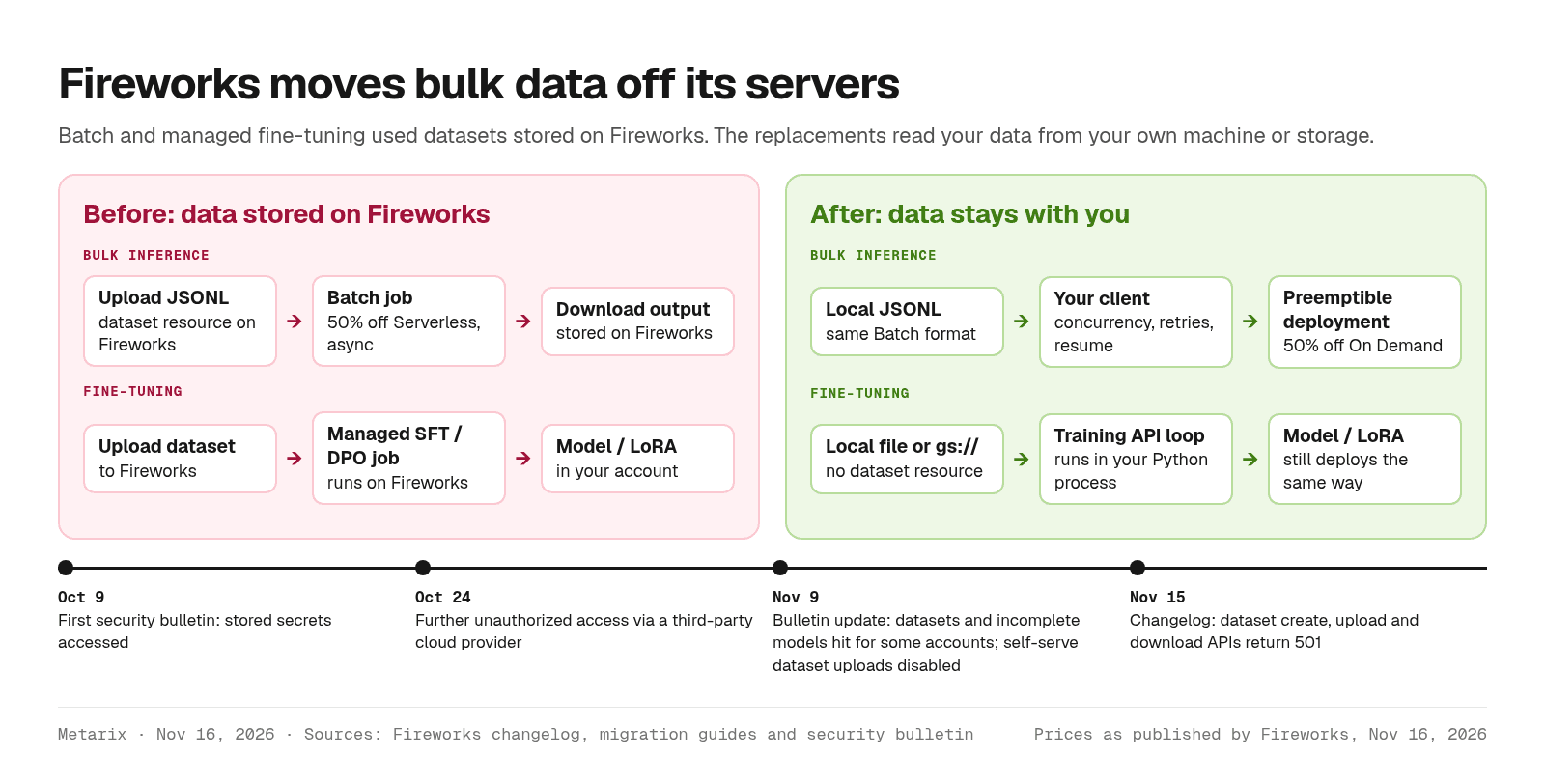
Fireworks AI has stopped storing customer datasets. A changelog entry dated Nov 15, 2026 says dataset create, upload, validate, preview, split and download calls now return 501 Not Implemented in the REST and gRPC API, firectl and the Python SDK. With that, two products built on stored datasets are off the table for new work: the Batch API is paused, and managed SFT and DPO fine-tuning jobs no longer accept new jobs.
If you run evals, synthetic data generation, backfills or fine-tunes on Fireworks, your pipeline needs a new path. This piece covers what changed, why, what the replacements cost, and how to move each workload.
Quick answer
Batch jobs move to your own client: keep the JSONL locally and send requests to a preemptible deployment (50% off On Demand GPU rates) or, for four models, Spot Serverless (30% off Standard per-token rates). Managed fine-tunes move to the Fireworks Training API, which reads data from your machine or Google Cloud Storage. Existing models and LoRA adapters keep working. Fireworks ties the change to its October 2026 security incident, in which some customers' stored datasets were accessed.
Scroll the table horizontally on smaller screens.
| Product | Status on Nov 16, 2026 | Replacement | What still works |
|---|---|---|---|
| Batch API | Paused: no new jobs, dataset uploads fail; stored Batch inputs and outputs will be permanently deleted | Your own client against a preemptible deployment (migration script provided) | Nothing new can be submitted; plan around the deletion |
| Managed SFT and DPO | No new jobs | Training API (Serverless or Dedicated) with cookbook recipes | Jobs created before Nov 9 finish; their models and adapters stay deployable |
| Dataset APIs | Create, update, upload, validate, preview, split and download return 501 (Nov 15) | Keep data locally or in your own storage | List, get and delete existing dataset records |
| Serverless and On Demand inference | Unchanged | n/a | Zero data retention by default, per Fireworks |
What changed, exactly
Batch API: paused, with stored data to be deleted
The Batch API page now opens with a notice: Batch is paused, new jobs are not accepted, dataset uploads return an error, and "all Batch input datasets and job outputs stored on Fireworks will be permanently deleted." Fireworks gives no date for the deletion. Batch offered 50% off Serverless per-token prices for asynchronous jobs, and it was popular for evals, labeling, distillation and synthetic data.
Fireworks' migration guide says it will no longer support an asynchronous dataset upload interface. Instead, you keep your dataset locally and send each request to the inference API yourself, which means your client now has to control concurrency, retry failed requests and resume after interruptions.
Managed fine-tuning: no new SFT or DPO jobs
According to the managed training migration guide, managed supervised fine-tuning and DPO no longer accept new jobs. For managed SFT, DPO and ORPO jobs created before November 9, 2026, queued and running jobs finish normally, you can still list, cancel and delete them, and their models stay in your account. You cannot resume a failed or cancelled managed job; you start a new one on the Training API.
Datasets: read-only metadata, no downloads
The Nov 15 changelog leaves only list, get and delete for existing dataset records. Download is among the retired calls, so you cannot pull a dataset back out of Fireworks. The Training API also cannot read datasets stored on Fireworks. If the only copy of your training or Batch file lived there, you will need to rebuild it from your own sources.
Why Fireworks did it: the October security incident
Fireworks published a security bulletin on Oct 9, 2026, saying stored secrets (such as those used in evaluation jobs) had been accessed. Its Nov 9 update widened the picture: investigators found impact to account and billing information, and for a limited set of accounts, to secrets, datasets and incomplete models. Fireworks says a third-party cloud provider hosting its R&D machines had an incident on Oct 23, which was used on Oct 24 to reach Fireworks development machines. It reports no further evidence of successful access to the customer platform since Oct 25.
Fireworks links the activity to a financially motivated group engaged in "LLMJacking", selling stolen access to models through illicit routing gateways, and points to Google Threat Intelligence Group and Mandiant's write-up on the trend. The same update says Fireworks disabled self-serve dataset uploads and downloads for Batch Inference and dataset-based training during the investigation, and that Inference, the Training SDK and Nexus are zero data retention by default. The Nov 15 changelog turns that pause into a permanent design change.
If you received an incident notification from Fireworks, follow it first. Either way, rotating any API keys or secrets you stored with Fireworks is cheap insurance; our guide to keeping secrets out of AI coding agents covers habits that also apply here.
What it means for cost
Batch was simple: same per-token price list, half off. The replacements price differently, so the bill for the same job can move in either direction.
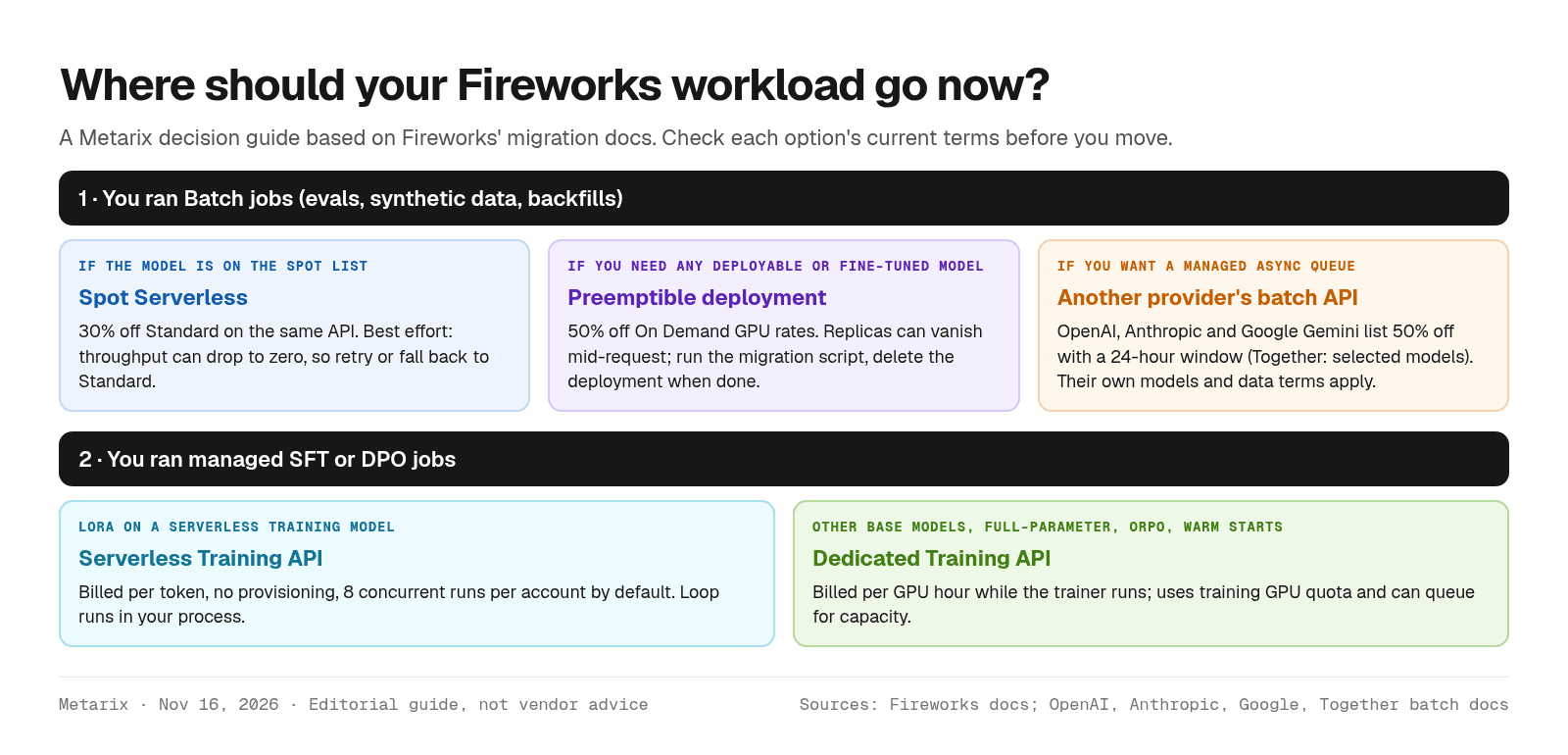
- Spot Serverless keeps per-token billing at 30% off Standard, but only for GLM-5.3, Kimi K3, DeepSeek V4.1 Flash and DeepSeek V4.1 Flash 1017 (Spot docs). It is best effort, and throughput can drop to zero.
- Preemptible deployments are 50% off On Demand pricing, which is billed per GPU-second. Fireworks' rate card lists H100 and H200 at $8.00 per GPU hour and B200 at $13.00 On Demand. You pay for GPU time, so cost depends on how well your client keeps the GPUs busy, and on how many GPUs the deployment shape uses.
- Managed fine-tuning to Training API: Serverless Training bills per token with no idle GPU charge; Dedicated Training bills per GPU hour while the trainer runs, including up to 60 minutes of inactivity before it stops.
An illustrative calculation with Fireworks' published DeepSeek V4.1 Flash prices ($0.30 input, $1.20 output per million tokens Standard; prices as of Nov 16, 2026): a job with 100M input and 20M output tokens costs $54 at Standard rates. At the old 50% Batch discount it would have been $27. On Spot it is $37.80. A preemptible single-H100 deployment at the implied $4 per GPU hour beats Spot only if it finishes the job in under about 9.5 GPU hours. These figures are arithmetic from list prices, not a measured run; cached input, deployment shape and real throughput will change them.
Scroll the table horizontally on smaller screens.
| Option | Discount | Billing unit | Models | Catch |
|---|---|---|---|---|
| Fireworks Spot Serverless | 30% off Standard | Per token | 4 models listed | Best effort; throughput can fall to zero, so retry or fall back |
| Fireworks preemptible deployment | 50% off On Demand | Per GPU-second | Any model you can deploy, including fine-tunes | Replicas can be preempted mid-request with no notice; you run the client |
| OpenAI Batch API | 50% off | Per token | OpenAI models | 24-hour completion window; input is an uploaded file |
| Anthropic Message Batches | 50% off | Per token | Claude models | Results available for 29 days; up to 100,000 requests or 256 MB per batch |
| Google Gemini Batch API | 50% of standard cost | Per token | Gemini models | 24-hour target turnaround; inline requests or an input file |
| Together AI Batch API | 50% off on selected models | Per token | Selected serverless models | Discount does not apply to dedicated inference; uploaded JSONL file |
How to migrate Batch jobs
Fireworks' path is a preemptible deployment plus its batch_to_realtime.py migration script. The script reads your existing Batch JSONL (OpenAI batch format, custom_id plus body), sends requests with concurrency and retries, writes results in the Batch output format, and resumes where it stopped if you rerun it. It needs Python 3.10 or newer and nothing else.
- Check preemptible quota. Preemptible deployments have their own GPU quota per accelerator type, separate from On Demand quota.
- Update firectl to 1.7.26 or newer. Fireworks warns that older builds silently ignore
--preemptibleand create a regular On Demand deployment at full price. - Pick an explicit deployment shape rather than the default, so you control GPU type and count. The
--preemptibleflag cannot be changed later. - Validate on a few hundred rows and compare against old Batch outputs before running the whole file.
- Delete the deployment when done. It bills until you do.
- Ignore the Batch line on the pricing page. As of Nov 16, 2026, Fireworks' pricing page still lists a Batch mode at 50% off, while the docs say Batch is paused.
The core commands, adapted from the migration guide on Nov 16, 2026 (placeholders in angle brackets; check the guide for current flags):
firectl deployment create <MODEL_ID> -a <ACCOUNT_ID> \ --deployment-id batch-migration --deployment-shape <SHAPE> \ --min-replica-count 1 --max-replica-count 1 --preemptible --waitpython batch_to_realtime.py --input batch_input.jsonl --output results.jsonl \ --model "<MODEL_ID>#accounts/<ACCOUNT_ID>/deployments/batch-migration" \ --concurrency 16firectl deployment delete batch-migration -a <ACCOUNT_ID>
Two behaviors to plan for. A preempted replica makes in-flight requests fail with dropped connections or 503s, which the script retries; the deployment stays READY while that happens, so watch replicaStats to see how many replicas are actually serving. And deployments that scale to zero return 503 while warming up (deployment docs). Our explainer on spot vs reserved GPUs covers when interruptible capacity is worth the extra client work.
If your model is on the Spot list, the lighter option is to switch the model ID to its -spot variant and fall back to Standard on failure. An illustrative pattern, not Fireworks sample code:
# illustrative: try Spot, fall back to StandardSPOT = "accounts/fireworks/models/deepseek-v4p1-flash-spot"STD = "accounts/fireworks/models/deepseek-v4p1-flash"try: r = client.chat.completions.create(model=SPOT, messages=msgs, timeout=60)except (openai.APIStatusError, openai.APITimeoutError): r = client.chat.completions.create(model=STD, messages=msgs)
How to migrate managed fine-tuning
The Training API runs your training loop in Python on your machine while Fireworks runs the GPU work. Fireworks recommends starting from its cookbook recipes, sft_loop.py and dpo_loop.py, and even provides a prompt you can paste into Claude Code, Cursor or Codex to set up the job. Point the recipe at the same JSONL you uploaded before; the row format is unchanged, except that the DPO and ORPO recipes ignore tool definitions in input.tools.
Scroll the table horizontally on smaller screens.
| Your managed job | Train it on | Billing |
|---|---|---|
| LoRA on a serverless training model | Serverless Training | Per token; 8 concurrent runs per account by default |
| LoRA on any other model | Dedicated Training, LoRA | Per GPU hour while the trainer runs |
| Full-parameter (LoRA rank 0) | Dedicated Training, full-parameter, if a shape exists; otherwise a LoRA adapter | Per GPU hour |
| ORPO, warm start from an adapter, or a reservation | Dedicated Training | Per GPU hour or your reservation |
- Always set lora_rank. The recipe default of 0 means full-parameter training, which needs a dedicated trainer.
- Match tokenizer_model to the base model's Hugging Face repo. Fireworks warns a mismatch corrupts training.
- Run long jobs on a machine that stays on. If your process stops, training stops. Use checkpoints (
dcp_save_interval) so you can resume. - Keep keys out of agent chats. Export
FIREWORKS_API_KEYin your shell before starting a coding agent, as Fireworks' guide advises.
Who should consider leaving Fireworks
For teams that used Fireworks Batch as a cheap queue for open-weight models, the trade-off is effort. OpenAI, Anthropic and Google still offer managed 50%-off batch queues, but only for their own models, and they store your batch files under their own terms. Staying on Fireworks keeps access to open models like DeepSeek V4.1 Flash, Kimi K3 and GLM-5.3 and to your fine-tuned adapters, at the cost of running a client and handling preemption.
On the inference side, Fireworks keeps adding per-request modes, including those from its Forge launch earlier this month. For serving fine-tuned models on interruptible or serverless GPUs elsewhere, see our serverless GPU inference comparison.
Verdict
This is a real breaking change, but a manageable one. If you used Fireworks Batch, rebuild the job on a preemptible deployment with Fireworks' migration script, or use a -spot model ID if your model is one of the four on the list. Test on a small sample and compare cost against the old 50% Batch rate before moving everything. If you ran managed fine-tunes, move to the Training API's Serverless tier for LoRA work; it bills per token and keeps data off Fireworks' disks.
Most important: don't assume Fireworks still holds a copy of your data. Downloads are gone and stored Batch files will be deleted, so make sure every dataset and output you care about exists in your own storage today.
Sources
- Fireworks documentation changelog: Dataset creation, upload, and download APIs retired (Nov 15, 2026)
- Fireworks: Migrating Batch API workloads to preemptible deployments and Batch API (accessed Nov 16, 2026)
- Fireworks: Migrate from Managed Training to the Training API and Training API overview (accessed Nov 16, 2026)
- Fireworks: Update on October 2026 security incident (last updated Nov 9, 2026) and original bulletin (Oct 9, 2026)
- Fireworks: Spot Serverless, On-demand deployments and Pricing (accessed Nov 16, 2026)
- Google Threat Intelligence Group and Mandiant: LLMJacking (Nov 2, 2026)
- Batch docs: OpenAI, Anthropic Message Batches, Google Gemini Batch API, Together AI (accessed Nov 16, 2026)
Tools covered in this article
Frequently asked questions
- Is the Fireworks Batch API shut down?
- It is paused. Fireworks no longer accepts new Batch jobs, dataset uploads return an error, and it says stored Batch input datasets and job outputs will be permanently deleted. Its migration guide moves Batch workloads to preemptible deployments driven by your own client.
- Can I still fine-tune models on Fireworks?
- Yes, through the Training API. Managed SFT and DPO no longer accept new jobs, but the Training API's Serverless tier handles LoRA training billed per token, and Dedicated Training covers other models and full-parameter runs. Models and adapters from earlier managed jobs remain deployable.
- Can I download my datasets from Fireworks?
- No. Since Nov 15, 2026, dataset download returns 501 Not Implemented along with create, upload and other calls. Only list, get and delete still work on existing dataset records, so use your own copy of the data.
- Why did Fireworks stop storing datasets?
- Fireworks disabled self-serve dataset uploads and downloads in response to its October 2026 security incident, in which some customers' datasets and incomplete models were accessed. Its Training SDK and inference are zero data retention by default, and the Nov 15 change makes dataset-free workflows permanent.
- What is the cheapest replacement for Fireworks Batch?
- It depends on the model and throughput. Spot Serverless is 30% off Standard per-token rates on four models. Preemptible deployments are 50% off On Demand GPU rates and can be cheaper if your client keeps the GPUs busy. Other providers' batch APIs offer 50% off, but only for their own models.