Author
Sabeen Hartwell
Sabeen Hartwell covers the SaaS Ecosystem & Business beat for Metarix. That category is where the site publishes work on packaging, pricing, credits and rate-limit tiers, enterprise entitlements, and the commercial changes around developer platforms and software products. She writes for people who buy, renew, or budget for these tools and need the business terms stated as carefully as the technical ones.
Pricing pages and packaging announcements are easy to misread. A "starting at" figure may omit usage minimums, credit multipliers, batch discounts, reserved capacity, or a different unit of billing. A new enterprise SKU may simply relabel a limit that already existed. Sabeen's articles try to reconstruct the offer as a buyer would encounter it: the plan name, the unit, the inclusions, the overage rules, and the date the page was checked. That is the information readers need to decide whether a change is a cut, a hike, a new tier, or a rename.
The sources she tracks are official pricing pages, plan comparison tables, billing and quota documentation, credit and usage guides, contract or terms pages when they affect published offers, deprecation notices that retire a plan or a SKU, and changelogs that mention packaging. She also watches for watermarking, data-use, or retention terms when a vendor ties them to a paid tier. If a price is quoted only on a blog post or in a conference remark and not on the billing page, the article says so.
Her writing voice is commercially precise and skeptical of round numbers. She would rather quote an official table than paraphrase it, and she avoids ranking vendors on cost when the billing units are not comparable. She does not describe a sales process, a procurement trial, or a hands-on evaluation of a paid plan unless the article records that work and its limits. Most coverage on this beat is documentation-based research, and she keeps that method in view.
Facts are verified against primary vendor material. Secondary coverage can flag a pricing change; it is not the source to rewrite. Figures are published with currency, plan, billing unit, source, and checked date. Product and plan names follow the vendor's wording on that date. When a pricing page, a docs page, and an announcement disagree, the article reports the disagreement.
Drafting and research at Metarix may involve AI tools, including on this beat. Model output is not treated as evidence. A human editor remains accountable for the published text, the framing, and any later correction, as set out in Metarix's Editorial Standards at /editorial-standards.
When a material factual error is found, or when a vendor later changes a price, a credit rate, a plan inclusion, or a retirement date, the article is updated. Material corrections receive an explicit note on the page. Smaller copy edits that do not change the facts do not. Readers can report an error or an outdated figure through the Contact page at /contact or by writing to [email protected].
On this beat she typically covers: seat and credit math; plan and packaging changes; renewal and true-up timing; processing tiers and rate limits; and cases where marketing copy disagrees with the pricing page.
Selected work on this beat, chosen because it shows the approach rather than because it is the newest, includes:
- Fine-Tuning API Pricing Compared: Where to Train Now — https://metarix.io/fine-tuning-api-pricing - Hugging Face Enterprise Pricing Jumps to $500 a Seat — https://metarix.io/hugging-face-enterprise-pricing - LLM API Processing Tiers: Batch vs Flex vs Priority — https://metarix.io/llm-api-processing-tiers - Open-Model API Providers Compared: Prices and Limits — https://metarix.io/open-model-api-providers - GitLab Duo Credits Go 2x Further, but Allowances Shrink — https://metarix.io/gitlab-duo-credits-pricing

SaaS · Comparison · Sabeen Hartwell · Nov 24, 2026 · 10 min
Fine-Tuning API Pricing Compared: Where to Train Now
OpenAI and Mistral are winding down self-serve fine-tuning and Fireworks now makes you write the loop. We compare Together AI, Google Cloud, Fireworks and Amazon Bedrock training prices as of Nov 24, with a worked cost example.
View comparison →
SaaS · Comparison · Sabeen Hartwell · Nov 23, 2026 · 9 min
Open-Model API Providers Compared: Prices and Limits
Together AI, Fireworks, Groq and DeepInfra all serve open-weight models behind an API. We compare their Nov 23 list prices on four popular models, plus caching, batch, rate limits and when each one wins.
View comparison →
SaaS · Analysis · Sabeen Hartwell · Nov 22, 2026 · 9 min
Hugging Face Enterprise Pricing Jumps to $500 a Seat
Hugging Face's pricing page now lists its Enterprise plan at $500 per user per month, up from $50 a week ago, with no announcement and docs that still say 'from $50'. Here's what Enterprise adds over the $20 Team plan, the seat math, and what to do before renewal.
Read analysis →
SaaS · Comparison · Sabeen Hartwell · Nov 20, 2026 · 12 min
LLM API Processing Tiers: Batch vs Flex vs Priority
OpenAI, Anthropic and Google now sell the same model at several speeds: Batch and Flex tiers cut token prices up to 50%, while Fast and Priority cost about 2x. Here's what each tier costs and which workloads belong on it.
View comparison →
SaaS · Analysis · Sabeen Hartwell · Nov 20, 2026 · 10 min
GitLab Duo Credits Go 2x Further, but Allowances Shrink
GitLab's new request-size pricing makes Duo Agent Platform credits go up to twice as far, but included Premium and Ultimate credits drop by a third on January 1, 2027. Here's who wins and whether to opt in before December 18.
Read analysis →
SaaS · Analysis · Sabeen Hartwell · Nov 18, 2026 · 11 min
GPT-6.2 Astra Pricing: What the 20% Cut Really Saves
OpenAI cut GPT-6.2 Astra to $8 input and $40 output per million tokens, matching Claude Fable 5.2, and kept GPT-6.2 Sol at $2 and $10. Here's what that, the new background windows and the caching changes mean per task.
Read analysis →
SaaS · Comparison · Sabeen Hartwell · Nov 17, 2026 · 12 min
LLM API Rate Limits Compared: OpenAI, Claude, Gemini
How OpenAI, Anthropic and Google set API rate limits and usage tiers, what counts toward them, and which 429 errors you should retry, with limits as of Nov 17, 2026 and a tested retry wrapper.
View comparison →
SaaS · Analysis · Sabeen Hartwell · Nov 17, 2026 · 9 min
Claude Text Watermark Now Covers Opus 4.6 and 4.5 Models
Anthropic extended its invisible text watermark to Claude Opus 4.6, Opus 4.5, Sonnet 4.5 and Haiku 4.5 on Nov 16, 2026. On older models, custom temperature, top_p or top_k may leave output unmarked.
Read analysis →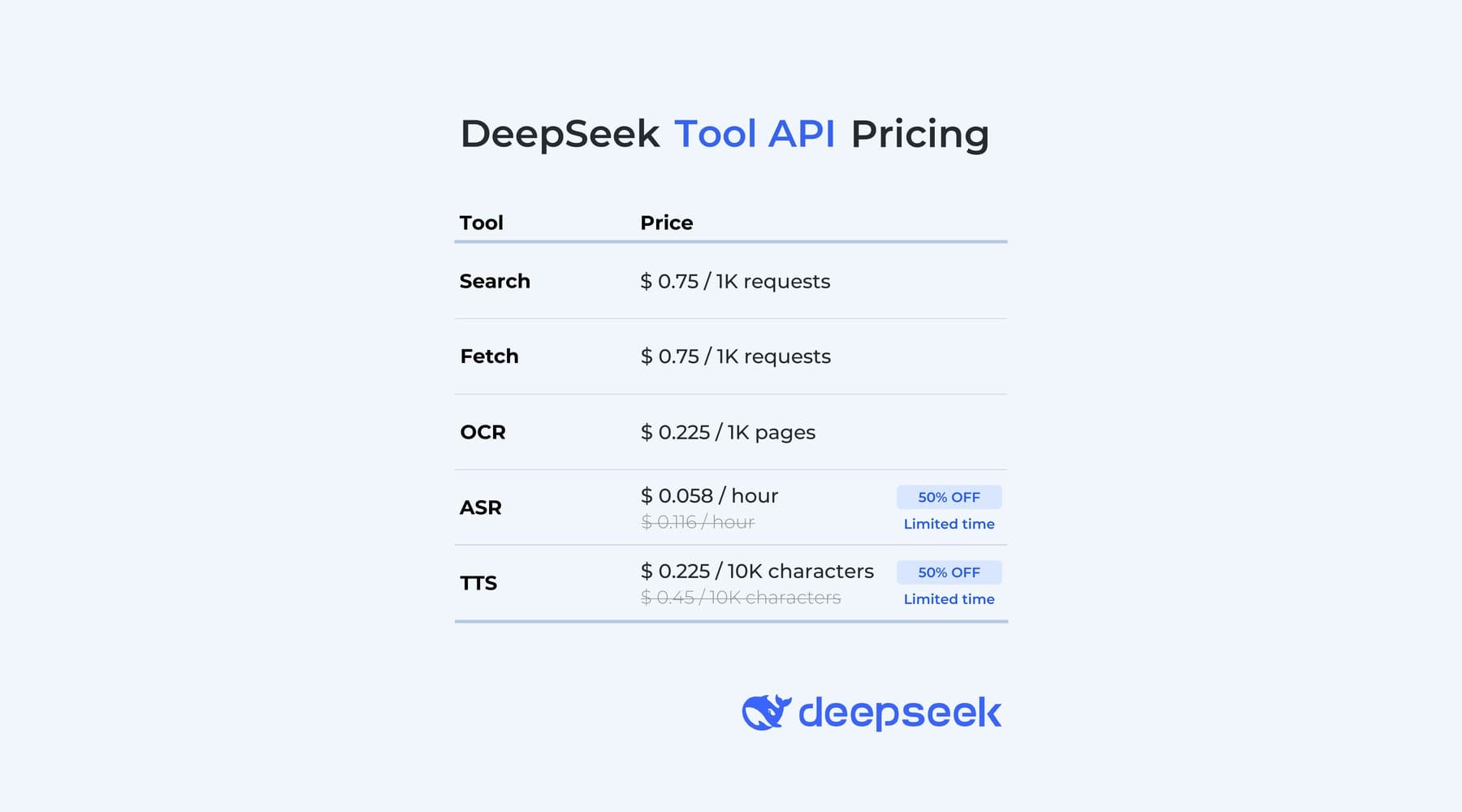
SaaS · Analysis · Sabeen Hartwell · Nov 14, 2026 · 10 min
DeepSeek API Tools: Search, OCR and Voice Pricing
DeepSeek now runs web search, URL reading, file parsing and safety checks server-side in its API, and sells Search, Fetch, OCR and voice as standalone endpoints. Search costs $0.75 per 1,000, about a thirteenth of Claude's and OpenAI's list price, but the tools come with real limits.
Read analysis →
SaaS · Analysis · Sabeen Hartwell · Nov 13, 2026 · 10 min
Gemini 4 Hydrogen Pricing: Twice Flash's Rate, Less per Task
Gemini 4 Hydrogen costs $1.50 per million input tokens and $7.50 per million output, double Gemini 3.8 Flash's rate until Flash matches it on January 1, 2027. Artificial Analysis estimates it costs far less per task. Here are the tiers, the numbers and the migration traps.
Read analysis →
SaaS · Analysis · Sabeen Hartwell · Nov 12, 2026 · 9 min
Gemini Decisions API: $0.10 Decisions, No Output Bill
Google's new Decisions API answers yes/no, choice and rubric questions with calibrated probabilities at $0.10 per million input tokens and no output bill. Here is what it costs against Haiku 5.5 and Flash-Lite, and where it fits.
Read analysis →
SaaS · Analysis · Sabeen Hartwell · Nov 11, 2026 · 10 min
Gemini 4 Carbon Pricing: Argon's Rate, Not Argon's Bill
Google priced Gemini 4 Carbon exactly like Argon: $2/$10 per million tokens until Nov 30, then $4/$20. But Carbon thinks longer, so cost per task differs. Here is the math, the Claude comparison and when to route to Carbon.
Read analysis →