SaaS · Analysis
Claude Text Watermark Now Covers Opus 4.6 and 4.5 Models
Anthropic extended its invisible text watermark to Claude Opus 4.6, Opus 4.5, Sonnet 4.5 and Haiku 4.5 on Nov 16, 2026. On older models, custom temperature, top_p or top_k may leave output unmarked.
Metarix Editorial · Nov 17, 2026 · 9 min read
- Claude
- Amazon Bedrock
- Grok
- Anthropic
- OpenAI
- SpaceXSI
- Google DeepMind
- Amazon Web Services
- SaaS Ecosystem & Business
- AI Agents & Coding
Documentation-based research
On this page
Since Nov 16, 2026, text from Claude Opus 4.6, Opus 4.5, Sonnet 4.5 and Haiku 4.5 carries Anthropic's invisible text watermark, according to the Claude Platform release notes. After this second retrofit wave, Anthropic's support table lists 19 watermarked Claude models, from Opus 3 to Fable 5.2. There is one catch builders need to know: on these older models, a request that sets temperature, top_p or top_k to a non-default value "might not" carry the watermark.
That matters in two opposite directions. If your company relies on Claude's mark for EU AI Act transparency, a low-temperature setting buried in a framework can quietly undo it. If you tuned sampling for consistent output, you now know exactly which models and API versions still let you do that. This piece covers what changed, who is affected, and what to do this week.
Quick answer
No code change is required for most apps: the watermark adds no tokens or characters, does not change the response format, and Anthropic says it doesn't change quality or price. If you need marked output (for your own compliance), remove temperature, top_p and top_k from requests to the six older models listed below, and check your SDK, framework and gateway for defaults they inject. Claude 4.7 and later models accept only default sampling values, so the caveat doesn't apply to them. Detection is not self-serve: Anthropic's watermark detection API is in private preview.
Scroll the table horizontally on smaller screens.
| Model group | Text watermark | Sampling caveat | Notes |
|---|---|---|---|
| Fable 5, 5.1, 5.2; Mythos 5, 5.1, 5.2 | Yes (first-party and cloud partners) | No | Fable 5.1 and Mythos 5.1 marked since their Sep 1 launch; Mythos 5 added Nov 3 |
| Opus 5.5, Opus 5, Opus 4.8, Sonnet 5.5, Sonnet 5, Haiku 5.5 | Yes | No | These accept only default sampling values |
| Opus 4.7 | Yes (since Nov 3) | No | Bedrock rollout flagged as possibly a few days later |
| Sonnet 4.6 | Yes (since Nov 3) | Yes | Non-default temperature, top_p or top_k may drop the mark |
| Opus 4.6, Opus 4.5, Sonnet 4.5, Haiku 4.5 | Yes (since Nov 16) | Yes | Bedrock may take a few extra days |
| Opus 3 (access on request) | Yes, first-party surfaces only | Yes | No cloud-partner text watermark listed |
What changed on Nov 16
The second retrofit wave
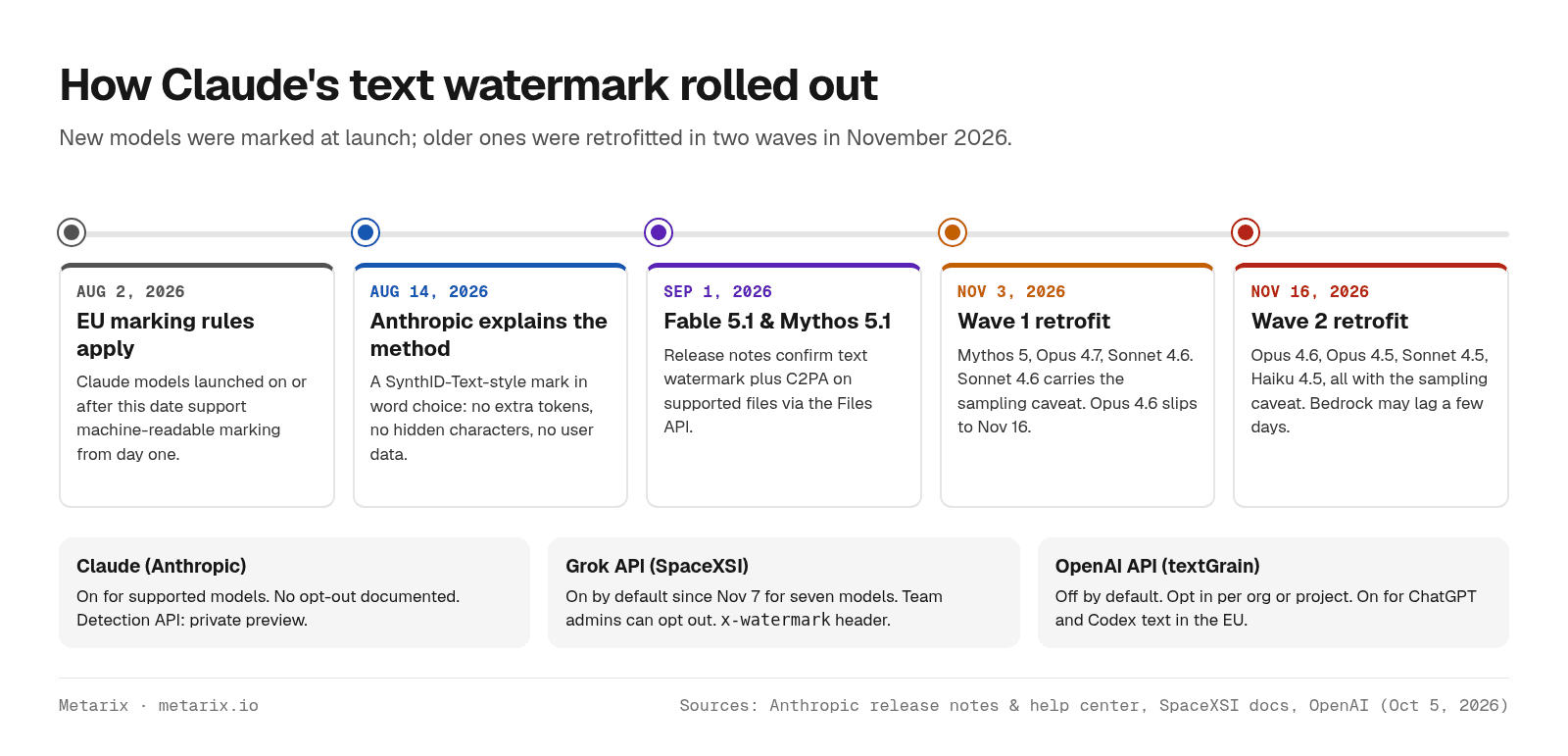
Anthropic's help-center page on marking says Claude models launched on or after Aug 2, 2026 support machine-readable marks from launch, and that the company is adding watermarks to models released before that date, as the EU's Code of Practice on transparency of AI-generated content allows a transition period for older systems. The first retrofit wave landed on Nov 3, when the release notes added Claude Mythos 5, Claude Opus 4.7 and Claude Sonnet 4.6. The Nov 16 entry adds Opus 4.6, Opus 4.5, Sonnet 4.5 and Haiku 4.5.
The Decoder reported that Anthropic's emails to API customers had originally put Opus 4.6 in the Nov 3 wave and later moved it to Nov 16 without giving a reason. Anthropic's public release notes simply list it on Nov 16.
The sampling caveat now covers six models
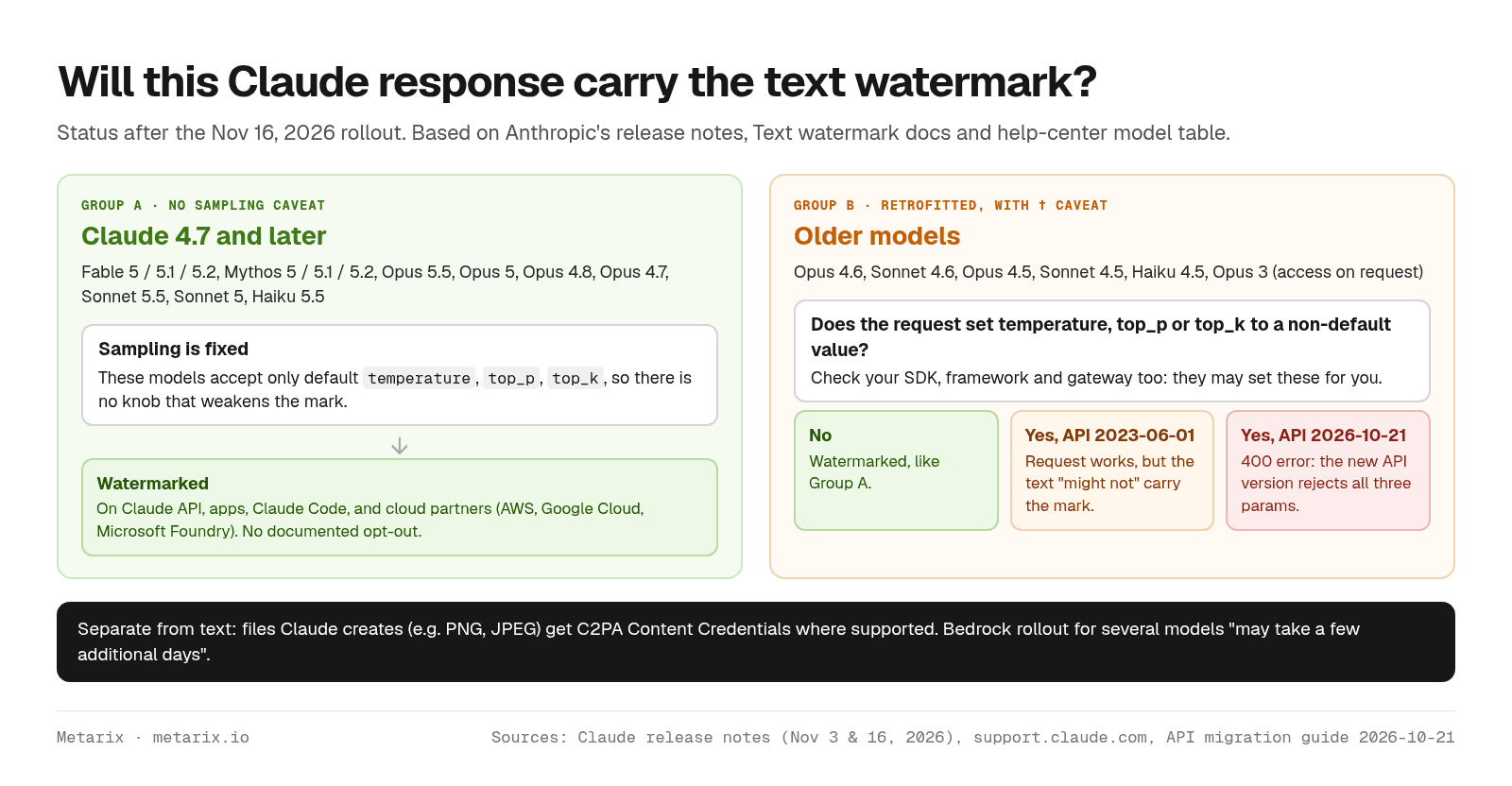
The Text watermark docs page applies its sampling warning to Opus 4.6, Sonnet 4.6, Opus 4.5, Sonnet 4.5, Haiku 4.5 and Opus 3. For those models, if a request sets any of the three sampling parameters to a non-default value, the output might not carry the watermark. Anthropic's advice is short: if you need the watermark, omit all three, and check whether your framework or client library sets them for you.
Where the mark applies
Because the watermark is applied at the model level, it applies on the Claude API, the Claude apps, Claude Code, Claude Cowork and Claude Tag, and, per Anthropic's table, to text from supported models served through AWS, Google Cloud and Microsoft Foundry. For several models the table carries an asterisk: rollout on Amazon Bedrock may take a few additional days. Separately, files Claude generates in supported formats get signed C2PA Content Credentials, which you can check with Anthropic's free Content Checker.
Why only older models have the loophole
The caveat lines up with a change in Anthropic's API. In the migration guide for API version 2026-10-21, any Messages or Message Batches request that sends temperature, top_p or top_k returns a 400 error, even at the default value, and the latest major SDK and CLI versions no longer expose the three parameters. The same guide says Claude 4.7 and later models already accept only the defaults.
So the gap stays open in one narrow place: an older model called on the older 2023-06-01 API version with a non-default sampling value. That is exactly the setup many production apps still have, because lowering temperature was a common way to get steadier classification, extraction or templated output from Sonnet 4.5 or Haiku 4.5.
Scroll the table horizontally on smaller screens.
| Setup | Can you lower temperature? | Watermark expected? |
|---|---|---|
| Claude 4.7+ model, any API version | No, defaults only | Yes |
| Older model, API 2026-10-21 | No, the request returns a 400 error | Yes (params can't be sent) |
| Older model, API 2023-06-01, params omitted | Not used | Yes |
| Older model, API 2023-06-01, non-default params | Yes | Not reliably ("might not") |
What it means for builders
Most teams need to do nothing. Responses look the same, cost the same and parse the same. The change matters for three groups.
- Teams that rely on the mark for compliance. If you deploy Claude in a product serving EU users and you count on Anthropic's watermark as part of your transparency approach, audit every request path to the six caveat models. Anthropic's help page also says you should independently assess what Article 50 of the AI Act requires of your own products.
- Teams that tuned sampling for consistency. If you lowered temperature on Haiku 4.5 or Sonnet 4.5 for steadier output, your setup still works on
2023-06-01, but that output may not be marked. Moving to2026-10-21or to a newer model takes that knob away in either case, so plan to get consistency from structured outputs, examples and evals instead. - Teams on Bedrock. Anthropic flags a possible delay of a few days on Amazon Bedrock. If you compare outputs across platforms during this week, don't assume parity yet.
A quick audit takes minutes. Search your code and config for the three parameter names, then log one real outgoing request body from each service, because gateways and agent frameworks can inject defaults you never wrote. The snippet below is illustrative, not a tested integration:
# 1) Find explicit sampling settings in code and configrg -n "temperature|top_p|top_k" src/ config/# 2) Python (anthropic SDK), illustrative: leave sampling at defaultsresp = client.messages.create( model="claude-haiku-4-5-20251001", max_tokens=1024, messages=[{"role": "user", "content": prompt}], # no temperature / top_p / top_k if you need the watermark)
There is also a calendar angle. Anthropic's deprecations page lists Sonnet 4.5 for retirement on Nov 30, 2026 (replacement: Sonnet 5.5), and Opus 4.5 as retiring not sooner than Nov 24, 2026. If you run either, migrating to a newer model fixes the retirement problem and the sampling caveat at once. For context on newer model pricing, see our Claude Fable 5.2 pricing analysis.
How Claude compares with Grok and OpenAI
All three big API providers now ship statistical text watermarks tied to the EU AI Act, but the defaults differ sharply. SpaceXSI turned on default watermarking for seven Grok API models on Nov 7, with an admin opt-out and an x-watermark response header (see our Grok API watermark analysis). OpenAI went the other way on Oct 5: its textGrain watermark is off by default in the API, customers can opt in per organization or project, and ChatGPT and Codex text in the EU gets the mark. Google DeepMind's SynthID watermarks text in the Gemini app and web experience; Anthropic says its own method is a version of the SynthID-Text approach published in Nature in 2024.
Scroll the table horizontally on smaller screens.
| Provider | API default | Opt-out or opt-in | How you can tell | Detector access |
|---|---|---|---|---|
| Anthropic (Claude) | On for all listed models | No opt-out documented; older models lose reliability with custom sampling | No response field documented | Private preview for eligible orgs |
| SpaceXSI (Grok API) | On for seven models since Nov 7, 2026 | Team admin opt-out in Console | x-watermark response header | By application |
| OpenAI (textGrain) | Off | Opt in per org or project, per model | No response field documented | Approved researchers and expert orgs |
For the regulatory backdrop and which AI Act deadlines moved, see our EU AI Act delay explainer. If you're choosing where to run Claude, our Claude API vs Bedrock vs Vertex AI comparison covers the platform trade-offs.
What the watermark can and can't do
Anthropic's explainer is candid about limits, and builders should read it before promising anything to customers or auditors:
- It is probabilistic. Detection estimates how likely it is that Claude was involved. Short passages carry little signal, and a missing mark proves nothing.
- Code and exact facts carry less of it. The mark only acts where several word choices are equally good, so code (comments aside), math and tight factual text are lightly marked.
- Light edits are not enough to remove it; full rewrites are. Anthropic says light editing probably won't remove the mark, while replacing every word will. Proofreading jobs leave little room for a mark at all.
- It carries no user data. Anthropic says the watermark can't be traced to a person, organization or chat.
- You can't verify it yourself yet. Watermark detection is in private preview for regulators, researchers, media and some enterprises with their own compliance needs.
Verdict
For most Claude users this is a non-event: no new parameter, no price change, no format change. The real action item is for teams with compliance exposure. If you rely on Claude's watermark, treat non-default temperature, top_p and top_k on Opus 4.6, Sonnet 4.6, Opus 4.5, Sonnet 4.5, Haiku 4.5 and Opus 3 as a bug, and verify what your gateway actually sends. If you rely on low temperature instead, know that the setting only survives on older models and the old API version, so start moving consistency into schemas and evals now.
Longer term, the simplest path is migration: Claude 4.7 and later models are always marked and never accept custom sampling, which removes the ambiguity entirely. With Sonnet 4.5 retiring on Nov 30, many teams will make that move this month anyway.
Sources
- Anthropic: Claude Platform release notes (entries for Nov 16 and Nov 3, 2026)
- Anthropic: Text watermark (accessed Nov 17, 2026)
- Anthropic: How Claude marks AI-generated content (help center, accessed Nov 17, 2026)
- Anthropic: How Claude's text watermark works (Aug 14, 2026, updated Sep 1, 2026)
- Anthropic: Migrating to API version 2026-10-21 and Model deprecations (accessed Nov 17, 2026)
- OpenAI: Our approach to EU text provenance rules (Oct 5, 2026)
- Google DeepMind: SynthID and Dathathri et al., Nature, 2024
- The Decoder: Anthropic's text watermark is easy to bypass on several older Claude models (Oct 31, 2026, updated Nov 4, 2026)
Tools covered in this article
Frequently asked questions
- Does Claude watermark its text output?
- Yes. Text from supported Claude models carries an invisible statistical watermark in word choice. Since Nov 16, 2026 that includes Opus 4.6, Opus 4.5, Sonnet 4.5 and Haiku 4.5, alongside newer models such as Opus 4.7 and later, Fable and Mythos.
- Can I turn off the Claude watermark?
- Anthropic documents no opt-out. On six older models (Opus 4.6, Sonnet 4.6, Opus 4.5, Sonnet 4.5, Haiku 4.5 and Opus 3), a non-default temperature, top_p or top_k means the text might not carry the mark, but that is a reliability caveat, not a supported off switch.
- Does the Claude watermark cost extra or change responses?
- No. Anthropic says the watermark adds no tokens or hidden characters, carries no user or organization data, and doesn't change the request or response format or the price.
- How can I check if text was written by Claude?
- Watermark detection is in private preview for eligible organizations such as regulators, researchers, media and some enterprises with compliance needs. Anyone can check files for Claude's C2PA Content Credentials with Anthropic's free Content Checker.
- Is the watermark on Claude models in Amazon Bedrock?
- Anthropic's table lists cloud-partner watermarking for supported models on AWS, Google Cloud and Microsoft Foundry, but notes that rollout on Amazon Bedrock may take a few additional days for several models, including the Nov 16 wave.