SaaS · Analysis
GitLab Duo Credits Go 2x Further, but Allowances Shrink
GitLab's new request-size pricing makes Duo Agent Platform credits go up to twice as far, but included Premium and Ultimate credits drop by a third on January 1, 2027. Here's who wins and whether to opt in before December 18.
Sabeen Hartwell · Nov 20, 2026 · Updated Nov 22, 2026 · 10 min read
- GitLab Duo Agent Platform
- GitHub Copilot
- GitLab
- GitHub
- SaaS Ecosystem & Business
- Developer & Productivity Tools
Documentation-based research
On this page
GitLab changed how Duo Agent Platform bills agent work on November 19, 2026. Under the new request-size pricing, short model calls and prompt-cached calls count as less than a full request, and GitLab says most customers' credits will now go up to twice as far. In its own example, a 500-person team's monthly bill falls from 100,086 to 47,218 credits.
There's a second change in the same post. From January 1, 2027, the free promotional credits bundled with existing Premium and Ultimate seats drop by a third. Agent-heavy teams still come out ahead. Teams that mostly use flat-rate features like Code Review Flow don't. Here's the math, who wins, and what to do before the December 18 switchover. Prices as of Nov 20, 2026.
Quick verdict
If your developers use Agentic Chat, Duo Developer or custom agents, opt in now: GitLab's example shows those features using 48% to 75% fewer credits, which more than covers the smaller included allowance. If most of your credit spend goes to Code Review Flow, SAST flows or Code Suggestions, nothing gets cheaper, so ask your account team in writing what opting out preserves before you decide. Either way, check model choice. GitLab's per-model rates differ by more than 10x per call, a much bigger lever than this 2x.
Scroll the table horizontally on smaller screens.
| Item | Before Nov 19, 2026 | After | Source |
|---|---|---|---|
| How a model call is counted | Each LLM call is a full request | Calls with fewer tokens or prompt-cache tokens count as less than a full request | GitLab Credits docs |
| GitLab's 500-person example | 100,086 credits a month | 47,218 credits a month (2.1x further) | GitLab blog |
| Flat-rate features (Code Suggestions, Code Review Flow, SAST flows) | Fixed credits per execution | Unchanged | GitLab blog |
| Self-hosted models | 8 requests per credit | Unchanged | GitLab blog and docs |
| Included credits, Premium seat | 12 per user per month (existing customers) | 8 from Jan 1, 2027; new customers get 8 now | GitLab Promotions Terms |
| Included credits, Ultimate seat | 24 per user per month (existing customers) | 16 from Jan 1, 2027; new customers get 16 now | GitLab Promotions Terms |
| On-demand credits | $1 per credit list price | $1 per credit list price | GitLab Credits docs |
| Switchover | n/a | New subscriptions from Nov 19; existing ones by default on Dec 18, 2026, or opt in earlier (one-way) | GitLab Credits docs |
What GitLab announced on November 19
- Fewer billable requests per task. GitLab says each task given to agents and flows now results in fewer model requests, and enabling prompt caching cuts them further. The credits documentation describes the mechanism: for GitLab-managed models, model calls with fewer tokens, and calls that use prompt-cache tokens, count as less than a full request (GitLab Credits docs).
- The per-model rate table is now a ceiling. Each model still has a published number of calls per credit, but that number is now the rate for a full-size request. A short follow-up message to Agentic Chat costs less than one long, context-heavy call on the same model (GitLab Credits docs).
- Flat-rate features are excluded. Code Review Flow, SAST flows and Code Suggestions stay billed per execution, and self-hosted models stay at 8 requests per credit (GitLab blog).
- A smaller free allowance. The promotional credits included with every Premium and Ultimate seat change to 8 and 16 credits a month from January 1, 2027. GitLab's promotion terms say subscriptions that started before November 19, 2026 keep 12 (Premium) and 24 (Ultimate) credits per user through December 31, 2026 (GitLab Promotions Terms).
- New spend tooling around it. GitLab points to per-user credit caps (GitLab 19.4), the Duo Agent Platform Impact dashboard (GitLab 19.5) and self-service usage views for individual users on GitLab.com (GitLab blog).
Where the savings come from
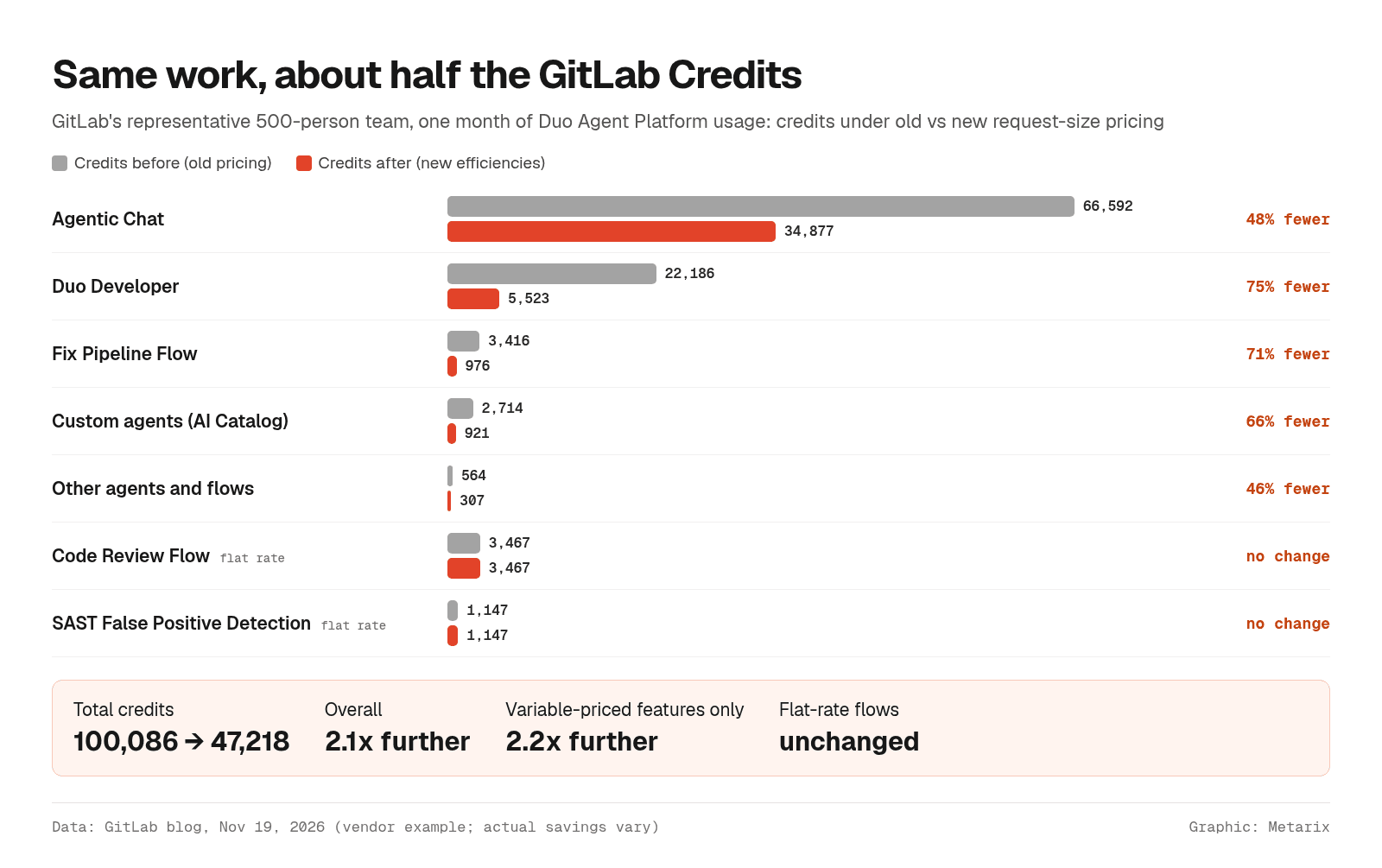
GitLab published a representative month for a real 500-person team. The savings are uneven. Long, context-heavy agent sessions gain the most, chat gains about half, and flat-rate flows gain nothing.
Scroll the table horizontally on smaller screens.
| Feature | Credits before | Credits after | Change |
|---|---|---|---|
| Agentic Chat | 66,592 | 34,877 | 48% fewer (1.9x) |
| Duo Developer | 22,186 | 5,523 | 75% fewer (4.0x) |
| Fix Pipeline Flow | 3,416 | 976 | 71% fewer (3.5x) |
| Custom agents (AI Catalog) | 2,714 | 921 | 66% fewer (2.9x) |
| Other agents and flows | 564 | 307 | 46% fewer (1.8x) |
| Code Review Flow (flat rate) | 3,467 | 3,467 | No change |
| SAST False Positive Detection (flat rate) | 1,147 | 1,147 | No change |
| Total | 100,086 | 47,218 | 53% fewer (2.1x) |
Duo Developer, which turns an issue into a merge request, shows the biggest drop. GitLab says these long sessions benefit most, especially with prompt caching on, which fits how the new counting works: an agent that re-sends a large, mostly unchanged context on every step was paying full price for cached tokens before.
Treat the 2x as a vendor example, not a promise. The table is one team's mix, and GitLab's own wording is "up to" twice as far. Your account team can model your recent usage under the new pricing, and that's the number to plan with.
The catch: included credits shrink by a third
Every Premium and Ultimate seat comes with promotional credits for AI features. GitLab's pricing page now lists $8 of included credits per Premium user and $16 per Ultimate user per month, down from the 12 and 24 that existing customers get through the end of 2026. The terms also say this promotion is not a contractual entitlement and its end date will be announced later (GitLab pricing, Promotions Terms).
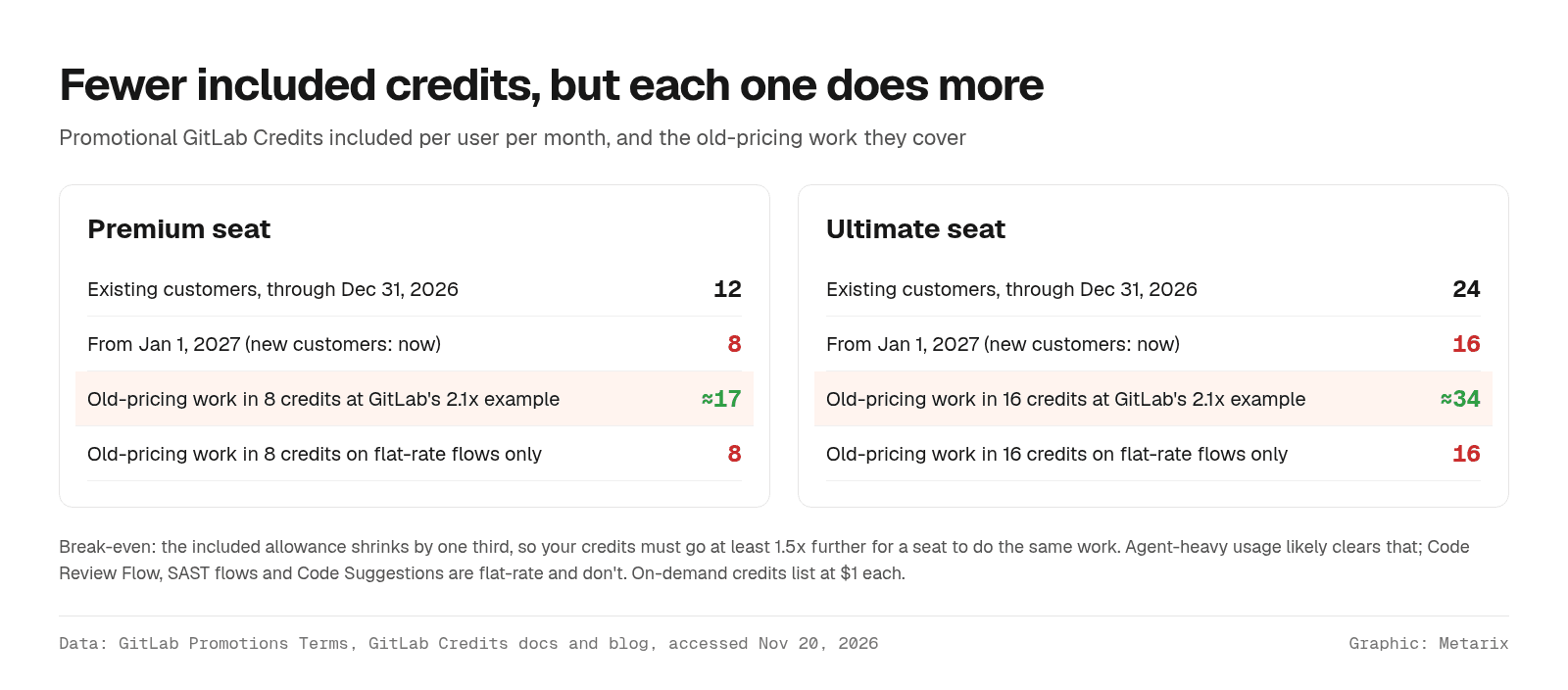
The break-even is simple. The allowance falls by one third, so your work needs to cost at least a third less in credits, which means credits going 1.5x further, for a seat to do the same amount with its free credits. GitLab's example clears that easily at 2.1x. A team that only runs Code Review Flow doesn't clear it at all. Code Review Flow costs a quarter of a credit per review (4 executions per credit), so a Premium seat's free allowance covers 48 reviews a month in December and 32 from January.
A worked example at list price
This is an illustration, not a quote. Take GitLab's 500-person example, assume every user is on Premium, and price everything above the included credits at the $1 on-demand list price, ignoring commitment-pool discounts:
Scroll the table horizontally on smaller screens.
| Scenario | Credits used | Included credits | Billable credits | At $1 list |
|---|---|---|---|---|
| December, old pricing | 100,086 | 6,000 (12 x 500) | 94,086 | $94,086 |
| January, new pricing | 47,218 | 4,000 (8 x 500) | 43,218 | $43,218 |
For a team this heavy, the included credits are a rounding error, and the request-size change is what moves the bill. For a small team that mostly stays inside its free allowance, the reverse is true: losing a third of the allowance can matter more than the efficiency gain.
Should existing customers opt in early?
Subscriptions that started before November 19 move to the new pricing automatically on December 18, 2026. Until then a billing account manager can opt in early, and opting in can't be undone. Alternatively, you can opt out. GitLab's blog says opting out before December 18 keeps your current terms and included credits until your next renewal or for 12 months, whichever comes first (GitLab blog, Credits docs).
One thing needs checking. The promotions terms separately say pre-November 19 subscriptions get the reduced 8 and 16 credits from January 1, 2027. If preserving the larger allowance is your reason to opt out, get your account team to confirm in writing which applies to your contract.
- Opt in now if Agentic Chat, Duo Developer, Fix Pipeline or custom agents make up most of your credit use. Every week before December 18 is a week at the old, higher rate.
- Consider opting out if your spend is mostly Code Review Flow, SAST flows or Code Suggestions, which don't get cheaper, and if your contract confirms you keep the larger allowance.
- Wait and measure if you're unsure. Ask your account team for the comparison GitLab offers, which shows your recent usage under the new pricing, then decide before December 18.
To opt in, sign in to the Customers Portal, open the GitLab Credits dashboard for the subscription, and select Switch to request-size pricing on the banner (GitLab Credits dashboard docs).
Model choice still matters more than 2x
The new counting changes how much of each request you pay for. It doesn't change the per-model rates, and those vary much more. On GitLab's table, one credit buys 8 full calls to Claude Haiku 5.5, 3.2 to Claude Sonnet 5.5, 2.86 to GPT-6.2 Sol (short context), 1.35 to Claude Opus 5.5, 0.75 to Claude Fable 5.2 and 0.67 to GPT-6.2 Astra (GitLab Credits docs).
Scroll the table horizontally on smaller screens.
| Model | Calls per credit | Note |
|---|---|---|
| claude-haiku-5.5 | 8.0 | Single rate |
| claude-sonnet-5.5 | 3.2 | Single rate |
| gpt-6.2-sol | 2.86 / 1.54 | Up to / over 272K tokens |
| gemini-4-carbon | 2.86 | Promo until Nov 30, 2026; about 1.33 afterwards |
| claude-opus-5.5 | 1.35 | Single rate |
| claude-fable-5.2 | 0.75 | Single rate |
| gpt-6.2-astra | 0.67 / 0.38 | Up to / over 272K tokens |
| Any supported self-hosted model | 8.0 | Unchanged by this update |
Moving routine chat from Opus 5.5 to Sonnet 5.5 alone more than doubles the calls per credit, and a frontier model on long context costs about 20 times a small model. Watch the promotional rates too: Gemini 4 Carbon and Argon drop to about 1.33 calls per credit after November 30. For how the underlying vendors price and limit these models, see our LLM API rate limits comparison.
Get the most out of each credit
- Keep prompt caching on. It's on by default. A top-level group Owner can check it under Settings > GitLab Duo > Change configuration > Data and privacy (GitLab docs). Cached calls now cost less than a full request, so turning caching off now costs you credits as well as latency.
- Set per-user caps before rolling out more agents. The credit caps page takes a default cap plus per-user overrides, and accepts a CSV paste (dashboard docs).
- Pick models per workflow, not per company. Use the cheaper premium models for chat and triage, and save Opus- or Astra-class models for work that fails without them.
- Read failures correctly. On GitLab.com with GitLab-managed models, a flow that fails before it completes deducts no credits. On Self-Managed with self-hosted models, calls are billed as they start, and flat-priced flows charge in full even when they fail.
Illustrative credit-cap override list in the CSV format GitLab documents (usernames are placeholders; caps are credits per month):
username,cap,enabledjsmith,40,truebuild-bot,200,truecontractor-a,0,false
Same day, same direction: Sourcegraph and Copilot
GitLab wasn't the only developer platform cutting credit costs on November 19. Sourcegraph cut Deep Search from 70 to 50 credits, Code Finder calls over MCP from 11 to 3, and made Smart Hovers free. It also started billing service accounts that do searches like human users, which can raise costs for teams that run agents through bot accounts (Sourcegraph). GitHub Copilot, by contrast, already bills by tokens at each model's rate, with 1 AI credit equal to $0.01 (GitHub docs).
Scroll the table horizontally on smaller screens.
| Platform | Unit | Included with seat | What changed Nov 19 |
|---|---|---|---|
| GitLab Duo Agent Platform | GitLab Credit, $1 on-demand list | 8 (Premium) / 16 (Ultimate) per user per month for new subscriptions | Request-size pricing; up to 2x further |
| Sourcegraph | Sourcegraph credits | Per agreement | Deep Search 70 to 50, Code Finder MCP 11 to 3; service accounts billed like users |
| GitHub Copilot Business | GitHub AI Credit, $0.01 | 1,900 credits ($19) per user per month, pooled | No change; token-based since mid-2026 |
The pattern is the same everywhere: model prices are falling, agents are burning more tokens, and vendors are passing some of the savings on while tightening what's free. Budget per task, not per seat. For per-review costs across vendors, see our AI code review tools comparison, and for terminal agents that work against any Git host, our AI CLI coding agents roundup.
Update, Nov 22, 2026: Hugging Face has made a bigger move on seat pricing, listing its Enterprise plan at $500 per user per month, ten times the earlier $50. Our Hugging Face Enterprise pricing breakdown runs the seat math.
Verdict
This is a real price cut for the work most teams buy Duo Agent Platform for. In GitLab's own example, long agent sessions like Duo Developer cost a quarter of what they did, and the total bill roughly halves. That's large enough to outweigh the smaller free allowance for any team that uses agents in earnest, so opt in rather than waiting for December 18.
The exceptions are teams whose credits mostly go to flat-rate reviews and scans, and small teams living inside the free allowance. For them, January 1 is effectively a price rise, and the opt-out terms are worth pinning down in writing. Whichever group you're in, the bigger lever is model routing, and caching and per-user caps are what keep the savings from turning into extra usage.
Sources
- GitLab: Duo Agent Platform now does up to 2x more per GitLab Credit (Nov 19, 2026)
- GitLab Docs: GitLab Credits and GitLab Credits dashboard (accessed Nov 20, 2026)
- GitLab: Promotions Terms and Conditions and GitLab pricing (accessed Nov 20, 2026)
- GitLab Docs: GitLab Duo data usage and prompt caching (accessed Nov 20, 2026)
- Sourcegraph: We're lowering credit costs (Nov 19, 2026)
- GitHub Docs: Plans for GitHub Copilot and Models and pricing for GitHub Copilot (accessed Nov 20, 2026)
Tools covered in this article
Frequently asked questions
- How much does a GitLab Credit cost?
- On-demand GitLab Credits list at $1 per credit, billed monthly after included and committed credits are used up. Teams can also buy a monthly commitment pool on an annual or multi-year term, which GitLab offers with tiered discounts. Prices as of November 20, 2026.
- How many GitLab Credits are included with Premium and Ultimate?
- New Premium and Ultimate subscriptions include 8 and 16 promotional credits per user per month. Subscriptions that started before November 19, 2026 get 12 and 24 through December 31, 2026, then the lower amounts from January 1, 2027. Included credits are per user, don't pool, and don't roll over.
- What is GitLab request-size pricing?
- It's the new way Duo Agent Platform counts model calls. Calls with fewer tokens, and calls that use prompt-cache tokens, count as less than a full request instead of one full request each. GitLab says this makes most customers' credits go up to twice as far. Flat-rate features and self-hosted models are unchanged.
- When do existing GitLab customers move to the new credit pricing?
- Automatically on December 18, 2026. Before then a billing account manager can opt in early from the GitLab Credits dashboard in the Customers Portal, which can't be undone, or opt out to keep current terms until the next renewal or for 12 months, whichever comes first.
- Does GitLab Code Review Flow get cheaper?
- No. Code Review Flow, the SAST flows and Code Suggestions are billed at a flat rate per execution, so the November 19 change doesn't affect them. Code Review Flow runs 4 executions per credit on GitLab-managed models and 5 on self-hosted models.