Benchmarks & Deep Dives · Free
MTEB
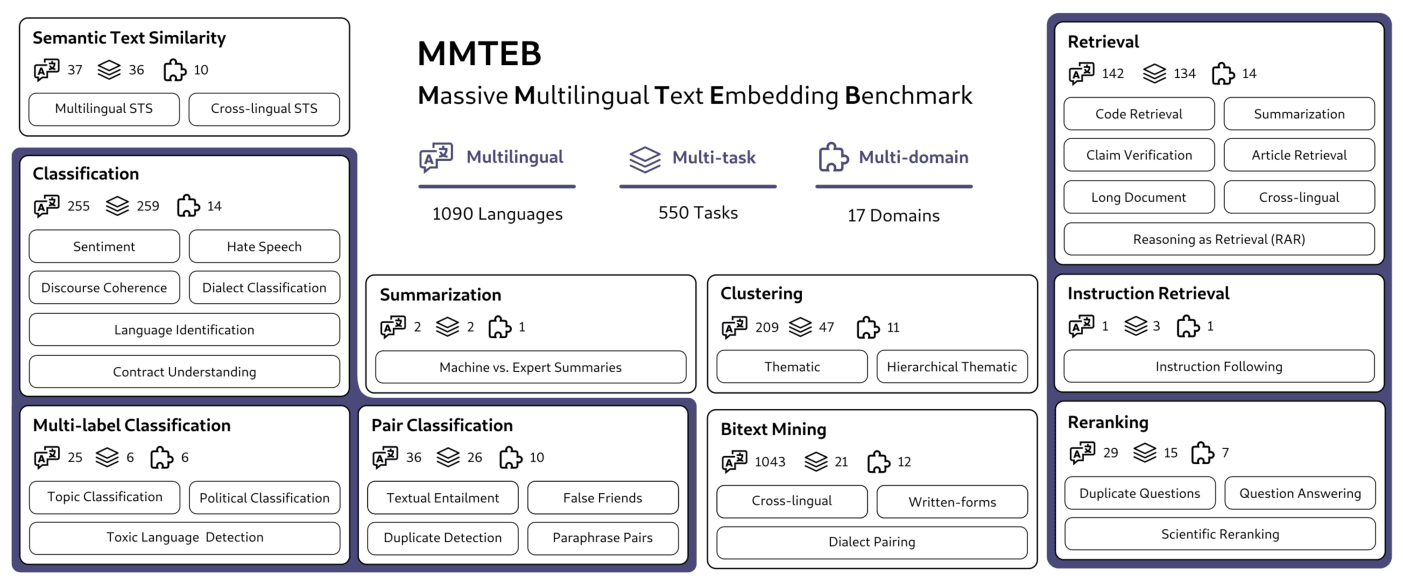
MTEB, the Massive Text Embedding Benchmark, is an open-source benchmark and Python toolkit for evaluating text embedding models, with a public leaderboard hosted on Hugging Face. It was introduced in the 2022 paper "MTEB: Massive Text Embedding Benchmark" (arXiv 2210.07316) by Niklas Muennighoff, Nouamane Tazi, Loïc Magne and Nils Reimers, and heavily expanded by the community in "MMTEB: Massive Multilingual Text Embedding Benchmark" (arXiv 2502.13595, accepted at ICLR). The code lives in the embeddings-benchmark/mteb repository on GitHub under the Apache 2.0 license and is published on PyPI as the mteb package.
What it measures: how well an embedding model's vectors work across many kinds of tasks, not just one. The original release covered 8 task types, 58 datasets and 112 languages. The MMTEB expansion grew the collection to more than 500 quality-controlled tasks across 250+ languages, adding instruction following, long-document retrieval and code retrieval. Task types include retrieval, reranking, classification, multi-label classification, clustering, pair classification, semantic textual similarity (STS), bitext mining and summarization.
Benchmarks inside MTEB: the toolkit packages many named benchmarks, each a fixed set of tasks. Common ones are MTEB(eng, v2) for English, MTEB(Multilingual, v2) for broad language coverage, MTEB(Code, v1) for code search, regional and language-specific suites, and RTEB for retrieval in specialized domains such as law, finance, code and healthcare. MTEB(eng, v2) is designed as a zero-shot benchmark: it removes datasets such as MS MARCO that many models are trained on, and the maintainers recommend it over MTEB(eng, v1), which also had a known scoring bug. The project has since grown to cover image, audio and video embedding benchmarks as well.
How the leaderboard ranks models: it shows the mean score across tasks, the mean across task types, and per-type columns, and it ranks models with a Borda count, treating each task as a voter. Scores from different benchmarks or versions are not comparable with each other.
Who it is for: developers choosing an embedding model for search, retrieval-augmented generation (RAG), classification or clustering; model builders reporting results; and researchers. Most production teams use the leaderboard to build a shortlist and then test finalists on their own data, since a general benchmark can't capture a specific corpus.
How to use it: install with pip install mteb, load a model with mteb.get_model, pick tasks or a benchmark with mteb.get_tasks or mteb.get_benchmark, and run mteb.evaluate. A command-line interface (mteb run) does the same.
Pricing type: free and open source.
Alternatives: BEIR for zero-shot retrieval, task-specific benchmarks such as BRIGHT for reasoning-heavy retrieval or LongEmbed for long documents, and in-house evaluation sets built from your own queries.
Official site: https://github.com/embeddings-benchmark/mteb