Cloud · Analysis
OpenRouter Pulls 125 Endpoints From Zero Data Retention
OpenRouter off-boarded three inference providers and pulled 125 endpoints from Zero Data Retention after Dragos showed prompts, including ZDR-flagged ones, were stolen or forwarded. Here's which requests to treat as exposed and the routing settings to tighten.
Nalini Groves · Nov 23, 2026 · 10 min read
Documentation-based research
On this page
OpenRouter has off-boarded three inference providers and removed 125 endpoints from its Zero Data Retention (ZDR) eligibility after security researchers at Dragos showed that prompts sent through several providers were stolen, forwarded or read, including requests flagged as ZDR. OpenRouter says it wasn't breached itself, and it has notified potentially affected customers.
If you route models through OpenRouter or any other gateway, two things change today: the set of endpoints your ZDR-enforced traffic can reach just got smaller, and "ZDR" on a router is now clearly a routing filter, not an end-to-end guarantee. Below: what OpenRouter changed, what each provider has disclosed, which requests to treat as exposed, and the settings worth tightening this week.
Quick verdict
Don't panic-migrate, but do act. Check your email and OpenRouter account for a notification, then rotate any credential that ever went into a prompt sent to the models and windows listed below. Turn on ZDR per model group at the account or guardrail level instead of relying on per-request flags, pin providers you trust with only and allow_fallbacks: false for sensitive traffic, and stop putting live secrets in prompts at all. For the most sensitive workloads, a first-party API under your own contract, or self-hosting, now has a clearer case.
Scroll the table horizontally on smaller screens.
| Action | Status | What it means for you |
|---|---|---|
| Off-boarded three providers | Done | Those providers no longer serve OpenRouter traffic; OpenRouter didn't name them |
| Removed 125 endpoints from ZDR eligibility | Done | ZDR-enforced requests can no longer route to them; some model and provider pairs may drop out of your ZDR pool |
| Notified potentially affected customers | Done | Check the email tied to your OpenRouter account |
| Continuous canary-style testing of providers | Underway | Adapted from the researchers' method |
| Network-path verification for undisclosed forwarding | Underway | Looks for requests passed on to third parties |
| Assurances and validation before restoring ZDR | Required | Removed endpoints stay out of ZDR until re-verified |
What OpenRouter changed
In its incident notice, dated November 22, OpenRouter says researchers reported earlier in the week that "certain inference providers had data compromised or otherwise shown evidence that their data policies were not being upheld." Its response has three completed parts and three in progress. The 125 endpoints pulled from ZDR include the providers the researchers flagged plus others removed as a precaution, and none of them gets ZDR status back without "appropriate assurances and validation."
The notice also keeps a live list of provider security posts. As of November 23 it links four: Atlas Cloud, Novita, Phala and Together. That list isn't the same as the three off-boarded providers. OpenRouter hasn't said which three those are, hasn't published the list of 125 endpoints, and notes that not every affected provider has posted publicly.
Why the ZDR change matters in practice: per OpenRouter's ZDR docs, ZDR enforcement only lets a request route to endpoints marked ZDR (plus Safety Retention endpoints, if your settings allow them). When 125 endpoints lose that mark, ZDR-enforced traffic has fewer places to go. Depending on the model, that can mean fewer fallbacks, a different price or latency profile, or a model that isn't reachable under ZDR at all until endpoints are restored. Check the models you depend on rather than assuming nothing moved.
What the Dragos research found
The trigger is a November 19 report by HD Moore, Dragos's chief research officer. From July through November 2026, the team sent roughly two million prompts carrying unique canary tokens (AWS keys, hostnames and URLs that exist nowhere else) to widely used AI services, then watched who used them. Any hit proves someone, somewhere, read that prompt. The findings below are Dragos's, as reported; providers are mostly unnamed in the report.
- Three providers were breached. Attackers were stealing request data inside three hosting providers, the earliest from mid-July, and none of them knew until Dragos told them. In the largest case, every request sent during a few late-October windows was stolen, including requests the provider rejected before a model ran, which points to copying at the front door. In the other two, some stolen requests were flagged ZDR.
- Stolen keys were used fast. Planted AWS keys were tested within hours in some cases, then used to list S3 buckets, search Secrets Manager and Parameter Store, try to enable Bedrock models, create Bedrock API keys and add IAM users: tens of thousands of AWS API calls in total.
- Marketplace sellers harvested prompts. On one inference marketplace, sellers listed models at the lowest price, turned on request logging and waited. Dragos also found a router quietly forwarding some traffic to that marketplace, a hop customers weren't told about.
- Privacy flags were ignored. A Chinese AI lab's systems fetched secret URLs from more than half of the prompts sent to its models between July and October, including about two-thirds of those marked no-data-collection or ZDR, and prompts sent to U.S. hosts reselling that lab's models triggered the same scraper.
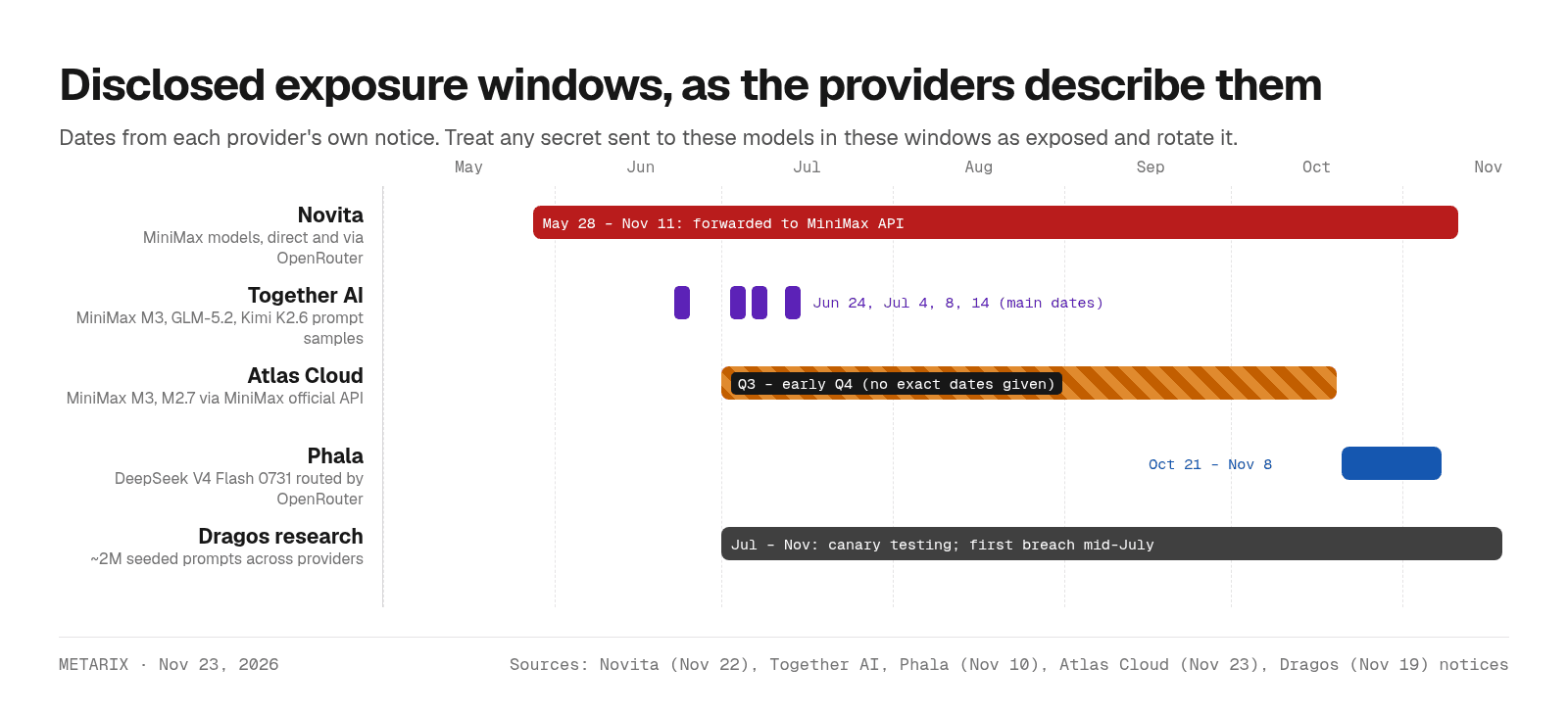
Dragos's own summary is the line every platform team should take away: "a privacy flag only binds the first hop."
What each provider has disclosed
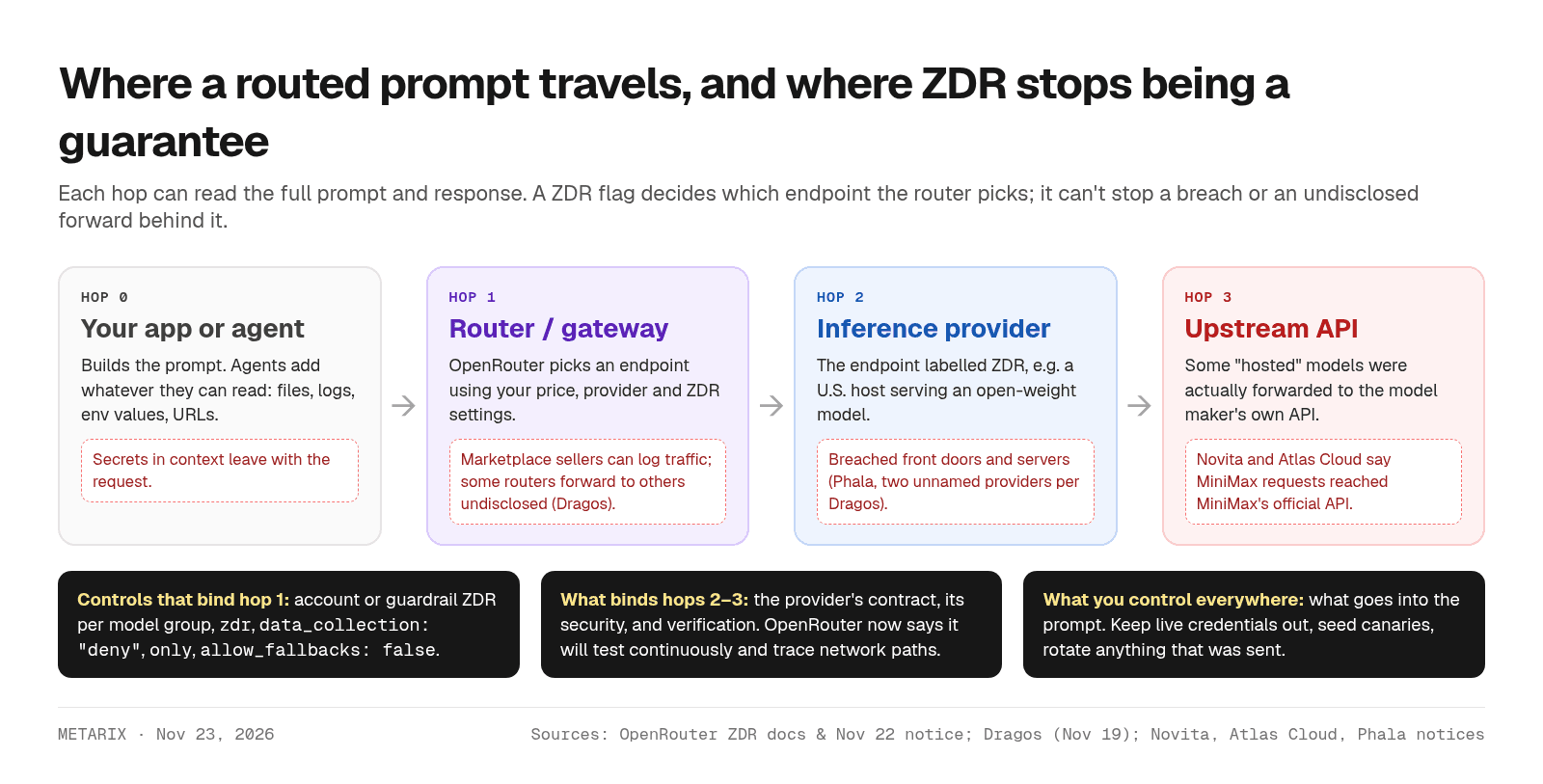
Four providers linked from OpenRouter's notice have published their own accounts. They describe different failures, so the action you need depends on which models you used and when.
Scroll the table horizontally on smaller screens.
| Provider | What happened (their account) | Affected requests | What they ask you to do |
|---|---|---|---|
| Novita (Nov 22) | A routing configuration issue sent some MiniMax requests to MiniMax's official API instead of Novita-hosted infrastructure | MiniMax models via Novita, directly or through OpenRouter, May 28 to Nov 11, 2026 | Revoke or rotate any live credentials or secrets sent in those requests |
| Atlas Cloud (Nov 23) | Testing showed a third party opened links from prompts sent to MiniMax's official API; Atlas says the access didn't happen on its infrastructure | MiniMax M3, M2.7 or M3.1 Flash on Atlas Cloud (M3 and M2.7 prompts in Q3 and early Q4 2026) | Treat any secret sent to these models as exposed; revoke credentials, tokens and links |
| Phala (Nov 10) | An attacker took control of an inference VM and could see in-flight request data; contained Nov 8 | DeepSeek V4 Flash 0731 requests routed to Phala by OpenRouter, Oct 21 00:00 UTC to Nov 8 05:35 UTC | Treat contents as exposed; rotate keys, tokens and passwords in those requests |
| Together AI | Stored prompt samples in a private Hugging Face repo were downloaded after an AI coding agent committed the repo credential to a public GitHub repo | Samples from MiniMax M3, GLM-5.2 and Kimi K2.6 requests, mainly Jun 24, Jul 4, 8 and 14, 2026 | Enable ZDR in account settings if you handle sensitive prompts; contact [email protected] |
Two details stand out. First, Novita and Atlas Cloud both trace their problem to MiniMax requests reaching MiniMax's own API. Atlas has stopped sending any request there and says MiniMax models stay available only where it hosts them or the host confirms requests don't reach that API. Atlas also says it took every one of its models off OpenRouter while it tests them, and that this was its own decision, not OpenRouter's.
Second, Together AI's leak (company profile) started with an AI coding agent. During work on its public xorl repository, an agent committed a credential for the private repository holding the prompt samples. Together's scanning caught it and the commit was reverted, but during the exposure window an unauthorized party obtained the credential, downloaded the samples, then searched the samples for other credentials; five of the ones tested were Dragos canaries. Together's fixes include scoped or short-lived credentials, credential checks on every pull request, ZDR by default for new accounts, and new rules for how its engineers use coding agents.
What to do this week if you route through OpenRouter
1. Find out whether you're affected
Look for OpenRouter's customer notification, then check your usage history for the models and windows in the table above. If you sent any of them prompts containing API keys, database URLs, tokens, passwords or private links, rotate those now. Phala's and Atlas Cloud's guidance is the same: treat the contents as exposed.
2. Enforce ZDR where it can't be forgotten
OpenRouter lets you enforce ZDR in account privacy settings, per guardrail, or per request, and per model group (Anthropic, OpenAI, Google, SpaceXSI and all other models). The request-level zdr flag only adds enforcement; it can't switch off an account or guardrail rule. That makes account or guardrail settings the safer default, because one forgotten flag in one service won't route sensitive traffic to a retaining endpoint. Decide explicitly whether to allow Safety Retention endpoints: self-serve accounts allow them unless you choose otherwise, and they don't meet a strict ZDR requirement.
3. Pin providers for sensitive traffic
The provider selection options let you narrow routing yourself instead of accepting the default pool. This illustrative request body (not a tested configuration; replace the model and provider slugs with ones you've vetted) restricts a call to named providers, refuses fallbacks and requires ZDR:
{ "model": "<model-slug>", "input": "...", "provider": { "only": ["<vetted-provider-slug>"], "allow_fallbacks": false, "data_collection": "deny", "zdr": true }}
The trade-off is availability: with fallbacks off, the request fails if your chosen provider is down. That's often the right failure mode for regulated or secret-bearing traffic, and the wrong one for a public chatbot. Split them by API key or guardrail.
4. Remember what ZDR doesn't cover
OpenRouter's docs say ZDR enforcement applies to provider routing for inference, not to plugins and tools you enable, such as web search, which may run on third-party services with their own retention policies. If an agent's tool calls carry the same sensitive context, those paths need their own review.
5. Keep secrets out of prompts, and seed canaries
Every incident here turned on the same thing: prompts contained secrets worth stealing. Coding agents are the main way they get in, because they read .env files, logs and configs and pass them along. Our guide to stopping AI coding agents leaking secrets covers masking and scoped credentials, and GitHub's public secret-leak monitoring covers the repo side, which is exactly where Together's credential escaped. Dragos also recommends planting your own fake credential in the context your agents already send; a free Thinkst Canarytoken is enough to start, and any use of it is an incident.
Router, direct API or self-hosted: the trade-off just shifted
Routers stay useful: one key, one bill, automatic failover and easy model switching, which is why we compared them in AI gateways compared. What this episode changes is the price of not choosing your upstream. Dragos's advice ranks the options by exposure, and it maps cleanly onto architecture decisions:
Scroll the table horizontally on smaller screens.
| Setup | Who can see prompts | Main risk shown this month | Good fit |
|---|---|---|---|
| Router, default pool | Router plus whichever provider wins the request, and anything behind it | Undisclosed hops, resellers, breached hosts | Prototypes, public data, cost-sensitive non-secret work |
| Router with pinned, ZDR-enforced providers | Router plus providers you chose | Breach or forwarding at a vetted provider | Most production apps, with secrets kept out of prompts |
| First-party API under your own contract | One provider, one policy | Provider breach or data-sharing terms | Sensitive work where one contract and audit trail matter |
| Self-hosted open-weight model | Only you | Your own security and the hardware bill | The most sensitive prompts, if volume justifies it |
If you're weighing the last row on cost, our self-hosted LLM vs API cost break-even covers the numbers. OpenRouter also offers in-region routing in the EU and US on its Business and Enterprise plans, per its provider logging docs, which addresses residency but not the hop-by-hop problem described here.
What we don't know yet
- Which three providers OpenRouter off-boarded, and which 125 endpoints lost ZDR status.
- The identity of the providers Dragos found breached that haven't disclosed publicly; Dragos says the first, from mid-July, still hadn't.
- Whether MiniMax will comment on the requests that reached its official API, and what it retained.
- When, and against what test, removed endpoints will regain ZDR eligibility.
We'll update this piece when OpenRouter or the providers publish more.
Verdict
OpenRouter's response is the right one: it acted on outside evidence, pulled eligibility broadly rather than narrowly, and is building the test into its platform. But the lesson isn't about one router. A ZDR badge tells you a policy someone signed, not what happens behind them. Treat routing settings as one control, keep credentials out of prompts so a leak costs you less, rotate anything the disclosed windows touched, and for genuinely sensitive data, choose your upstream yourself or run the model yourself.
Sources
- OpenRouter: Data Processing Incidents on Inference Providers (Nov 22, 2026)
- Dragos: Three breaches, endless leaks: Your AI supply chain needs canaries (Nov 19, 2026)
- OpenRouter docs: Zero Data Retention and Provider selection
- Novita: Privacy notice regarding MiniMax requests on Novita (Nov 22, 2026)
- Atlas Cloud: Security notice on MiniMax's official API (Nov 23, 2026)
- Phala: November preliminary incident report (Nov 10, 2026)
- Together AI: Security event, prompt leakage for requests in June and July of 2026
- The Hacker News: OpenRouter drops 3 providers after researchers catch months of prompt theft (Nov 22, 2026)
Tools covered in this article
Frequently asked questions
- What is Zero Data Retention (ZDR) on OpenRouter?
- ZDR is a routing setting: when enforced, OpenRouter only sends a request to endpoints whose policy is no routine storage of prompts or responses after processing (plus Safety Retention endpoints if you allow them). You can enforce it per account, per guardrail, per model group, or per request with "zdr": true.
- Does ZDR protect my prompts if a provider is breached?
- No. ZDR controls which endpoint a router chooses based on that endpoint's stated policy. Dragos found stolen requests flagged as ZDR at breached providers, and providers forwarding requests to other APIs. It reduces routine retention; it doesn't stop an attacker inside the provider.
- Which OpenRouter requests should I treat as exposed?
- Per the providers' notices: MiniMax models via Novita from May 28 to Nov 11, 2026; DeepSeek V4 Flash 0731 requests routed to Phala from Oct 21 to Nov 8, 2026; and MiniMax M3, M2.7 or M3.1 Flash on Atlas Cloud. Rotate any secret those prompts contained, and check for OpenRouter's notification email.
- How do I force OpenRouter to use only specific providers?
- Add a provider object to the request with "only" set to the provider slugs you allow and "allow_fallbacks": false. Combine it with "zdr": true or "data_collection": "deny" for sensitive traffic, and prefer account or guardrail ZDR settings so a missing flag can't relax the rule.