Benchmarks · Benchmark
Gemini 4 Neon Benchmarks: Carbon's Score, 2.5x Faster
Google's new Gemini 4 Neon costs $3 input and $15 output per million tokens and matches Gemini 4 Carbon's Artificial Analysis index score at about half Carbon's December cost per task. Here's which launch benchmarks hold up and when to route work to it.
Pavel Holmgren · Nov 19, 2026 · 11 min read
- Gemini 4 Neon
- Gemini 4 Carbon
- Gemini 4 Hydrogen
- Gemini API
- Antigravity CLI
- GPT-6.2 Sol
- Claude
- Terminal-Bench
- HLE-Diamond
- Google DeepMind
- Artificial Analysis
- Anthropic
- OpenAI
- Benchmarks & Deep Dives
- SaaS Ecosystem & Business
Documentation-based research
On this page
Google released Gemini 4 Neon on November 18, 2026, a new middle tier between Gemini 4 Hydrogen and Gemini 4 Carbon, priced at $3 per million input tokens and $15 per million output tokens. Independent runs from Artificial Analysis put Neon at its default high setting level with Carbon on the Intelligence Index, in about 40% of the time per task and, at Carbon's December list price, under half of Carbon's measured cost per task.
Google's launch table claims wins over Claude Opus 5.5 and GPT-6.2 Sol on most benchmarks. Some of those numbers hold up, a few don't compare like for like, and Carbon still leads on some hard reasoning tests. Here is what the benchmarks say, what Neon costs per task rather than per token, and when to route work to it. Prices and scores as of Nov 19, 2026.
Quick verdict
Neon is the new default for serious Gemini coding and agent work. At high it matches Carbon's Intelligence Index score at roughly half Carbon's measured cost per task (at Carbon's December price) and finishes tasks about 2.5 times faster. Keep Hydrogen for cheap, high-volume calls and Carbon for the hardest residue. If cost per task matters more than the last few index points, benchmark GPT-6.2 Sol alongside it. It scored lower but cost far less per task in Artificial Analysis' runs. Until November 30, Carbon's promotional rate makes the two Gemini models roughly even per task, so the real savings start in December.
Scroll the table horizontally on smaller screens.
| Item | Gemini 4 Neon | Source |
|---|---|---|
| Model ID | gemini-4-neon | Gemini API docs |
| Standard price (per 1M tokens) | $3 input / $15 output / $0.15 cached input | Gemini API pricing |
| Batch and Flex | $1.50 / $7.50 | Gemini API pricing |
| Priority | $5.40 / $27 | Gemini API pricing |
| Free tier | None (paid tier only) | Gemini API pricing |
| Context window | 1,048,576 tokens shared by input, thinking and output | What's new in Gemini 4 Neon |
| Output | 64K per synchronous request; up to 1M with long decode | What's new in Gemini 4 Neon |
| Thinking levels | low, medium, high (default), xhigh | Gemini API changelog |
| AA Intelligence Index v5.0.1 | 61 (xhigh), 60 (high), 55 (medium), 44 (low) | Artificial Analysis |
What Google shipped on November 18
- A new model between Hydrogen and Carbon. Google describes Neon as built for complex coding, analytical reasoning and production enterprise workflows. Carbon stays the pick for the hardest long-horizon projects and Hydrogen for fast everyday execution (Google launch post). The model card says Neon is adapted from Gemini 4 Carbon and has a March 2026 knowledge cutoff (model card).
- General availability in the Gemini API on day one. The changelog lists
gemini-4-neonas GA on the paid tier, with four thinking levels and long decode up to 1M tokens (changelog). - Antigravity integration. Paid Google AI Pro and Ultra subscribers get Neon in the Antigravity desktop app, Antigravity CLI and IDE extensions. A new Orchestrator setup pairs Neon's planning with Hydrogen subagents behind one prompt (Antigravity blog).
- Same API shape as other Gemini 4 models. Moving from Carbon, Argon or Hydrogen needs only a model ID change, but Neon defaults to
highthinking where Carbon and Argon default tomedium(migration notes). - A restricted cyber variant. A version tuned for vulnerability finding and patching is rolling out to vetted defenders through Google's Fairwind Program, not the public API (Google launch post).
Google's benchmark table, read carefully
Google's evaluation report compares Neon with Claude Opus 5.5 and GPT-6.2 Sol. Neon was run at its highest thinking setting unless noted. Competitor numbers are mostly the providers' own self-reported results, at maximum reasoning where available (evaluation methodology). Treat the table as a vendor claim with mixed sourcing, not a controlled head-to-head.
Scroll the table horizontally on smaller screens.
| Benchmark | Gemini 4 Neon | Claude Opus 5.5 | GPT-6.2 Sol | Comparable? |
|---|---|---|---|---|
| AA Intelligence Index v5.0.1 | 61 | 59 | 57 | Yes, all from Artificial Analysis |
| Vals Index v2.2 | 70.9% | 70.1% | 66.1% | Yes, all from Vals AI |
| Terminal-Bench 4.1 | 65.2% | 65.8% | 61.5% | Mostly; Neon via AA's Antigravity CLI run, others from leaderboard |
| FrontierCode 2.0 | 46.2% (high) | 47.3% | 43.8% | Yes, official leaderboard |
| SWE-sweep, provider harness | 39.0% | 10.1% | 8.3% | No: Antigravity CLI vs Claude Code vs Codex, all self-computed by Google |
| SWE-sweep, mini-SWE harness | 12.8% | 3.6% | 11.6% | Closer: same harness, self-computed |
| HLE-Diamond | 71.3% | 67.9% | 64.0% | Yes, from Artificial Analysis |
| GraphWalks (256K to 1M, BFS F1) | 95.2% | 66.8% | 80.1% | Self-computed by Google |
| Chartography | 73.5% | 66.3% | 75.1% | Partly; Neon and Sol self-computed |
Where Neon doesn't win
Even in Google's own table, Opus 5.5 edges Neon on Terminal-Bench 4.1 (65.8% vs 65.2%) and FrontierCode 2.0 (47.3% vs 46.2%), the two coding benchmarks with the cleanest public leaderboards. GPT-6.2 Sol beats it on Chartography. In other words, on agentic coding Neon is level with the leading models, not ahead of them.
Artificial Analysis' Neon-versus-Carbon comparison adds more nuance. Carbon at high still scores higher on Terminal-Bench 4.0 (65.2% vs 63.6% for Neon at xhigh) and on the hard subset of the CritPt physics benchmark (69.0% vs 60.5%) (AA comparison). If your workload looks like hard research-grade reasoning, don't assume Neon replaces Carbon.
Numbers you can't compare directly
The 39.0% SWE-sweep result is the headline coding number, and it's the least comparable. Google ran Neon in its own Antigravity CLI harness, which includes a default sub-agent tool that fans out across the codebase. Opus 5.5 ran in Claude Code and Sol in Codex, all scored by Google. On the shared mini-SWE harness the gap shrinks to 12.8% vs 11.6% for Sol. That tells you the harness, not just the model, is doing much of the work. Our guide to reading LLM leaderboards covers why harness and effort settings matter this much.
Rankings also depend on how you count. Google's post says Neon ranks #3 overall on the Artificial Analysis Intelligence Index. When we checked Artificial Analysis' model page on Nov 19, 2026, it listed Neon (xhigh) at #6 of 96 model entries (AA model page). Google also reports a #2 debut on Arena's new Agent Arena Index, which scores real user agent sessions rather than a fixed test set (Arena).
What independent measurements show
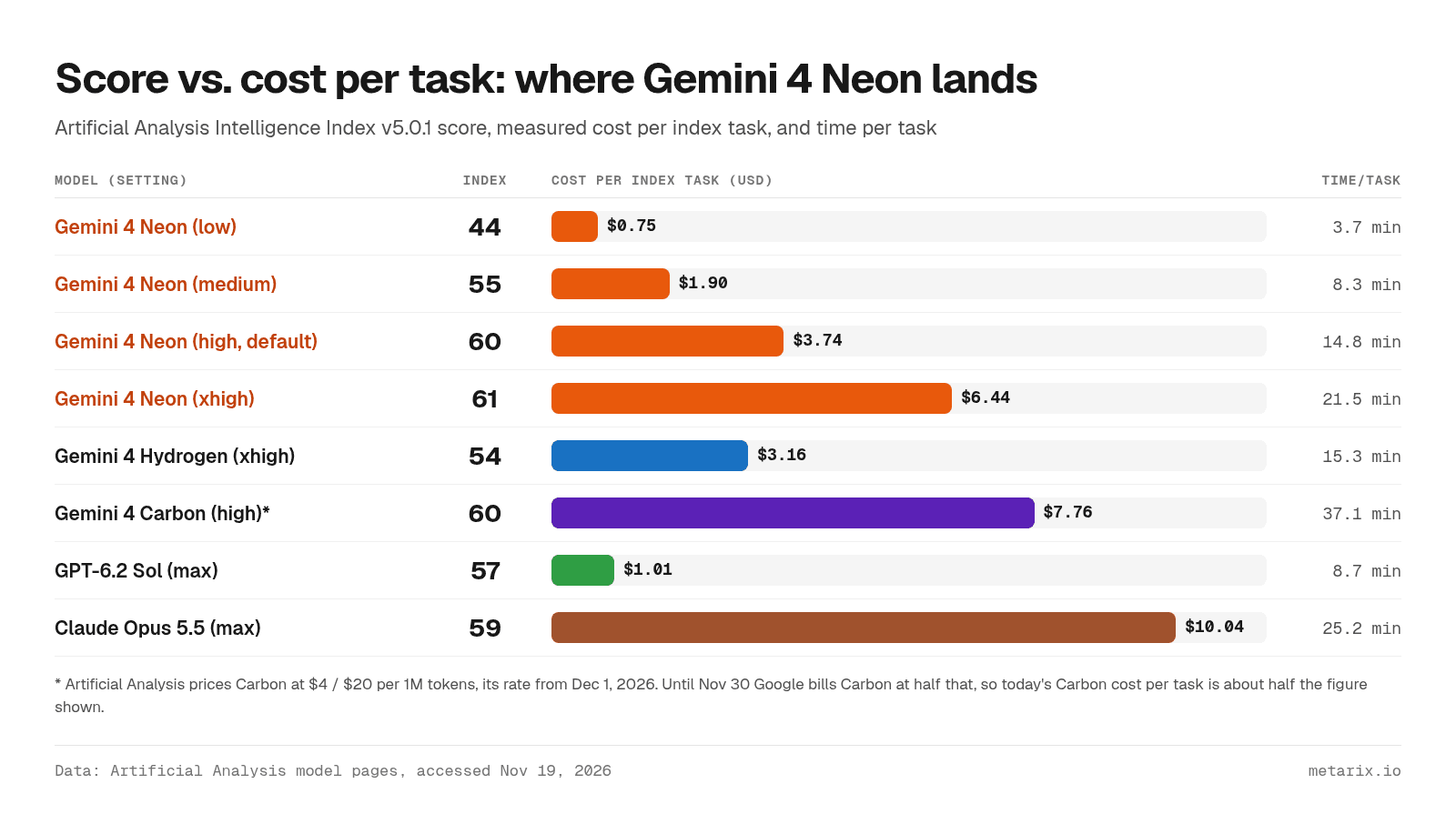
Artificial Analysis runs every model through the same nine-evaluation Intelligence Index, so its numbers are the best like-for-like view available on launch day. Its key finding is that Neon at high scores 60, the same as Carbon at high, at $3.74 per index task versus $7.76 for Carbon and 14.8 minutes per task versus 37.1 (AA comparison).
Scroll the table horizontally on smaller screens.
| Evaluation | Neon (xhigh) | Neon (high) | Carbon (high) | Leader |
|---|---|---|---|---|
| Intelligence Index v5.0.1 | 61 | 60 | 60 | Neon xhigh, by 1 |
| AA-Briefcase v1.1 | 1700 | 1632 | 1611 | Neon |
| Terminal-Bench 4.0 | 63.6% | 61.6% | 65.2% | Carbon |
| FrontierCode-AA 2.0 | 44.4% | 43.3% | 40.6% | Neon |
| HLE-Diamond | 71.3% | 68.4% | 69.1% | Neon xhigh |
| CritPt v2 (Hard Subset) | 60.5% | 59.0% | 69.0% | Carbon |
| Terminal-Bench-Science 0.1 | 70.0% | 65.7% | 64.8% | Neon |
| Output speed | 110 tok/s | 101 tok/s | 55 tok/s | Neon |
| Time per task | 21.5 min | 14.8 min | 37.1 min | Neon |
Two caveats from the same data. First, Neon is slow to start: Artificial Analysis measured about 41 seconds to the first answer token at high and 57 seconds at xhigh, so it's not a chat-latency model. Second, it's verbose. At xhigh it generated 283 million output tokens across the index, against a median of 65.1 million for comparable models, which is why xhigh costs about 1.7 times as much per task as high for one extra point (AA model page).
Benchmark context for the evaluations above: our explainers on HLE-Diamond and Terminal-Bench cover what they test.
Price per token vs price per task
Neon's $3/$15 list price sits between Hydrogen and the December Carbon rate, and between GPT-6.2 Sol and Claude Opus 5.5. Per-token price only matters alongside how many tokens a model burns to finish the job, so the table puts both side by side. Prices as of Nov 19, 2026.
Scroll the table horizontally on smaller screens.
| Model | Input | Output | Cached input | AA index (top setting) | AA cost per index task |
|---|---|---|---|---|---|
| Gemini 4 Hydrogen | $1.50 | $7.50 | $0.075 | 54 (xhigh) | $3.16 |
| Gemini 4 Neon | $3.00 | $15.00 | $0.15 | 61 (xhigh); 60 (high) | $6.44 (xhigh); $3.74 (high) |
| Gemini 4 Carbon, through Nov 30 | $2.00 | $10.00 | $0.10 | 60 (high) | about $3.88 (our estimate at promo rate) |
| Gemini 4 Carbon, from Dec 1 | $4.00 | $20.00 | $0.20 | 60 (high) | $7.76 |
| GPT-6.2 Sol | $2.00 | $10.00 | $0.10 | 57 (max) | $1.01 |
| Claude Opus 5.5 | $4.00 | $20.00 | $0.20 (cache hits) | 59 (max) | $10.04 |
The Carbon promo changes the math until November 30
Through November 30, Google bills Carbon at $2/$10, which is cheaper per token than Neon. At that rate Carbon's measured cost per task works out to roughly $3.88, about the same as Neon at high, though Neon still finishes about 2.5 times faster. From December 1, Carbon doubles to $4/$20 and Neon becomes the clearly cheaper way to get Carbon-level scores. Our Gemini 4 Carbon pricing breakdown covers the promo in detail.
Where Neon beats Hydrogen
The surprising row is Hydrogen. Hydrogen at xhigh scores 54 at $3.16 per task and 15.3 minutes. Neon at medium scores 55 at $1.90 and 8.3 minutes, so it's higher, cheaper per task and faster, despite costing twice as much per token (AA Hydrogen page, AA Neon page). If you have been pushing Hydrogen to its top thinking level, test Neon at medium instead. Hydrogen keeps its lower per-token price and its free tier for simple, high-volume calls at low or medium; our Gemini 4 Hydrogen pricing analysis covers its tiers.
Against OpenAI and Anthropic
Against Claude Opus 5.5, Neon scores two points higher on the index at about 64% of the cost per task at their top settings. Against GPT-6.2 Sol the trade is less one-sided. Sol (max) scores 57 at $1.01 per task and 8.7 minutes, so Neon's extra 3 to 4 index points cost about 3.7 to 6.4 times as much per task (AA Sol page, AA Opus 5.5 page). Our GPT-6.2 pricing analysis has the full OpenAI price sheet.
Choosing a thinking level
Thinking level is the main cost control on Neon, and thinking tokens are billed as output. Google recommends starting at high and using xhigh only where high falls short (thinking levels).
Scroll the table horizontally on smaller screens.
| Level | AA index | Cost per index task | Time per task | Use it for |
|---|---|---|---|---|
| low | 44 | $0.75 | 3.7 min | Fast chat, classification, high-throughput processing |
| medium | 55 | $1.90 | 8.3 min | Interactive coding, UI prototyping, latency-sensitive tool calls |
| high (default) | 60 | $3.74 | 14.8 min | Complex coding, agent runs, multimodal document work |
| xhigh | 61 | $6.44 | 21.5 min | The hardest multi-step engineering and science problems |
Migration checklist before you switch
Coming from another Gemini 4 model, the request schema is the same. Coming from Gemini 3.x, several defaults change. These are the ones most likely to break a production pipeline (migration notes):
- Paid tier only. Free-tier API keys won't reach
gemini-4-neon. - Default thinking is `high`. Carbon and Argon default to
medium. If you swap model IDs without settingthinking_level, you will spend more tokens per call than before. - `minimal` is rejected. Requests with
thinking_level: minimalreturn an error, so update any config that uses it. - No explicit caching.
cachedContentsandcaches.createaren't supported. Implicit caching applies automatically to prompts of at least 4,096 tokens and bills cache hits at $0.15, a 95% discount. - Sampling parameters are gone. In-range
temperature,top_pandtop_kvalues are ignored, and out-of-range values return a 400. - Declare tools natively. Prompting for raw JSON tool calls with no declared tools can return
MALFORMED_FUNCTION_CALL. Use function calling or structured outputs. - Outputs past 64K need background mode. Set
background: truewith a highermax_output_tokens, or use client-side continuation.
Illustrative request (adapted from Google's docs; not run by Metarix) that pins the thinking level instead of relying on the new default:
from google import genaiclient = genai.Client()interaction = client.interactions.create( model="gemini-4-neon", input="Refactor the retry logic in payments/queue.py and add tests.", generation_config={"thinking_level": "medium"}, # start low, raise only if evals fail)print(interaction.output_text)
Where Neon fits in a routing setup
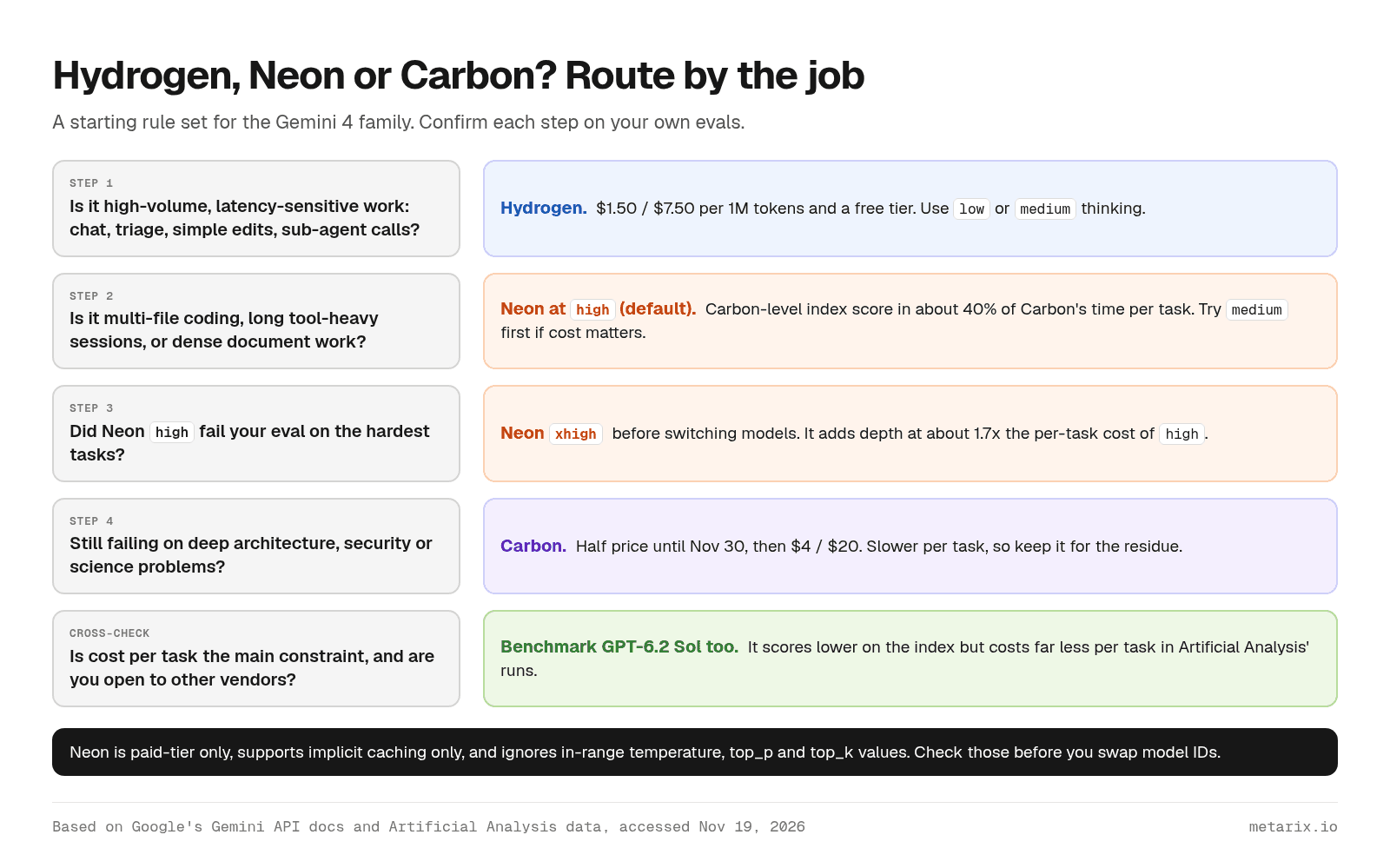
Most teams won't use one Gemini model for everything. The flow below is a starting rule set built from Google's positioning and the Artificial Analysis cost data. Confirm each step on your own evals before you hard-code it.
Verdict
Gemini 4 Neon is the most useful Gemini release for developers since Carbon. It isn't the smartest model available, but it brings Carbon-level scores to a speed and per-task cost you can run all day. Make it the default for complex coding and agent work on Gemini, starting at medium or high rather than xhigh. Keep Carbon for the hardest reasoning, where it still leads on Terminal-Bench 4.0 and CritPt, and keep Hydrogen at low effort for volume.
Be sceptical of the launch table's biggest numbers. The SWE-sweep lead mostly reflects Google's own harness, and on the cleanest coding leaderboards Neon only matches Opus 5.5. If you're cost-bound and vendor-neutral, GPT-6.2 Sol remains the value pick per task. Run your own evals across all three before December 1, when Carbon's price doubles and the case for Neon gets stronger.
Sources
- Google: Introducing Gemini 4 Neon (Nov 18, 2026)
- Google DeepMind: Gemini 4 Neon model evaluation and methodology and model card (November 2026)
- Gemini API: What's new in Gemini 4 Neon, model page, pricing and changelog (accessed Nov 19, 2026)
- Google Antigravity blog: Gemini 4 Neon in Google Antigravity (Nov 18, 2026)
- Artificial Analysis: Gemini 4 Neon and Neon vs Carbon comparison, plus Hydrogen, Claude Opus 5.5 and GPT-6.2 Sol model pages (accessed Nov 19, 2026)
- Anthropic: Claude pricing and OpenAI: API pricing (accessed Nov 19, 2026)
- Arena: Introducing the Agent Arena Index (updated Nov 18, 2026)
Tools covered in this article
Tool
Gemini 4 Neon
AI Agents & Coding · Paid
Tool
Gemini 4 Carbon
AI Agents & Coding · Paid
Tool
Gemini 4 Hydrogen
AI Agents & Coding · Freemium
Tool
Gemini API
SaaS Ecosystem & Business · Freemium
Tool
Antigravity CLI
AI Agents & Coding · Freemium
Tool
GPT-6.2 Sol
AI Agents & Coding · Paid
Tool
Claude
AI Agents & Coding · Freemium
Tool
Terminal-Bench
Benchmarks & Deep Dives · Free
Tool
HLE-Diamond
Benchmarks & Deep Dives · Free
Frequently asked questions
- How much does Gemini 4 Neon cost?
- As of November 19, 2026, Gemini 4 Neon costs $3 per million input tokens, $0.15 per million cached input tokens and $15 per million output tokens on the Gemini API Standard tier, with thinking tokens billed as output. Batch and Flex are half price ($1.50 and $7.50), Priority is $5.40 and $27, and there is no free tier.
- Is Gemini 4 Neon better than Gemini 4 Carbon?
- Not across the board. Artificial Analysis scores Neon at high and Carbon at high the same (60) on its Intelligence Index, with Neon faster and cheaper per task. Carbon still leads on some hard tests, including Terminal-Bench 4.0 and the hard subset of CritPt, so keep it for the most difficult reasoning work.
- Is Gemini 4 Neon better than Claude Opus 5.5 for coding?
- It's roughly level. In Google's own table Opus 5.5 scores slightly higher on Terminal-Bench 4.1 (65.8% vs 65.2%) and FrontierCode 2.0 (47.3% vs 46.2%). Neon's large SWE-sweep lead comes from Google's own Antigravity harness and isn't directly comparable. Neon is cheaper per token and, per Artificial Analysis, per task.
- Does Gemini 4 Neon have a free tier?
- No. Gemini 4 Neon is available only on the paid tier of the Gemini API. Paid Google AI Pro and Ultra subscribers can use it in Google Antigravity, and Pro and Ultra subscribers can select it in the Gemini app.
- What context window does Gemini 4 Neon have?
- Neon has a unified 1,048,576-token window shared by input, thinking and output tokens. A single synchronous response is capped at 65,536 tokens; longer outputs up to the full window need background execution or client-side continuation.