Benchmarks · News
HLE-Diamond’s New Leader Is a Model You Can’t Call Yet
Artificial Analysis launched its HLE-Diamond leaderboard. Gemini 4 Carbon leads at 69.1% but has no public API; Opus 5.5 is the top model you can use today.
Wajid Ali · Oct 31, 2026 · 5 min read
On this page
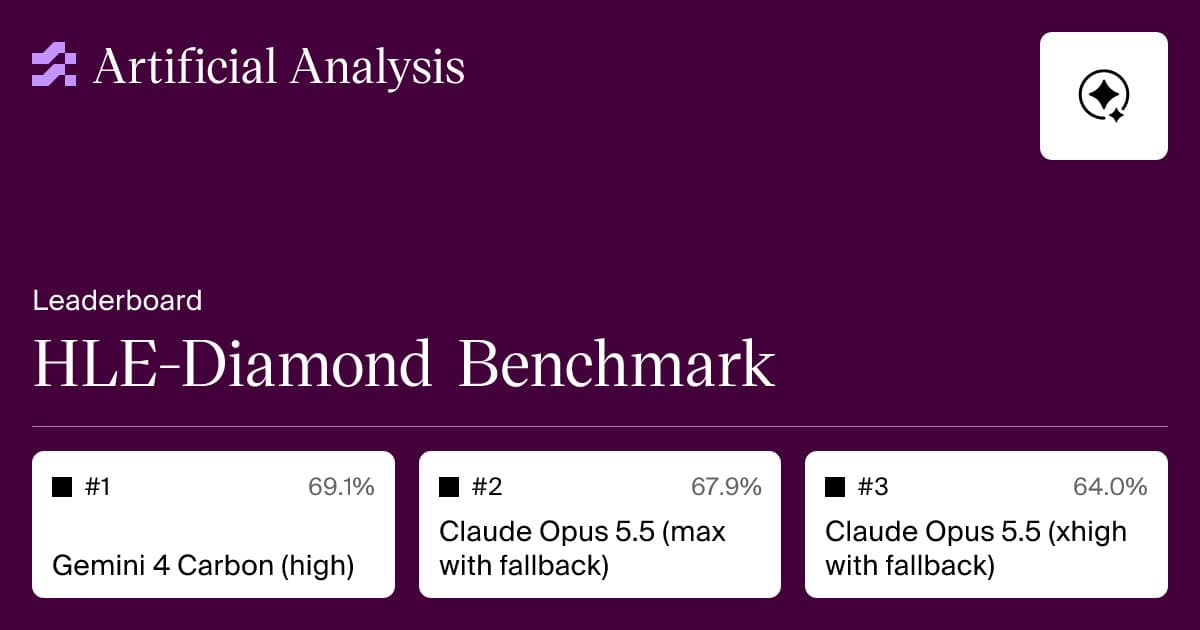
Artificial Analysis launched its HLE-Diamond leaderboard on Oct 30, 2026, and the model at the top is one most developers cannot use. Gemini 4 Carbon (high) leads with 69.1%, just ahead of Claude Opus 5.5 at max effort with 67.9%. Carbon has no public API yet, though. If you pick models off leaderboards, this one needs a careful read.
What changed on Oct 30
Artificial Analysis (AA) announced the leaderboard on X on Oct 30, 2026 (6:09 AM Dubai time). It is the standalone view of a test AA added to Intelligence Index v5 on Oct 27. In v5, HLE-Diamond replaces the original Humanity's Last Exam and carries 10% of the Index weight.
HLE-Diamond itself comes from the Center for AI Safety and Scale AI. According to AA's benchmark page, it works like this:
- 1,000 questions, split into 500 reasoning and 500 knowledge questions. 272 of them include an image.
- No tools. Each model answers each question once, using the official HLE system prompt.
- LLM-graded. GPT-5.6 Luna (medium) checks every answer against the reference answer. The score is pass@1, the share judged correct.
- Private. The dataset authors ask people not to share the questions, so the set is harder to train on than the public HLE.
The leaderboard today
These are the top results AA lists on its HLE-Diamond page. The rows from fourth place down are as reported by OfficeChai from the same leaderboard.
- Gemini 4 Carbon (high): 69.1% (79.6% reasoning, 58.6% knowledge)
- Claude Opus 5.5 (max, with fallback): 67.9% (78.0% reasoning, 57.8% knowledge)
- Claude Opus 5.5 (xhigh, with fallback): 64.0%
- GPT-6 Astra (max): 63.8%
- Claude Fable 5.1 (max): 60.1%
- GPT-6.1 Sol (max): 58.8%
- Claude Sonnet 5.5 (max): 53.3%
- GPT-6.1 Terra (max): 47.3%
When AA announced Index v5 on Oct 27, Opus 5.5 led HLE-Diamond at 68%. Carbon was added after Google announced it on Oct 28. AA also says Carbon is now #1 on the full Intelligence Index v5 with 59, one point ahead of Opus 5.5 (max) at 58.
Open-weight models are far behind. AA's v5 write-up puts the best one, Kimi K3.1 Pro (weights not yet released), at 37%. The same gap shows up on coding benchmarks in our open-weight coding model comparison.
The catch: you can't call Carbon yet
Google announced Gemini 4 Carbon on Oct 28. It said access would start that week with a subset of cyber defenders, then widen to trusted partners through its Fairwind Program. Developers, businesses and consumers will get it "as soon as possible", with no date given.
On Oct 31, Google's Gemini API models page still lists only gemini-4-argon under Gemini 4. There is no Carbon model ID. Google has announced the price: $2 per million input tokens and $10 per million output tokens to start, the same as Argon, then $4 and $20 after the introductory period.
So for work you can ship today, the top of the board is really Opus 5.5, then GPT-6 Astra.
Effort settings move the score more than the model choice
For developers, the most useful part of the launch thread is about effort settings. AA found that higher reasoning effort lifts scores a lot, but the cost per question rises much faster:
- Claude Opus 5.5: 42% at low effort, 68% at max, at about 35x the cost per task.
- GPT-6 Astra: 45% at low effort, 64% at max, at about 11x the cost per task.
That 26-point swing within a single model is wider than the gap between the top three vendors. A model card or leaderboard score with no effort setting attached tells you little about what your bill will look like. We saw the same pattern in GPT-6.1 Terra's pricing.
Knowledge is the weak spot, not reasoning
Every question is labeled as reasoning or knowledge. AA reports that every model above 50% scores 16 to 35 points higher on reasoning than on knowledge. GPT-6.1 Sol (max) has the widest gap among the leaders: 76% on reasoning and 41% on knowledge.
HLE-Diamond is run without tools, so this is closed-book recall of expert facts. In production, you can close much of that gap with retrieval, search grounding or file search. The reasoning score is the better signal of what a model brings by itself.
How to read it, and what it doesn't measure
HLE-Diamond is closed-ended academic questions. It does not test coding agents, tool use or long multi-step tasks. For those, look at agentic benchmarks like Terminal-Bench and FrontierCode, which we covered in SWE-bench vs Terminal-Bench. Three more things to keep in mind:
- One run per question. Gaps of a point or two at the top, like 69.1% vs 67.9%, are close to noise.
- An LLM judge. Grading uses an OpenAI model with the official HLE judge prompt. That is consistent, but it is not human review.
- One evaluator. All of these scores come from AA's own runs. Vendors' self-reported HLE numbers may use other settings and won't match.
Verdict
HLE-Diamond is a cleaner, harder and more private replacement for Humanity's Last Exam, and AA's leaderboard is a useful reference for expert-level reasoning. Don't read the top spot as a buying decision yet. Carbon leads, but you can't call it. Among models you can use today, Claude Opus 5.5 at max effort is the strongest, at a steep cost per task. The more practical lesson is to benchmark at the effort level you will actually pay for. Add retrieval if your agent needs facts, not just reasoning.
Sources
- Artificial Analysis: HLE-Diamond benchmark page and methodology
- Artificial Analysis: Announcing Intelligence Index v5 (Oct 27, 2026)
- Artificial Analysis on X: HLE-Diamond leaderboard launch thread (Oct 30, 2026)
- Artificial Analysis on X: Gemini 4 Carbon tops Intelligence Index v5 (Oct 28, 2026)
- Google: Introducing Gemini 4 Carbon (Oct 28, 2026)
- Google AI for Developers: Gemini API models
- OfficeChai: HLE-Diamond leaderboard coverage (Oct 30, 2026)
Frequently asked questions
- What is HLE-Diamond?
- HLE-Diamond is a refined 1,000-question version of Humanity's Last Exam from the Center for AI Safety and Scale AI. It splits evenly into 500 reasoning and 500 knowledge questions, 272 of which include an image, and tests expert-level closed-ended questions without tools.
- Which model leads the HLE-Diamond leaderboard?
- As of Oct 31, 2026, Artificial Analysis lists Gemini 4 Carbon (high) first at 69.1%, followed by Claude Opus 5.5 (max, with fallback) at 67.9% and Claude Opus 5.5 (xhigh) at 64.0%.
- Can developers use Gemini 4 Carbon through the Gemini API?
- Not yet. Google announced Gemini 4 Carbon on Oct 28, 2026 with access for a subset of cyber defenders and Fairwind Program partners first. The Gemini API models page lists only gemini-4-argon under Gemini 4, and Google has given no date for developer access.
- How is HLE-Diamond scored?
- Each model answers every question once with the official HLE system prompt and no tools. An LLM judge, GPT-5.6 Luna (medium), compares each answer with the reference answer, and the score is the share judged correct (pass@1).
- Does reasoning effort change HLE-Diamond scores?
- A lot. Artificial Analysis reports Claude Opus 5.5 rises from 42% at low effort to 68% at max effort at about 35x the cost per task, and GPT-6 Astra rises from 45% to 64% at about 11x the cost.