Benchmarks · Analysis
Inkling 2 Mini Benchmarks: A Laptop-Sized Coding Model
Thinking Machines' Inkling 2 Mini is a 26.4B-parameter Apache 2.0 model that runs on a 32 GB Mac and, on vendor numbers, leads Qwen3.8-27B on most agentic coding tests. Here's what the benchmarks show, what it costs, and where it trails.
Pavel Holmgren · Nov 21, 2026 · 10 min read
- Inkling 2 Mini
- SWE-bench
- Terminal-Bench
- vLLM
- SGLang
- Thinking Machines Lab
- NVIDIA
- Benchmarks & Deep Dives
- AI Agents & Coding
Documentation-based research

On this page
Thinking Machines Lab's Inkling 2 Mini, released November 20, 2026, is a 26.4B-parameter open-weight model that fits in a 20 GB checkpoint and runs on a 32 GB Mac. On the vendor's own benchmark table it beats Qwen3.8-27B and Gemma 4 31B on most agentic coding tests, including 79.2% on SWE-bench Verified, while trailing Qwen on factual recall and some reasoning tests.
The trick is a looped transformer: the middle half of the model runs three times per token. Here's what the benchmarks do and don't show, what it costs to run, and when it's worth replacing your current local or self-hosted coding model. All scores below are vendor-reported unless stated, accessed Nov 21, 2026.
Quick verdict
If you run coding agents locally or on a single GPU, Inkling 2 Mini is the open model to test this week. It's Apache 2.0, it's priced well below Qwen3.8-27B on Tinker, and its reported SWE-bench, DeepSWE and MCP Atlas scores lead its size class. Keep Qwen3.8-27B (or a hosted frontier model) for knowledge-heavy questions, long multi-turn chats and strict instruction following, and treat every number here as a vendor claim until independent leaderboards catch up.
Scroll the table horizontally on smaller screens.
| Spec | Inkling 2 Mini |
|---|---|
| Released | November 20, 2026, by Thinking Machines Lab |
| License | Apache 2.0, open weights on Hugging Face |
| Parameters | 26.4B total MoE, 3.4B active (about 5.4B effective per token with looping) |
| Architecture | 24 layers; middle 12 run three times with shared weights (48 layer passes) |
| Precision and size | Trained and shipped in NVFP4 plus MXFP8; checkpoint about 20 GB |
| Context and inputs | Up to 1M tokens; text and image in, text out |
| Local hardware | Apple silicon with 32 GB+ memory, NVIDIA DGX Spark, or GPUs with about 32 GB VRAM |
| Hosted access | Tinker sampling and fine-tuning; Tinker Playground; third-party providers |
What Thinking Machines shipped
Inkling 2 Mini is the small sibling of Inkling 2 Small, which Thinking Machines says is 594B parameters. Mini is a Mixture-of-Experts model that routes each token to 8 of 128 experts per layer, takes text and images, and supports a context window of up to 1M tokens, according to the model card. The weights are on Hugging Face under Apache 2.0, so commercial use and fine-tuning are allowed without a custom license.
Two details matter more for developers than the parameter count:
- It ships in the precision it was trained in. Most expert layers were trained in 4-bit NVFP4 and the last four layers in 8-bit MXFP8, and the released checkpoint keeps those formats. That's why the download is about 20 GB, and why there's no separate quantization step that usually costs some quality.
- Day-one runtime support is broad. Thinking Machines lists Ollama and Exo for Apple silicon; SGLang, vLLM, NVIDIA Dynamo, Unsloth and TokenSpeed for NVIDIA; GGUF builds via Unsloth and llama.cpp; and RL fine-tuning in SkyRL, Miles and NVIDIA NeMo AutoModel. Hugging Face added Transformers and MLX support.
The company also released a research checkpoint, TML-d24-varloop-research, that lets you choose how many loop passes to run. It exists mainly for interpretability work, but it's also the easiest way to see how much the loop itself buys you.
How the looped design works
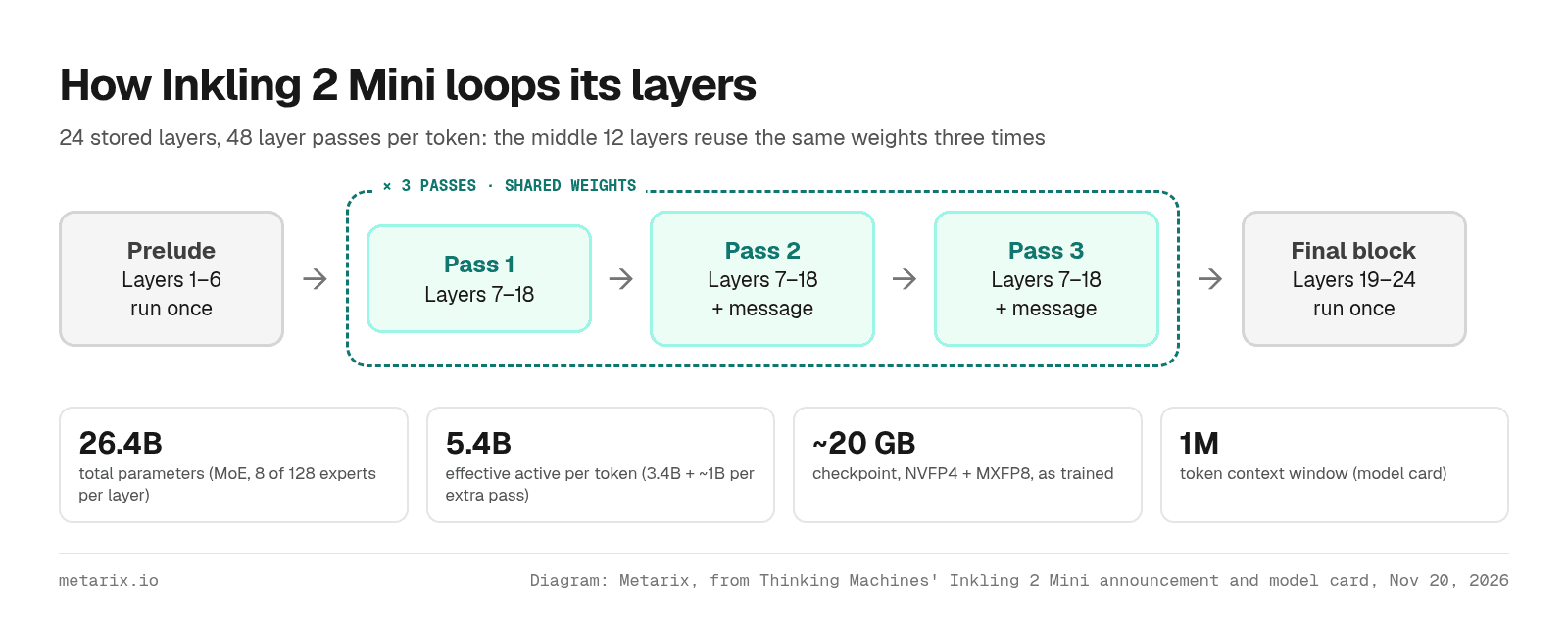
A standard transformer sends each token through its layer stack once. Inkling 2 Mini splits its 24 layers into four six-layer blocks. The first block (the prelude) and the last block run once; the two middle blocks run three times, reusing the same weights. Each later pass also reads a "message" from the previous pass, mixed in through a learned gate. The result is 48 layer applications per token from 24 stored layers.
For you, that trades memory for compute. You store and load a 26B model, but each token gets roughly the depth of a much bigger one. Thinking Machines says each extra pass adds about 1B effective active parameters, which is how it gets from 3.4B active to about 5.4B per token. The vendor also reports that, at matched training compute, a non-looped version cost 7.5% less to train but needed 140% more inference compute to reach the same loss on long agentic traces.
The catch is that looping helps reasoning, not memory. Thinking Machines says knowledge benchmarks such as AA-Omniscience and SimpleQA Verified barely move with more passes, while long-context retrieval and multi-step reasoning improve. In practice, give the model search and tools rather than relying on what it remembers.
Inkling 2 Mini benchmarks vs Qwen3.8-27B and Gemma 4 31B
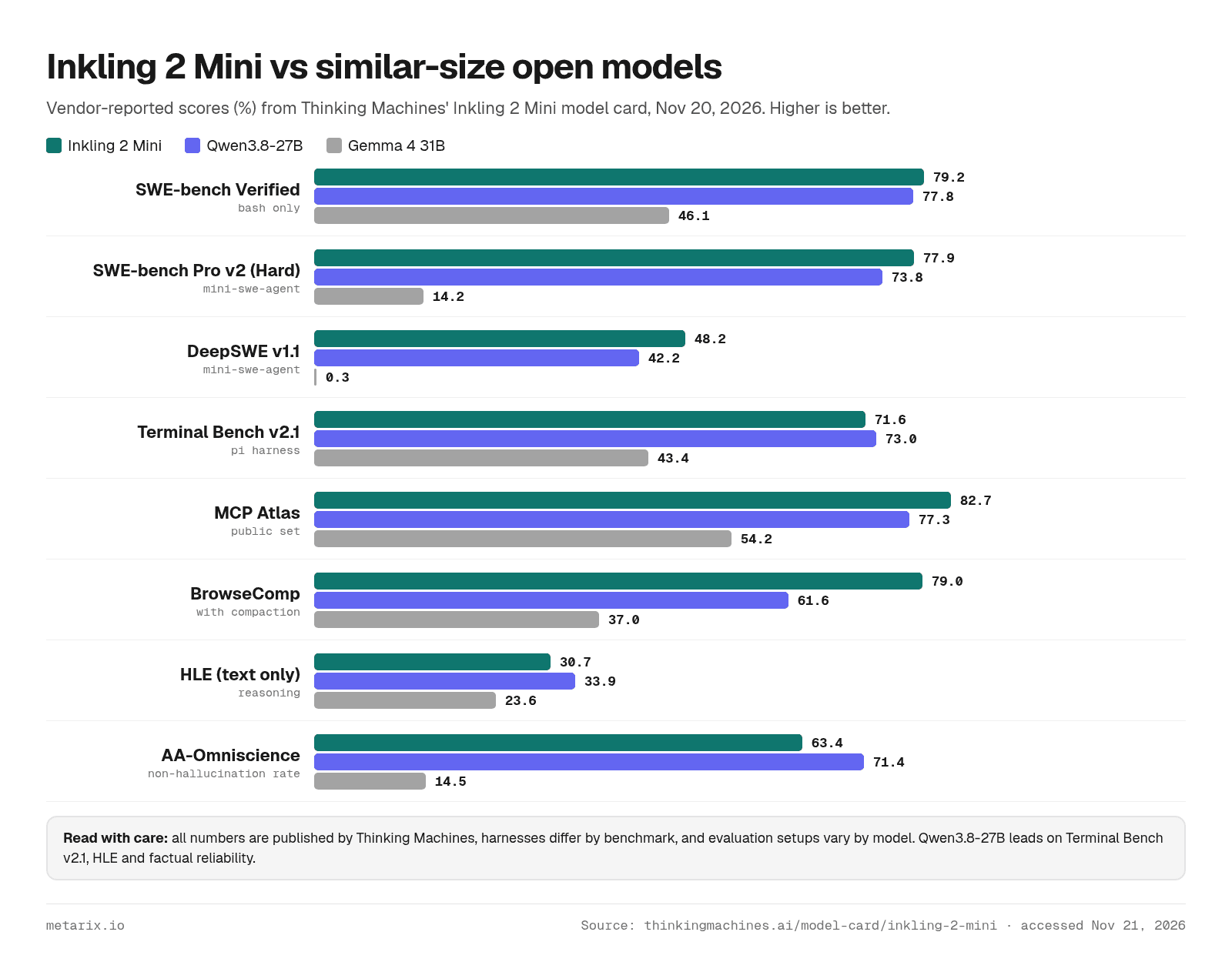
Thinking Machines compares Mini with four open models of similar size. The table below pulls the rows most relevant to coding agents. All numbers come from the Inkling 2 Mini model card, dated November 20, 2026. The harness is named where the vendor gives one, and the vendor notes that "evaluation setups vary by model", so read small gaps as ties.
Scroll the table horizontally on smaller screens.
| Benchmark (harness) | Inkling 2 Mini | Qwen3.8-27B | Gemma 4 31B |
|---|---|---|---|
| SWE-bench Verified (bash only) | 79.2% | 77.8% | 46.1% |
| SWE-bench Pro v2 Hard (mini-swe-agent) | 77.9% | 73.8% | 14.2% |
| SWE-bench Multilingual (bash only) | 73.7% | 70.0% | 43.0% |
| DeepSWE v1.1 (mini-swe-agent) | 48.2% | 42.2% | 0.3% |
| Terminal Bench v2.1 (pi) | 71.6% | 73.0% | 43.4% |
| Terminal Bench v4.0 (mini-swe-agent) | 5.6% | 5.6% | 0.0% |
| MCP Atlas (public) | 82.7% | 77.3% | 54.2% |
| BrowseComp (with compaction) | 79.0% | 61.6% | 37.0% |
| AA Index v5.0 | 20.1 | 20.1 | 4.4 |
Three things stand out. First, the lead over Qwen3.8-27B on real-repository coding (SWE-bench Verified, Pro and Multilingual) is a few points, not a generation. Second, the gap is wider on agentic search and tool use: BrowseComp and MCP Atlas, which test multi-step tool calls, are where looping seems to pay off most. Third, on Terminal Bench the two models are effectively tied, and Qwen is slightly ahead on v2.1. If you want a refresher on what these tests measure, see our explainer on SWE-bench vs Terminal-Bench.
Where it trails
The vendor is upfront about the weak spots, and they matter for product decisions:
- Factual reliability. On AA-Omniscience v1.1, Mini's non-hallucination rate is 63.4% against 71.4% for Qwen3.8-27B. The model card warns it's more likely than larger models to state wrong information with confidence.
- Hard reasoning. On HLE (text only), Mini scores 30.7% to Qwen's 33.9%, and Thinking Machines says it trails larger models on CritPt v2 and HLE-Diamond.
- Chat and constraints. It scores 50.0% on MultiChallenge (multi-turn instruction following), and the vendor says it isn't the strongest small model for multi-turn chat or instructions with many constraints.
- Reasoning loops. The model card says it sometimes gets stuck re-checking its own work, especially when debugging, and recommends caps on output tokens and agent turns.
Independent coverage is only starting. Hugging Face's launch post says that in its own informal "vibe tests" Mini is "at least comparable" with Qwen3.8-27B and that more validation is needed. Until third-party leaderboards publish their own runs, use our guide on how to read LLM leaderboards as a checklist for these numbers.
What it costs to run
There are two ways to pay: your own hardware, or tokens on Thinking Machines' Tinker platform. Prices as of Nov 21, 2026, from the Tinker pricing page (the page labels its rates "as of October 19, 2026").
Scroll the table horizontally on smaller screens.
| Model | Prefill | Cached prefill | Sample (output) | Train |
|---|---|---|---|---|
| Inkling 2 Mini | $0.15 | $0.015 | $0.50 | $0.75 ($1.50 at 256K) |
| Inkling 2 Small | $0.30 | $0.03 | $1.00 | $1.50 |
| Qwen3.8-27B | $0.6975 | $0.1395 | $5.595 | $4.103 |
| Qwen3.6-35B-A3B | $0.45 | $0.09 | $1.335 | $1.177 |
| GPT-OSS-20B (32K) | $0.18 | $0.036 | $0.45 | $0.396 |
As an illustration (our arithmetic, not a vendor quote), an agent session that sends 2M prefill tokens and samples 200K output tokens on Tinker would cost about $0.40 on Inkling 2 Mini ($0.30 + $0.10) versus about $2.51 on Qwen3.8-27B ($1.40 + $1.12), before any prompt-cache discount. That gap is mostly the output price: $0.50 against $5.595 per million tokens.
Two caveats. Tinker is a fine-tuning and sampling platform, and its serverless inference beta, which is aimed at production traffic, currently covers Inkling 2 Small and older Inkling models but not Mini. For production API traffic, check the third-party providers Thinking Machines mentions, or self-host. For self-hosting, the break-even logic in our self-hosted LLM vs API cost guide applies, with one advantage: a 20 GB model fits on a single prosumer GPU or Mac, so the hardware bill starts low.
Running it locally
On a Mac, Ollama's library page lists a 20 GB build with a 1M context window and image input. It currently needs Ollama's preview release (0.40.17 at launch), and Ollama says Windows and other hardware support will follow. A minimal setup, shown for illustration:
# Mac with 32 GB+ memory, Ollama preview build installedollama run inkling-2-mini# Point a coding agent at the local model (commands listed by Ollama)ollama launch claude --model inkling-2-miniollama launch opencode --model inkling-2-mini
Because the model card warns about runaway reasoning, set a hard output cap in your client, for example Ollama's num_predict option, and a maximum number of agent turns. Long contexts also cost memory beyond the 20 GB of weights; if a 1M-token prompt pushes your machine into swap, see why local AI runs out of memory. On NVIDIA hardware, vLLM and SGLang have published recipes; our vLLM vs SGLang vs TensorRT-LLM comparison covers which to pick.
Researchers at Stanford's Hazy Research and Scaling Intelligence labs, who had early access, measured 0.703 on their intelligence-per-joule metric for Mini on a DGX Spark, against 0.430 for Qwen3.6-35B-A3B, according to Thinking Machines. Those runs used different precisions per model (MXFP8 for Mini, NVFP4 or INT4 for the others), so treat it as directional.
What it means for developers and founders
- Local coding agents just got a credible default. A model that reportedly scores near 80% on SWE-bench Verified and fits on a 32 GB laptop changes what you can do offline, on air-gapped machines, or where code can't leave the building.
- Agent workloads may get cheaper. If its tool-use scores hold up in your own evals, Mini's $0.50 output price is among the lowest on Tinker's list and about a tenth of Qwen3.8-27B's, and it's free to self-host.
- Fine-tuning is the real play. Apache 2.0 weights plus Tinker training at $0.75 per million tokens make Mini a cheap base for a narrow, company-specific agent.
- Monitoring needs a second look. Looping lets a model do more reasoning without writing it down. Thinking Machines reports that at this scale chain-of-thought stayed legible and sabotage tests didn't rise with more loops, but if your safety story depends on reading reasoning traces, track this as looped models get bigger.
For how Mini fits with larger open models such as Kimi K3.1 Pro, see our roundup of the best open-weight coding models.
Verdict
Inkling 2 Mini is the most interesting small open model of the month: Apache 2.0, laptop-sized, and, on its maker's numbers, the best coding and tool-use model under 100B parameters. Pull it into your eval harness now if you run local or self-hosted coding agents, especially for repo-level fixes and tool-heavy workflows. Don't swap out Qwen3.8-27B or a hosted frontier model for fact-heavy answers, long chats or strict multi-constraint prompts, and wait for independent SWE-bench and Terminal-Bench runs before you make it a production default.
Sources
- Thinking Machines Lab: Introducing Inkling 2 Mini (Nov 20, 2026)
- Thinking Machines Lab: Inkling 2 Mini model card (accessed Nov 21, 2026)
- Thinking Machines Lab: Tinker pricing (accessed Nov 21, 2026)
- Hugging Face: thinkingmachines/Inkling-2-Mini (accessed Nov 21, 2026)
- Ollama: inkling-2-mini (accessed Nov 21, 2026)
- Hugging Face blog: Welcome Inkling 2 Mini (Nov 20, 2026)
Tools covered in this article
Frequently asked questions
- Can Inkling 2 Mini run on a MacBook?
- Yes, if it has at least 32 GB of memory. The checkpoint is about 20 GB, and Ollama's preview release supports it on Apple silicon Macs with ollama run inkling-2-mini. Long contexts need extra memory on top of the weights.
- Is Inkling 2 Mini open source?
- Its weights are open under the Apache 2.0 license on Hugging Face, which allows commercial use and fine-tuning. Thinking Machines also published a variable-loop research checkpoint, TML-d24-varloop-research.
- Is Inkling 2 Mini better than Qwen3.8-27B?
- On Thinking Machines' own benchmark table it leads Qwen3.8-27B on most agentic coding and tool-use tests, such as SWE-bench Verified (79.2% vs 77.8%) and DeepSWE v1.1 (48.2% vs 42.2%). Qwen leads on factual reliability, HLE and Terminal Bench v2.1. The scores are vendor-reported and setups vary by model.
- What is a looped transformer?
- A model that runs some of its layers more than once per token with the same weights. Inkling 2 Mini runs its middle 12 of 24 layers three times, giving 48 layer passes. This adds reasoning depth without adding stored parameters, but doesn't improve factual knowledge.
- How much does Inkling 2 Mini cost on Tinker?
- As of November 21, 2026, Tinker lists $0.15 per million prefill tokens, $0.015 cached, $0.50 per million sampled tokens and $0.75 per million training tokens at 64K context ($1.50 at 256K). The weights themselves are free to download.