Author
Soraya Lindquist
Soraya Lindquist covers the AI Agents & Coding beat for Metarix. That category is where the site publishes work on coding assistants, agent workflows, model APIs, and the product changes that affect how developers write, review, and ship software. She writes for engineers and technical founders who need a clear account of what a launch actually changes: a limit, a price, a permission model, an API shape, or only the language on a marketing page.
The beat moves on vendor timelines. A new coding agent, a revised tool-use interface, or a quietly tightened quota can change a team's week. Readers in this category are usually trying to decide whether to adopt, wait, or ignore a release, and they are poorly served by recaps that restate a keynote. Soraya's articles start from the official record and stay there: what the documentation now says, what the changelog lists, and what the vendor has not specified.
The sources she tracks are the ones that can be checked again later. She follows product changelogs, API reference pages, pricing tables, deprecation and retirement notices, model cards, release notes, and status pages for the tools and providers in this beat. When a vendor says an agent can run longer, call more tools, or replace a previous model, she looks for the version, the date, the quota, and the conditions attached to that claim. If those details are missing, the article says they are missing.
Her writing voice is plain and cautious. She prefers short sentences, dated figures, and a direct verdict over atmosphere. She is skeptical of "agent" language that is not tied to a documented capability. She does not write as if a product had been used in a private test unless the article itself records that test: the version, the date, the workload, the settings, and the limits of the run. Most coverage on this beat is documentation-based research, and she keeps that distinction explicit.
Facts are verified against primary sources. A secondary news post can point to a change; it is not the source to rewrite. Prices and limits are recorded with currency, plan, billing unit, and the date they were checked. Model and product names are written as the vendor writes them on the checked date. When two official documents from the same company disagree, the article notes the conflict instead of choosing the more convenient line.
Drafting and research at Metarix may involve AI tools, including on this beat. Model output is not treated as evidence. A human editor remains accountable for the published text, the framing, and any later correction, as set out in Metarix's Editorial Standards at /editorial-standards.
When a material factual error is found, or when a vendor later changes a price, a limit, or a retirement date, the article is updated. Material corrections receive an explicit note on the page. Smaller copy edits that do not change the facts do not. Readers can report an error or an outdated figure through the Contact page at /contact or by writing to [email protected].
On this beat she typically covers: coding agents and IDEs; model APIs and tool use; agent workflows and permissions; and what a release actually changes in the coding loop.
Selected work on this beat, chosen because it shows the approach rather than because it is the newest, includes:
- From Chat to Agents to Machines: What 2026 Actually Changed — https://metarix.io/agentic-ai-2026-what-changed - Google’s Elephant–Goldfish Plugin Explained: Uses and Limits — https://metarix.io/google-elephant-goldfish-plugin - A Thousand Pull Requests for Ten Dollars — https://metarix.io/a-thousand-pull-requests-for-ten-dollars - Salesforce Koa vs Claudeforce: Two AI Stacks — https://metarix.io/salesforce-koa-claudeforce - Claude Code Now Runs a Team — https://metarix.io/claude-code-now-runs-a-team

AI Agents · Analysis · Soraya Lindquist · Sep 19, 2026 · 3 min
Devin Scans the Whole Repo First
Code Scans is MapReduce for a codebase. You name an outcome. Parallel agents hunt. A last agent ranks the findings and opens pull requests.
Read analysis →
AI Agents · Analysis · Soraya Lindquist · Sep 19, 2026 · 3 min
Claude Code Now Runs a Team
Projects is no longer a shared folder. A coordinator splits the job into cloud threads. Each thread is a full Claude Code session on its own branch.
Read analysis →
AI Agents · News · Soraya Lindquist · Sep 18, 2026 · 3 min
Factory Is Now Worth $5 Billion
The enterprise coding-agent company raised $200M and tripled its price to $5B. The product pitch is not one more chat. It is a software factory you can put behind a firewall.
Read article →
AI Agents · Analysis · Soraya Lindquist · Sep 18, 2026 · 3 min
Raindrop Catches Agent Failures Live
Raindrop now has $50M total and a new Simulations product. It watches live agents for silent mistakes, then replays real traffic on every pull request before you ship.
Read analysis →
AI Agents · Analysis · Soraya Lindquist · Sep 17, 2026 · 3 min
Cursor Runs the Fleet Now
Projects is a coordinator that does not write the code. It keeps context for months, farms subagents in the cloud, and watches Slack and CI without a new prompt.
Read analysis →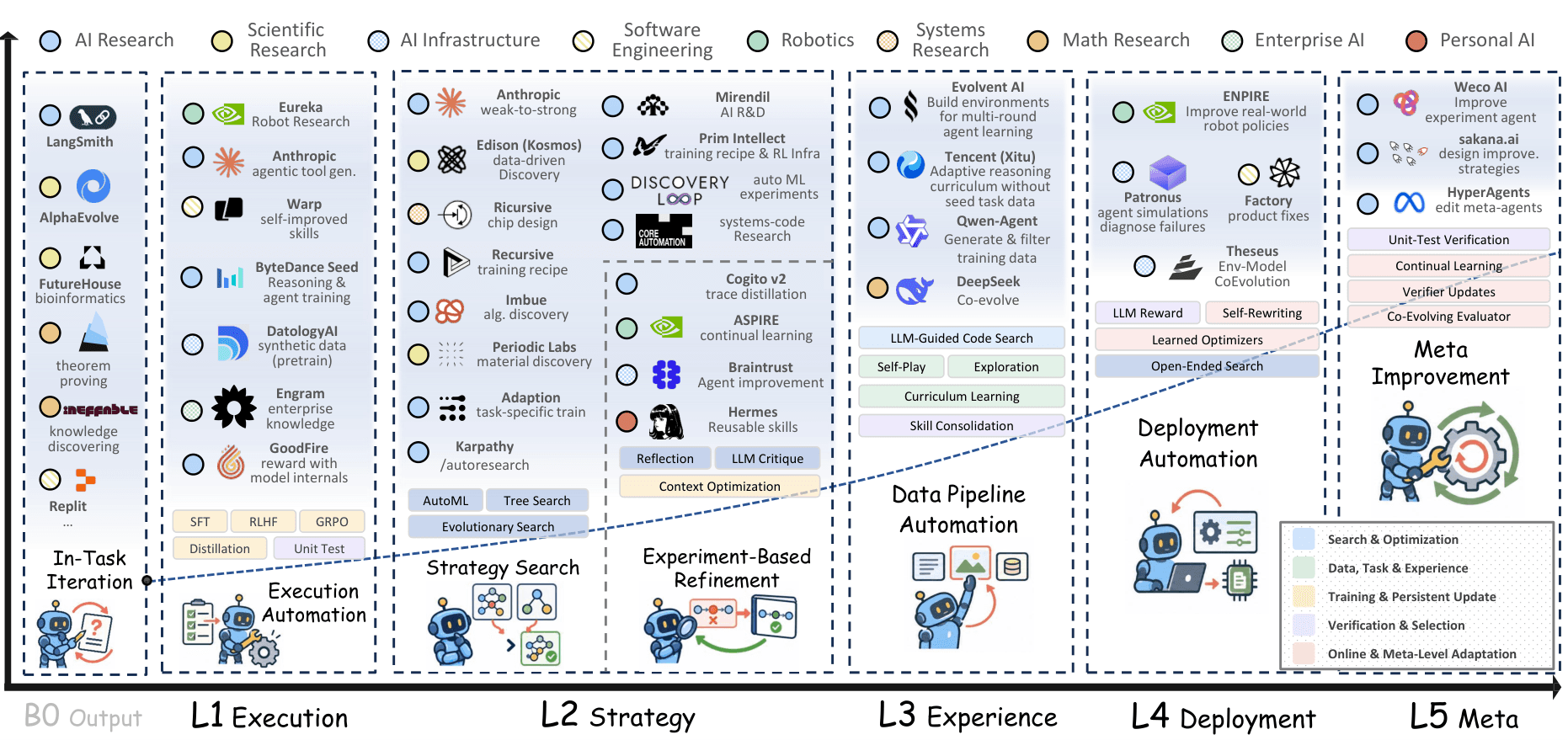
AI Agents · Deep dive · Soraya Lindquist · Sep 17, 2026 · 3 min
A Map of AI That Improves Itself Is Not a Launch Date
A ByteDance–Tsinghua–Shanghai AI Lab preprint ranks 491 papers on five rungs of recursive self-improvement. The interesting part is what the ladder does not measure.
Read the deep dive →
AI Agents · Comparison · Soraya Lindquist · Sep 17, 2026 · 3 min
Salesforce Koa vs Claudeforce: Two AI Stacks
Koa is a CRM reasoner Salesforce trains and hosts. Claudeforce puts 37 sales skills inside Claude. Same Dreamforce week; two control models.
View comparison →
AI Agents · News · Soraya Lindquist · Sep 16, 2026 · 4 min
Claude Drops Extra Tabs
Chat, Cowork, Docs, and Slides now share one Claude. You stop picking a mode. Claude routes the job — Pro and Max first.
Read article →