SaaS · Analysis
Copilot Code Review Billing Moves to the Org on Dec 30
Unless an admin picks Member, Copilot code reviews by licensed members will be billed to the repository's organization from Dec 30, 2026. At GitHub's own estimates, review spend can exceed the included pool, and user budgets stop capping it.
Sabeen Hartwell · Nov 26, 2026 · 8 min read
On this page
From Dec 30, 2026, Copilot code reviews by licensed members of a Copilot Business or Enterprise organization will be billed to the organization that owns the repository, unless an admin has saved a different choice. The seat price does not change. What changes is which budget stops a review: today it is the developer's own entitlement and budget; after the switch it is an organization limit that GitHub calls optional.
At GitHub's own per-review estimates, a 25-seat team that reviews every push can spend more on reviews than its whole included credit pool. So the useful question for an admin is not "will this cost more?" It is "which cap do I want to hit first, and have I set it?" The worked math below answers that at 10, 25 and 50 seats.
The setting that flips on Dec 30
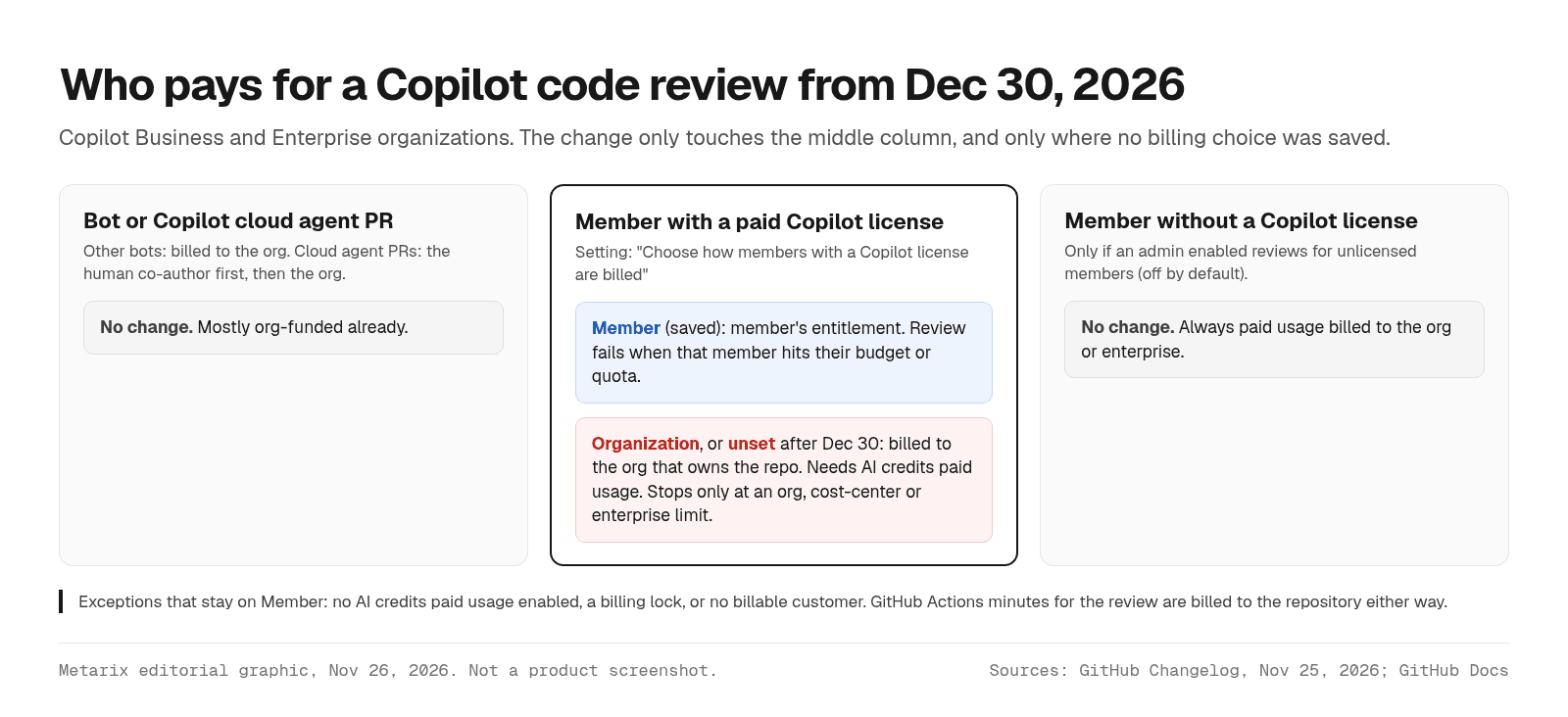
GitHub announced the change on Nov 25. It applies to one setting in organization and enterprise Copilot policies, labelled "Choose how members with a Copilot license are billed". It has two saved values:
- Member: the review uses the member's Copilot entitlement. If that member's quota or budget is exhausted, the review fails.
- Organization: the review is billed to the organization that owns the repository. This needs the AI credits paid usage policy turned on. A budget is optional.
If nobody has saved a value, the setting currently shows Default (Member) with a notice. From Dec 30 an unset setting means Organization. Saved choices stay as they are. Three kinds of account are set to Member instead of flipping: those without AI credits paid usage enabled, those with a billing lock, and those with no billable customer. On Copilot Business and Enterprise the paid-usage policy is on by default, so most organizations will flip unless an admin acts.
The setting covers manual and automatic reviews. It only changes who pays. It does not give unlicensed members access, and the separate switch for unlicensed members (off by default) is untouched. It is also not in the API: GitHub's configuration page lists billing among the code review settings that the REST and GraphQL endpoints cannot change. Our earlier look at the code review API covers what those endpoints can do.
The docs already describe the new default
One detail can confuse an audit. As of Nov 26, 2026, GitHub Docs already say an unsaved setting bills the organization, on both the configuration page and the code review concepts page. The changelog says that only becomes true on Dec 30, and that until then unset settings show Default (Member). Go by the label in your own settings and the changelog date, not the docs wording.
Worked math at 10, 25 and 50 seats
Copilot Business costs $19 per granted seat per month and each seat adds 1,900 AI credits to a pooled monthly allowance. One AI credit is $0.01, so the pool is worth exactly the seat fee: $19 per seat. Copilot Enterprise is $39 per seat with 3,900 credits, again $39. The pool also pays for Copilot Chat, CLI, cloud agent and Spaces usage. It resets at 00:00 UTC on the first of each month. Prices as of Nov 26, 2026, from GitHub's plans page and usage-based billing docs.
For reviews, GitHub publishes only estimates, because the model behind code review is not disclosed. Its models and pricing page puts an average review at about $0.25 on Lite, $1.50 on Balanced and $10 on Max, with typical ranges of $0.05–$1, $0.25–$5 and $1.50–$25. Balanced is the built-in default. Those figures exclude GitHub Actions minutes.
The table applies those averages to a Business organization. The usage is a Metarix assumption, not GitHub data: 20 pull requests per developer per month, reviewed once, or three times when "Review new pushes" is on in a ruleset (the first review plus two pushes).
Scroll the table horizontally on smaller screens.
| Seats | Included pool (all Copilot use) | Balanced, 1 review per PR | Balanced, 3 reviews per PR | Lite, 3 reviews per PR |
|---|---|---|---|---|
| 10 | $190 (19,000 credits) | $300 (200 reviews) | $900 (600 reviews) | $150 |
| 25 | $475 (47,500 credits) | $750 (500 reviews) | $2,250 (1,500 reviews) | $375 |
| 50 | $950 (95,000 credits) | $1,500 (1,000 reviews) | $4,500 (3,000 reviews) | $750 |
Two things stand out. At Balanced, one review per pull request already costs about $30 per developer per month against $19 of included credits, before anyone opens Copilot Chat. And reviewing every push triples that. Lite keeps review spend under the pool, but at $15 per developer it leaves only about $4 per seat for everything else.
GitHub's docs do not say whether organization-billed reviews draw down the included pool before metered charges begin. At the Balanced volumes above it makes little difference, because review spend alone is larger than the pool.
The budget that stops a review moves
For a company with one organization, the invoice goes to the same place either way. The difference is control. GitHub's code review docs are explicit: if a review is billed to a user, it is blocked when that user reaches their budget. If it is billed to an organization, it is blocked only when an organization budget, a cost-center budget or the enterprise spending limit runs out. How those limits interact is in the budget docs.
Take the 25-seat team with a universal user-level budget of $30 per developer. GitHub describes that universal budget as the primary tool for a baseline limit. Under Member billing, all of that team's AI credit use, reviews included, stops at 25 × $30 = $750 a month. A developer who burns $30 on reviews by mid-month also loses Chat and CLI until the reset: reaching a user budget blocks every credit-consuming feature, not just reviews. Under Organization billing with no organization budget, those 1,500 Balanced reviews can run to $2,250 without hitting a cap. Going by GitHub's description, they also stop drawing on each developer's $30.
Enterprises with several organizations have a second effect. "The organization that owns the repository" may not be the organization that pays for the reviewer's seat. A platform org that owns shared repositories can start carrying review costs for product teams whose seats sit elsewhere, and cost-center reports will move with it.
Some things stay the same. Reviews of pull requests opened by bots are already billed to the organization; Copilot cloud agent PRs go to the human co-author first. GitHub Actions minutes for the agentic part of the review are attributed to the repository, and self-hosted runners use none. Copilot code review in Azure DevOps bills the linked Azure subscription, per GitHub's Nov 17 changelog.
Who can ignore this
- Individuals on Copilot Pro, Pro+ or Max. The change is for Business and Enterprise organizations.
- Organizations where an admin already saved Member or Organization.
- Organizations that turned AI credits paid usage off. They are set to Member, and reviews stop when credits run out, as they do now.
What to do before Dec 30
- Check the label. Organization settings → Copilot → Code review, or for an enterprise: AI controls → Copilot → Configure features & clients. If it reads Default (Member), you are in scope. There is no API for this, so list your organizations and check each one, or set one enterprise policy.
- Measure a month of reviews. Reviews run as the
copilot-pull-request-reviewerActions workflow, so the Actions metrics for that workflow, or the billing usage report filtered bydynamic/agents/copilot-pull-request-reviewer, show how often they ran. Multiply by GitHub's average for your effort level to get a range. The AI usage page shows credits by model, but GitHub says it generally cannot trace credits to a specific feature. - Pick on purpose. Member keeps per-developer caps but lets reviews fail mid-month. Organization keeps reviews and developers' budgets apart, but only an organization, cost-center or enterprise limit stops it.
- If you pick Organization, set the budget the docs call optional, and turn on "Stop usage when budget limit is reached". Without one, nothing caps organization-billed reviews except a cost-center budget or the enterprise spending limit, if you have one.
- Cap the effort. Set Maximum review effort to Balanced unless some repositories need Max. Adaptive cannot pick above the maximum, but with No limit it can choose Max.
- Trim volume where it is cheap to do so. "Review new pushes" and draft-PR reviews in rulesets multiply review counts. Keep them on repositories where the extra pass pays off.
- Tell developers which mode you chose. Under Member, a failed review means a budget ran out, not a broken bot.
For the wider choice of review tools and how per-review pricing compares with seat pricing, see our AI code review tools roundup. For another credit-metered review bill, see our GitLab Duo credits breakdown. The GitHub Copilot and GitHub pages collect the rest of our Copilot coverage. We will recheck these figures by Feb 24, 2027, or sooner if GitHub changes its estimates.
Our take
Choose before Dec 30 rather than inherit the new default. For most teams, Organization billing with an enforced organization budget is the better setup: review spend becomes one line you can watch, and a heavy review week no longer locks a developer out of Chat. Size that budget from a measured month of reviews, not from the seat count. If you cannot set an organization budget this month, save Member now and revisit it after the January bill.
Sources
- GitHub Changelog: Copilot code review billing will default to the organization, Nov 25, 2026.
- GitHub Docs: Configuring code review by GitHub Copilot, accessed Nov 26, 2026.
- GitHub Docs: GitHub Copilot code review (usage, billing and estimated consumption), accessed Nov 26, 2026.
- GitHub Docs: Models and pricing for GitHub Copilot (code review cost section), accessed Nov 26, 2026.
- GitHub Docs: Usage-based billing for organizations and enterprises, accessed Nov 26, 2026.
- GitHub Docs: Budgets for usage-based billing, accessed Nov 26, 2026.
- GitHub Docs: Plans for GitHub Copilot, accessed Nov 26, 2026.
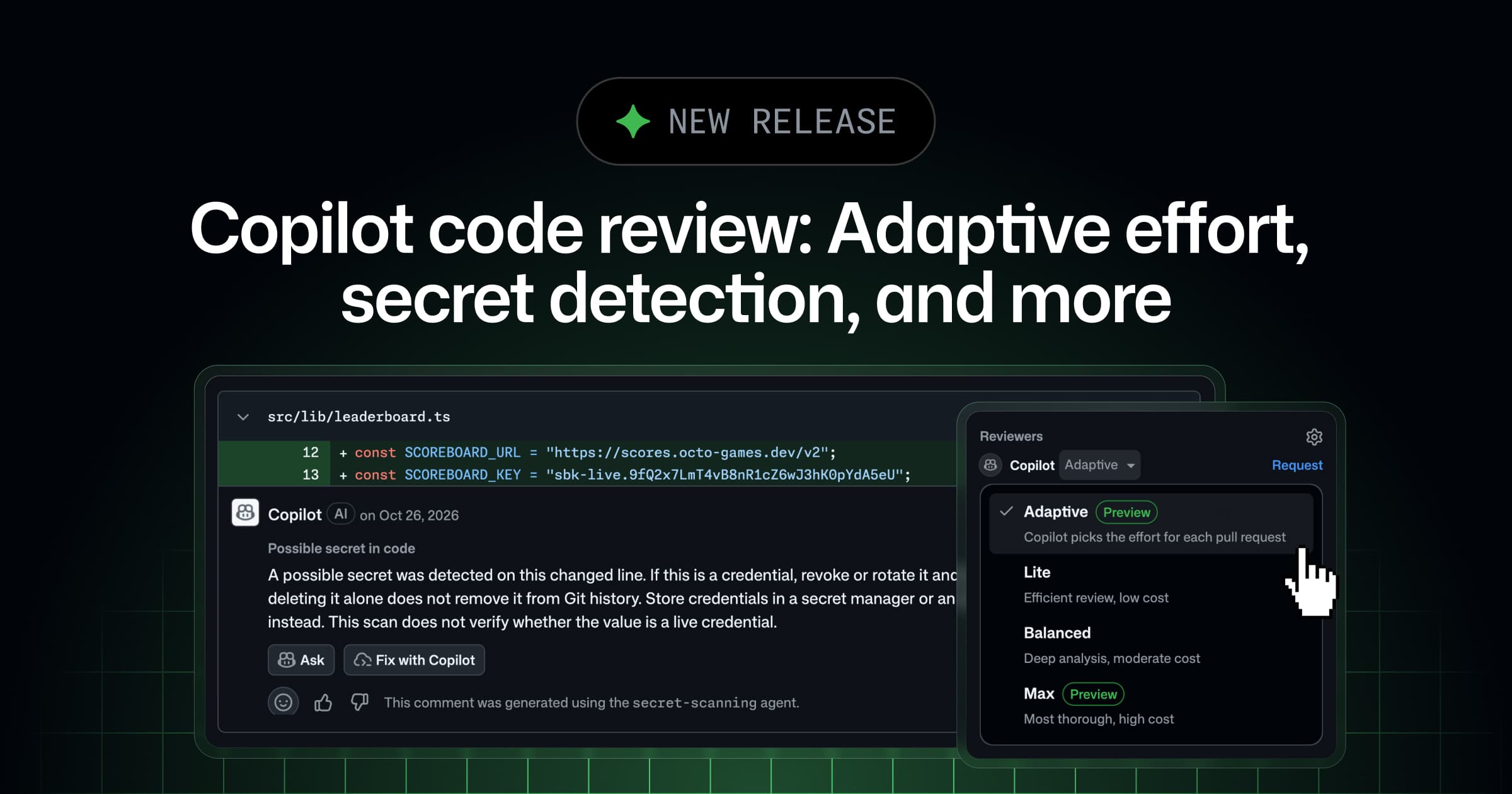
- GitHub Changelog: Copilot code review: Adaptive effort, secret detection, and more, Nov 17, 2026.
Tools covered in this article
Frequently asked questions
- Does this change the price of a Copilot Business or Enterprise seat?
- No. As of Nov 26, 2026, GitHub lists Copilot Business at $19 and Copilot Enterprise at $39 per granted seat per month. The change only decides whether a licensed member's code review is charged to that member's entitlement or to the organization that owns the repository.
- Can I set the code review billing choice through the GitHub API?
- No. GitHub's configuration docs list billing, maximum review effort and approvals among the code review settings that the REST and GraphQL APIs cannot manage. Admins have to set it in organization or enterprise settings, or enforce one enterprise policy.
- What happens when a member runs out of budget under Member billing?
- The review fails, and other features that consume AI credits are blocked too. The user stays blocked until the next billing cycle starts on the first of the month at 00:00 UTC or an admin raises the budget. Inline completions keep working because they do not use AI credits.
- Do GitHub Actions minutes for code review change on Dec 30?
- No. The agentic part of a review runs on GitHub Actions, and those minutes are attributed to the repository whichever billing choice you make. Self-hosted runners do not consume Actions minutes; larger GitHub-hosted runners cost more per minute.