Productivity · Analysis
Claude Ship Approvals: Close the Unreviewed-Merge Gaps
Claude Ship's approving review can satisfy a GitHub rule that requires one approval. Here are the documented gaps that let a PR merge with only its author looking, the setting that closes each, and who on the team acts.
Owen Prestwick · Nov 29, 2026 · 8 min read

On this page
Anthropic's Claude Ship, launched on Nov 23, 2026, can post an approving review on your pull requests, and GitHub can count that review as the one approval your branch rule requires. Anthropic's own docs list at least a dozen settings under which a change merges with only its author, or nobody, looking at it. Closing them takes three people, not one: the GitHub repo admin, whoever writes .claude/approvals.yml, and the Owner of the Claude organization.
This piece is the audit to run before anyone deletes mode: observe: each gap, the exact setting that closes it, and who on the team has to act. The launch post recommends starting in observe mode and stops there; the details sit in the setup docs.
What shipped on Nov 23
Claude Ship bundles three agents for GitHub pull requests, per the announcement and the Claude Ship docs:
- Code Review (generally available) reads the change with the surrounding code, verifies candidate issues and posts inline findings, at a Quick, Standard or Deep level per repository.
- PR Steward (public beta) works on failing checks, merge conflicts and review comments, and pushes fixes. It is designed not to approve or merge.
- Claude Approvals (public beta) is a check driven by a policy file. Each rule names paths, how many human seats a change needs, and whether Claude
comments,blocksorapproves.
It is for Claude Team and Enterprise organizations on github.com, including GitHub Enterprise Cloud. The agents are not available with Zero Data Retention, the HIPAA configuration or customer-managed encryption keys, and Approvals cannot start with FERPA or Access Transparency settings. Developers also get a /ship command in the Claude Code CLI (v2.1.330 or later) that opens the PR, reviews it and keeps fixing from the local session.
Billing is per token through the organization's usage credits, separate from seats. The Code Review cost page says there is no flat per-review price, and reviews are billed to the organization, not to the developer who opened the PR. That is the same shift GitHub is making for Copilot, covered in our piece on Copilot code review billing.
Claude's approval is a real GitHub approval
The part that changes your merge path is small. Claude Approvals reports a check named Claude Approvals, and where the policy allows it, claude[bot] posts an approving review. According to Approvals and your GitHub rules, that review can satisfy a branch rule that requires one approval. The check itself blocks nothing unless GitHub lists it as required.
So a policy that looks strict on paper can still let a PR through, because GitHub, not the policy file, decides what merges. And the policy has its own soft spots. A seat can be filled by the PR's author. Per the policy reference, the humans set includes machine users, meaning any user account a script or agent drives. The claude account that Claude's cloud sessions commit as does not count.
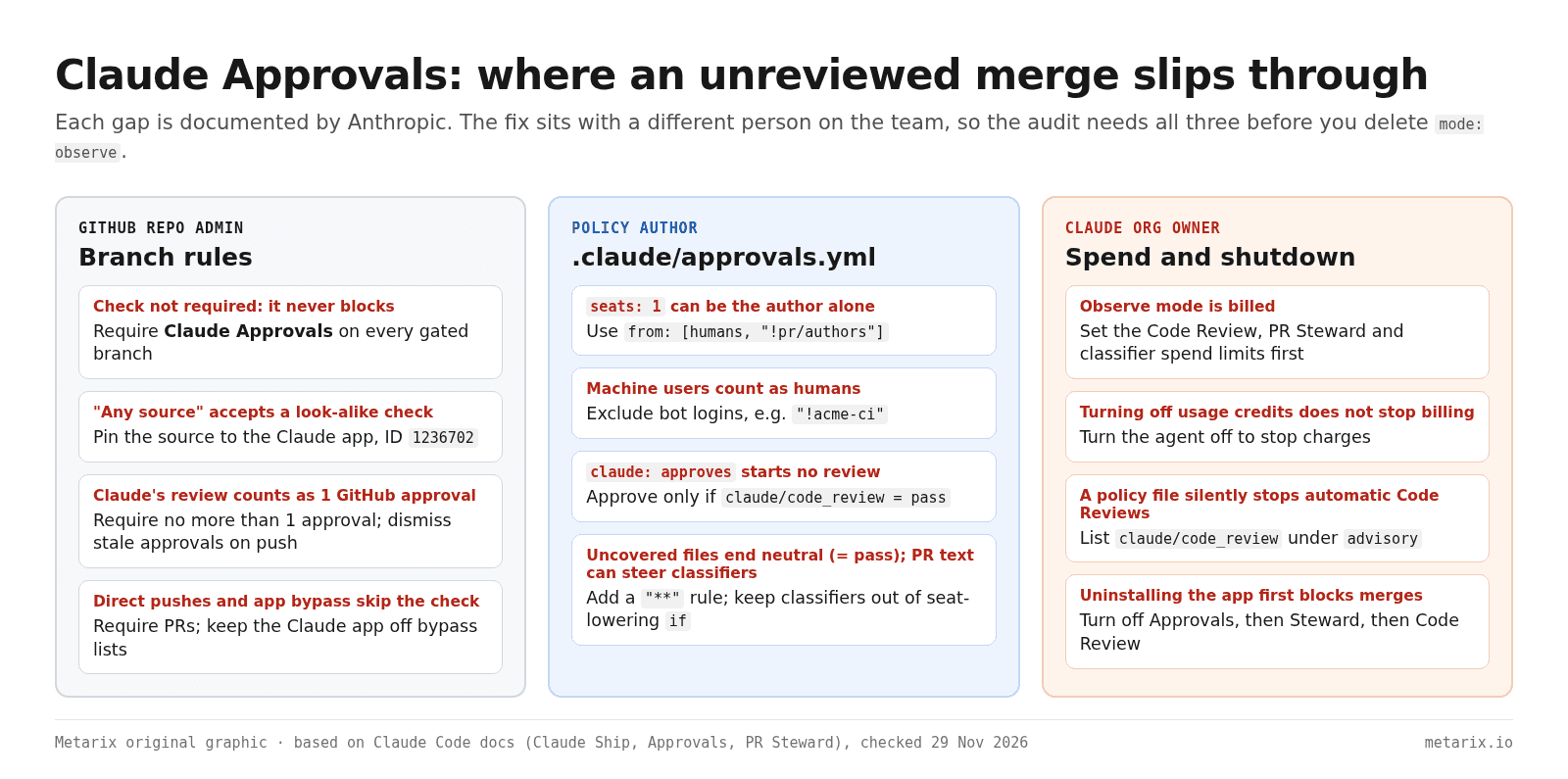
The gaps, and the setting that closes each
Scroll the table horizontally on smaller screens.
| Gap | Why it happens | Fix | Who acts |
|---|---|---|---|
| Check not required | The Claude Approvals check blocks only where GitHub requires it; observe mode normally passes | Require the check on the default branch and every branch the policy gates | GitHub admin |
| Look-alike check | If the required check accepts any source, a check named Claude Approvals from elsewhere counts | Pin the source to the Claude app (ID 1236702 in rulesets or branch protection) | GitHub admin |
| Claude fills GitHub's one approval | Claude's approving review counts toward required approvals | Require no more than one approval in GitHub and ask for more people in seats; dismiss stale approvals on push | GitHub admin |
| Direct push or bypass | A push straight to the default branch gets no check; bypass actors skip it | Require pull requests; keep the Claude GitHub App off bypass lists | GitHub admin |
| Author fills the seat | seats: 1 can be met by the author; seats: 0 lets a bot-written PR merge with nobody | Use seats with from: [humans, "!pr/authors"] | Policy author |
| Machine users | Agent-driven user accounts count as humans | Exclude their logins, for example "!acme-ci" | Policy author |
| Approve without review | A rule with claude: approves starts no Code Review by itself | Let Claude approve only in an override on claude/code_review = pass | Policy author |
| Uncovered files | Files no rule covers get no reviewer; if nothing is covered the check ends neutral, which GitHub counts as passing | Keep a rule on "**" | Policy author |
| Steerable classifiers | A PR's own text can steer a classifier answer that lowers seats | Keep classifier answers out of seat-lowering if, override and reuse conditions | Policy author |
| Unprotected control files | Only policy files, classifiers, REVIEW.md, CODEOWNERS and some git files are protected | Write rules for .github, CLAUDE.md, AGENTS.md and .mcp.json | Policy author |
| Auto-merge and merge queues | Queue commits are stamped as passed; an observed PR can sit in the queue unchecked | Rerun the check on open PRs after enforcing; grant the app's Merge queues permission | GitHub admin |
Two of these deserve a second look. The reuse key, which keeps earlier approvals after a push, can let two people who each held the author's seat at different commits fill seats: 2 with nobody approving. Exclude authors there too. And a policy file in a subdirectory decides for the files under it, so it can ask for less than the root file, unless the root rule is marked nested: inherit.
The costs nobody turns off
The money side has its own traps, and they land on the Claude org Owner. Observe mode is billed. A policy that reads claude/code_review in a condition can start a billed review when a PR opens and at each push, even if your Code Review settings ask for fewer. Turning off usage credits does not stop an agent that is on; the Claude Ship page says it keeps running and billing until you turn it off.
Push frequency is the multiplier. Code Review's After every push setting is the default for a repository added from the admin page. Take a team that opens 40 PRs a month at five pushes each (a Metarix scenario, not a measured workload): that is 200 reviews a month on After every push, against 40 on Once after PR creation. Anthropic publishes no per-review price, so run its suggested pilot with a spend limit before you multiply.
Limits are opt-in. PR Steward has no spend limit until you set one, and the Code Review row under Organization settings > Usage can start without one. One more surprise: once a policy file is on the default branch, automatic Code Reviews normally stop for the files it covers, unless a rule lists claude/code_review under advisory.
Who should care, and who can skip it
Act now if you are on Team or Enterprise, already run Code Review, and someone on the team can merge a .claude/approvals.yml. Anyone who can merge into the default branch can turn Approvals on, so the policy can arrive before the admin work does. If you run PR Steward or /ship watches, read what PR Steward can access: it cannot approve, but merging, auto-merge and force-pushes are left to GitHub's branch rules plus a model check that the docs admit a reworded command can pass. The /ship docs also warn that during a watch, anyone who can merge to the base branch or push to your branch can run programs on your computer with your credentials.
You can skip the approval half if your organization uses Zero Data Retention, HIPAA or CMEK, or if your code lives off github.com. For a comparison with Copilot, CodeRabbit and others that only comment or approve under your own GitHub rules, see our AI code review tools roundup.
Rollout checklist
- Owner: set spend limits for Code Review, PR Steward and Approvals classifier runs before turning anything on.
- Owner: pilot Code Review in one repository on Once after PR creation, and PR Steward on Manual (@claude steward).
- Policy author: merge the policy in its own PR with
mode: observe, a"**"rule that asks for one person who isn't an author, andclaude/code_reviewunderadvisory. - Reviewers: compare the observe-mode check titles with what you actually decided, until they match.
- Policy author: delete
mode: observe, wait five minutes, comment@claude approvals rerunon each open PR, and keep them out of the merge queue until rerun. - GitHub admin: require pull requests, then require Claude Approvals on each gated branch with the source pinned to app 1236702.
- Everyone: open a PR that touches
.claude/and confirm the check reads Waiting on human review from any person (1/2) and GitHub lists it as required. - GitHub admin, last: lower GitHub's required approvals to at most one and turn on stale-approval dismissal. Anthropic's setup page puts this change after the switch, not before.
To back out, turn off Approvals first, then PR Steward, then Code Review. Uninstalling the Claude GitHub App first can leave a required check that blocks merges and approvals that GitHub still counts.
Take
Claude Ship is worth piloting if you are already on Team or Enterprise: Code Review is GA, and a path-based policy file is easier to read than a sprawling CODEOWNERS. Just don't let Claude approve anything yet. Make your first enforced policy a copy of Anthropic's "keep two people on each change" starter whose seat excludes authors, pin the check's source, and set every spend limit. Then widen claude: approves one path at a time, starting with test fixtures and docs, once a few weeks of observe-mode titles match your reviewers.
Sources
- Anthropic: Introducing Claude Ship, Nov 23, 2026
- Claude Code docs: Claude Ship
- Claude Code docs: Claude Approvals and Set up Claude Approvals
- Claude Code docs: Claude Approvals and your GitHub rules
- Claude Code docs: Claude Approvals policy file reference
- Claude Code docs: What PR Steward can access
- Claude Code docs: Code Review costs and usage
- Claude Code docs: /ship and /steward
- InfoQ: Anthropic Introduces Claude Ship to Review, Fix, and Approve Pull Requests by Policy, Nov 28, 2026
- All documentation checked 29 Nov 2026.
Tools covered in this article
Frequently asked questions
- Can PR Steward approve or merge a pull request?
- It cannot approve: Anthropic's service refuses approval requests from PR Steward sessions, along with changes to branch protection and check runs. Merging, auto-merge and force-pushes are left to your GitHub branch rules, so require reviews there and keep the Claude GitHub App off bypass lists.
- What happens to a pull request that edits the policy file?
- Approvals applies the rules already on the default branch, not the ones proposed in the pull request. The policy file is a protected file, so a covered change normally needs a person with write access, but that person can be the pull request's author unless your rules exclude authors.
- Is observe mode free?
- No. In observe mode the check does not block merges, but the Code Reviews and classifier runs that your policy starts are billed to the organization's usage credits.
- Does Claude Ship work with GitLab or Bitbucket?
- The organization agents and Claude Approvals work on github.com, including GitHub Enterprise Cloud. The /ship command can watch a merge request on GitLab, Bitbucket or Azure DevOps from your local Claude Code session, with fewer abilities than on GitHub.