SaaS · Analysis
Siri AI Is Finally Shipping. Treat It as OS Infrastructure, Not Another Chatbot.
Apple’s rebuilt assistant is in beta with iOS 27. The story is not a smarter Siri voice — it is an on-device plus Private Cloud Compute stack, a hardware and geography gate, and a system API surface developers have to take seriously.
Alex Rivera · Sep 16, 2026 · Updated Oct 22, 2026
On this page
Apple spent two years telling the market Siri would become a real assistant. On 14 September 2026, the company stopped previewing and started shipping: Siri AI is in beta on the 27-generation platforms — iOS, iPadOS, macOS, watchOS, and visionOS — as an English-first rollout, with French, Japanese, Korean, Portuguese, and Spanish listed for October.
That is the news. The intelligence is what it actually is.
This is not ChatGPT with an Apple skin. It is an operating-system assistant: personal context across Mail, Messages, and Photos; onscreen awareness; web knowledge; and systemwide app actions. Apple also put it in Spotlight, context menus, Camera, a dedicated Siri app with iCloud conversation history, and Vision Pro as a spatial object you look at and speak to. If you ship software for Apple platforms, or you advise a team that does, the comparison set is App Intents and Private Cloud Compute — not another wrapper around a hosted LLM.
Image from URLhttps://www.apple.com/newsroom/images/2026/09/siri-ai-a-profoundly-more-capable-and-personal-assistant-is-here/article/Apple-Siri-AI-onscreen-awareness_inline.jpg.large.jpg
Alt: Siri AI answering a question about content on the user’s screen
What actually shipped
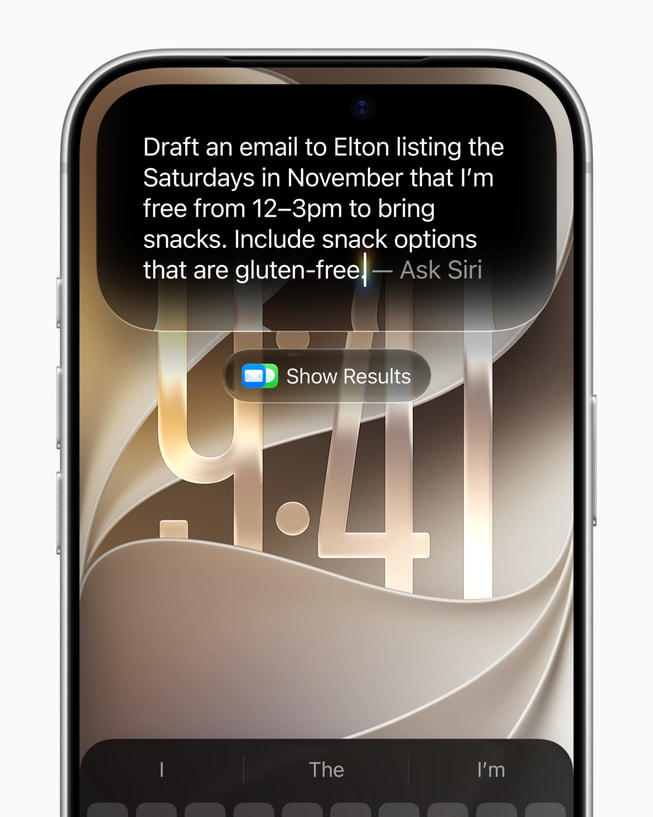
Siri AI can search a user’s own messages and mail, then chain an action: find the recipe a relative mentioned, pull the instructions from email, drop the ingredients into Reminders. It can look at a sports site and add home games to Calendar. It can draft from a blank field, rewrite in place, and match tone per recipient in Mail and Messages. Systemwide proofreading now runs in most third-party apps, not just Apple’s.
Visual Intelligence is no longer an iPhone-only stunt. Camera on iPhone gets a Siri mode. iPad hooks it into screenshots. Mac gets a keyboard shortcut against whatever is on the display. Vision Pro can answer questions about windows and physical objects in view.
Around the assistant, Apple Intelligence landed in the rest of the system: Spatial Reframing, Extend, and a stronger Clean Up in Photos; photorealistic Image Playground on Private Cloud Compute, including generation from the Siri app; Safari tab topics, restock/price Notify Me, and extensions from a description; Shortcuts you describe instead of assemble; Call Context on Phone; Home camera summaries.
Coming later in the year, Audio Intelligence on Apple Watch Series 12 and Ultra 4 (Sound Recognition, Live Rewind, Siri Recap) and a Health app Insights layer. Those are adjacent. The assistant itself is the product that just left the lab.
The architecture is the product
Apple is explicit about the stack. Siri AI runs on the next Apple Foundation Models, built with Google and Gemini, split between on-device inference and Private Cloud Compute. Dictation and the more expressive voices sit on AFM Core Advanced, which Apple calls its most capable on-device model. Heavier generative work — Image Playground is the named example — goes to PCC. Apple still says personal data in that path is not stored and is not available to Apple, and that outside researchers can keep inspecting the promise.
The orchestration layer matters more than the model card. Apple says Siri uses a system orchestrator against Spotlight and App Toolbox, on-device, so the assistant can find local state and invoke apps without shipping that index to a generic chat backend. That is why this lands as infrastructure: retrieval and tool use are OS services, not a plugin the user installed.
Two product constraints sit next to that architecture.
First, daily usage limits on server-side features, including Siri AI, intelligent photo tools, Image Playground, and AFM 3 Cloud models in Shortcuts. Apple says expanded access will be paid later. Treat the current assistant as freemium OS capability, not an unlimited API.
Second, availability is not “everyone on iOS 27.” Apple Intelligence on these releases needs iPhone 15 Pro / 15 Pro Max and iPhone 16 or newer, iPad mini with A17 Pro, iPad and Mac with M1 or later, MacBook Neo (A18 Pro), Vision Pro, and recent Apple Watch paired with an eligible iPhone. A phone can install iOS 27 and still not get Siri AI. The EU does not get Siri AI on iPhone, iPad, or Watch at launch. China is held for regulatory clearance. Language support for Apple Intelligence is broad; Siri AI itself starts in English.
If you write “Apple upgraded Siri” without those gates, you are writing marketing.
What developers should do this week
Siri already acts in third-party apps Apple named — WhatsApp, Audible — and Apple says Outlook, Notability, and Tripsy-class actions are next. The practical question is whether your app is a destination the orchestrator can call with a clean intent, or a blob of UI the assistant cannot see.
Priorities, in order:
- Expose the jobs users already pay you for as App Intents (create, search, add, share), with parameters the assistant can fill from personal context or the screen.
- Assume Shortcuts-from-description will hit those intents. If a user can say the workflow, Siri will try to build it. Ambiguous intents will fail in public.
- Decide what must stay on-device. Anything you would not send to a hosted LLM should not require a cloud round-trip if Spotlight and App Toolbox can satisfy it locally.
- Budget for caps and a future SKU. If your product’s “works with Siri” story depends on unlimited cloud generations, it will break on a Tuesday afternoon, then again when Apple meters PCC.
- Do not plan an EU or China Siri AI feature as a global launch checkbox. Ship a fallback.
This is closer to designing for Spotlight and Share Sheet than to wrapping an OpenAI key.
How to read it against ChatGPT and Gemini
Google is already inside the foundation models. That does not make Siri a Gemini app. The differentiation Apple is selling is where the assistant lives: index, screen, camera, watch, and app graph, with a privacy story tied to silicon (including Secure Exclave on the new Watch for audio features that never persist raw audio).
ChatGPT remains the better general researcher for many people. Gemini remains the better default inside Google’s own surfaces. Siri AI is the bet that the assistant that can see the email, the lock screen, and the local file wins the next layer of workflow — if the models are good enough and the limits are not insulting.
We do not have independent quality numbers yet. Until someone runs a proper tool-use and personal-context eval against ChatGPT and Gemini with the same tasks, treat Apple’s “profoundly more capable” line as a ship notice, not a benchmark. That eval belongs on Metarix once the beta is in enough hands.
Spec, as shipped
- Product: Siri AI (beta), Apple Intelligence 27-generation
- Shipped: 14 September 2026 (English); more languages listed for October
- Surfaces: iPhone, iPad, Mac, Apple Watch, Vision Pro
- Hardware floor: iPhone 15 Pro class and newer; M1 / A17 Pro class elsewhere
- Out at launch: EU on iOS / iPadOS / watchOS; China pending
- Stack: Apple Foundation Models (with Google / Gemini), AFM Core Advanced on-device, Private Cloud Compute for heavier jobs
- Metering: daily limits on server-side features; paid expanded access “in the future”
- Primary sources: Apple Newsroom, 14 Sep 2026 and Apple Intelligence support
The upgrade is real. The mistake is covering it as a voice-assistant anecdote. It is Apple inserting a gated, metered, OS-native agent into the graph every Apple developer already ships against. That is the article. The quality bake-off comes next.