Cloud · Analysis
Cloudflare Search for Agents: Who Pays for Queries
Cloudflare's Search for Agents adds a public /.well-known/search endpoint to your domain with one toggle. From Dec 1, 2026, every agent query past 1,000 a month bills to your account at $0.75 per 1,000.
Nalini Groves · Nov 27, 2026 · 8 min read
On this page
Cloudflare's Search for Agents, released on Nov 25, 2026 as a beta on every plan, turns one dashboard toggle into a public search endpoint at /.well-known/search on your own domain. The constraint that decides whether to flip it is the meter, not the setup. Any agent that finds the endpoint runs its queries against your account's AI Search allowance, and once AI Search billing starts on Dec 1, 2026, every hybrid query past the first 1,000 in a month costs $0.75 per 1,000.
Below: what the toggle builds, what agent traffic would cost at four volumes, and the robots, bot and WAF settings that can stop the crawler or the agents before either reaches your content.
What the toggle builds in your account
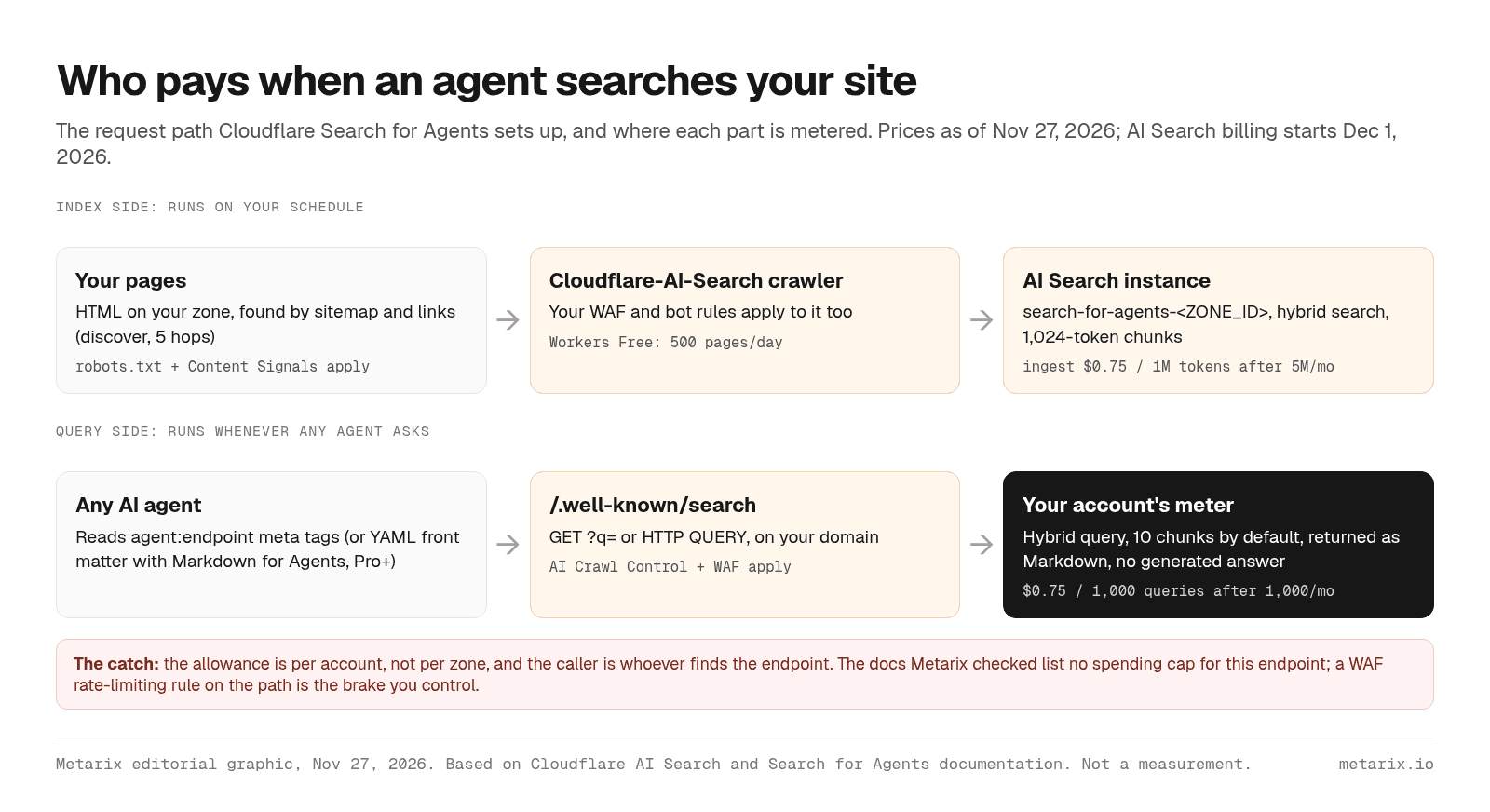
Turning it on under Quick Actions on a zone's Overview page creates a Cloudflare AI Search instance named search-for-agents-<ZONE_ID> in the default namespace. Its data source is your domain, crawled with the discover parse type, which reads your sitemaps and follows links. Then Cloudflare adds agent: meta tags to the <head> of every HTML page so agents can find the endpoint. The setup guide lists the defaults. These are the ones that change cost or coverage:
Scroll the table horizontally on smaller screens.
| Setting | Default | Why it matters |
|---|---|---|
| Parse type | discover: sitemaps plus links, five hops deep | Reaches pages your sitemap misses, including ones you may not want indexed |
| Sync interval and crawl cache age | 24 hours each | Edits can take a day or more to show up unless you trigger a sync |
| Search mode | Hybrid (vector plus BM25 keyword) | Every query is billed at the semantic rate, not the cheaper full-text rate |
| Embedding model | @cf/qwen/qwen3-embedding-0.6b, 1,024-token chunks, 10% overlap | The model and data source are fixed at creation |
| Results per query | 10 chunks, match threshold 0.4 | Sets how much text each agent pulls per request |
| Similarity cache | On, Strong match, 48 hours | Repeats are served faster; billing for cache hits is not documented |
| Reranking and query rewriting | Off | Turning either on adds model work per query |
The endpoint returns retrieved Markdown with source paths and relevance scores. It does not generate an answer; the agent's own model does that. Agents can call it with GET ?q= or with the new HTTP QUERY method, which carries the question in the request body.
How much text comes back is up to the site owner. On Nov 27, 2026, Metarix sent one GET request with curl to Cloudflare's own docs endpoint, asking for the maximum push size in Cloudflare Artifacts. It returned HTTP 200 and text/markdown: 50 results and 50,569 bytes, which counts as 11,823 tokens with the cl100k_base tokenizer (tiktoken 0.14.0). The right page ranked first. That instance clearly returns more than the 10-chunk default, so treat the number as one sample of one configuration, not a benchmark. Still, it shows how one search can fill a large share of the calling agent's context. If you run the agent rather than the site, score what that retrieval returns the way you would any RAG pipeline; our RAG evaluation tools comparison covers the options.
The billing start date depends on which page you read
The AI Search limits and pricing page, last updated Nov 17, says billing begins on Dec 1, 2026. The AI Search release notes still carry the Oct 1 general-availability entry, which says usage-based billing begins on Nov 1, 2026. The newer pricing page is the one to plan around. Even so, look at your November usage before you assume it was free.
Every account gets the same allowance each month: 5 million ingestion tokens, 10 GB-month of storage, 1,000 semantic queries and 1,000 full-text queries. Past that, ingestion costs $0.75 per million tokens, storage $2.00 per GB-month, semantic, vector and hybrid queries $0.75 per 1,000, and full-text queries $0.10 per 1,000. All prices are in USD, as of Nov 27, 2026.
The allowance is per account, not per zone. Turn the feature on for three domains and they share the same 1,000 queries.
Search for Agents explicitly selects hybrid search, and hybrid queries bill at the $0.75 rate. The hybrid search docs describe opting out by deleting the keyword index, which leaves vector search at the same price. Metarix found no documented way to run this endpoint on the $0.10 full-text meter. The similarity cache may soften repeat traffic, but the pricing page does not say whether a cache hit counts as a query. Budget as if every request does.
What agent traffic would cost
Ingestion and storage are small for most sites. The query line has no ceiling, and you do not choose who calls. The table applies the published list rates to four monthly query volumes, assuming one site per account and nothing else using the AI Search allowance.
Scroll the table horizontally on smaller screens.
| Agent queries per month | About per day | Billable after 1,000 included | Monthly cost |
|---|---|---|---|
| 3,000 | 100 | 2,000 | $1.50 |
| 30,000 | 1,000 | 29,000 | $21.75 |
| 300,000 | 10,000 | 299,000 | $224.25 |
| 3,000,000 | 100,000 | 2,999,000 | $2,249.25 |
Generation, query rewriting and external model calls are not in those figures. Cloudflare bills them through the service that runs them, such as Workers AI or your gateway. For how gateway fees work, see our AI gateways comparison.
Indexing is a one-off cost plus whatever changes later. To size it, Metarix assumed 1,200 tokens of extracted Markdown per page, plus 10% for chunk overlap. That is about 1,320 billable tokens a page; your pages may be shorter or much longer.
Scroll the table horizontally on smaller screens.
| Site size | Ingestion tokens | Cost after 5M included | Days to crawl on Workers Free |
|---|---|---|---|
| 500 pages | 0.66 million | $0.00 | 1 |
| 5,000 pages | 6.6 million | $1.20 | 10 |
| 50,000 pages | 66 million | $45.75 | 100 |
Two things fall out of those tables. A docs site with a few thousand pages costs a dollar or two to index. Its query line, though, moves from pocket change to a real invoice if a popular coding agent starts calling the endpoint on every task. And on Workers Free, the 500-pages-a-day crawl cap means a large archive stays partly unsearchable for weeks or months.
Settings that can stop the crawler, or the agents
Cloudflare's own setup guide says to index only content you intend to make publicly searchable, and that requests to the endpoint stay subject to your AI Crawl Control and WAF settings. In practice, four settings decide whether anything gets through:
- robots.txt. The crawler's user agent is
Cloudflare-AI-Search. Pages it disallows are logged asblocked_by_robots_txtand left out. The crawler declares thesearchandai-inputpurposes, so a Content Signals line setting either tonorejects the whole crawl. - Bot and WAF rules. Bot Management, WAF and Turnstile rules apply to the crawler as well. The website data source docs give a Skip rule for Bot Detection ID
122933950to let it in. - AI crawler blocks. If you already block AI bots at the edge, agents calling
/.well-known/searchgo through the same AI Crawl Control and WAF checks. Test with the agents you actually want before you assume the endpoint is reachable. - Path filters. Include and exclude rules match the full URL, so a docs-only index needs a pattern like
**/docs/**. A bare/docs/**will not match, because it ignores the hostname.
One more constraint sits on the brake. A WAF rate limiting rule scoped to the path is the obvious way to slow a runaway caller. On a Free zone plan you get one such rule, matched on path, counted per IP over 10 seconds. That stops one noisy agent. It is not a monthly budget, because traffic from many IPs passes under it. AWS took a different route for agent traffic, inspecting MCP and A2A requests in its WAF; see our AWS WAF AI security breakdown.
Who should turn it on, and who can wait
API references, developer docs and help centres gain the most. Their readers already ask coding agents about them, and a ranked chunk of the live page is more current than a model's memory of last year's version. Cloudflare turned it on for its own developer docs before launch, and the announcement shows an OpenCode session finding and using the endpoint.
Wait if your archive is large and your account is on Workers Free, if your content is licensed or paywalled, or if you deliberately block AI crawlers. Zones on the Free plan also miss one discovery path: the YAML front-matter version of the endpoint metadata only appears with Markdown for Agents, which needs Pro, Business or Enterprise. The <head> meta tags work on every plan.
Before you turn it on
- Read your robots.txt and any Content Signals line for
search=noorai-input=no. - Decide which paths should be searchable, and set include and exclude rules in the instance's Settings tab right after it is created.
- Add the Skip rule for the AI Search crawler if bot or WAF rules would block it.
- Add a rate limiting rule on
/.well-known/search, and check AI Search usage weekly in December. - Run a
GETand aQUERYrequest against your own endpoint, and check how many tokens come back.
Take
For a documentation site that wants agents to cite current pages instead of guessing, turn it on. The indexing cost is small and the setup is a toggle. But you are publishing a metered API on your own bill, so narrow the paths and put a rate limit on it first. For a large archive on Workers Free, or a site that blocks AI crawlers on purpose, leave it off until the beta label and the billing-date conflict are cleared up. Recheck by Feb 25, 2027, or sooner if Cloudflare changes the pricing page.
Sources
- Cloudflare changelog: Introducing Search for Agents, Nov 25, 2026
- Cloudflare Blog: Introducing Search for Agents, Nov 25, 2026
- Cloudflare docs: Search for Agents, last updated Nov 25, 2026
- Cloudflare docs: AI Search limits and pricing, last updated Nov 17, 2026
- Cloudflare docs: AI Search release notes
- Cloudflare docs: Website data source and parse types
- Cloudflare docs: Hybrid search and similarity cache
- Cloudflare docs: Markdown for Agents
- Cloudflare docs: WAF rate limiting rules
Tools covered in this article
Frequently asked questions
- Does Search for Agents generate answers from my content?
- No. The /.well-known/search endpoint returns retrieved chunks of your pages in Markdown, with source paths and relevance scores. The calling agent's own model writes any answer. Generation settings only apply if you use the same AI Search instance through its chat completions API.
- Can I change the embedding model later?
- Not on the same instance. Cloudflare's guide says some settings, including the embedding model and the data source, are fixed at creation. Search for Agents uses @cf/qwen/qwen3-embedding-0.6b by default. Most retrieval and crawl settings can be changed later in the instance's Settings tab.
- Is Search for Agents generally available?
- No. As of Nov 27, 2026, Cloudflare's docs list it as available in beta on all plans. AI Search itself, which it runs on, has been generally available since Oct 1, 2026.
- Can I use the same index for my own site search or an MCP server?
- Yes. The instance is a standard AI Search instance, so it can also serve a Workers binding, public REST and MCP endpoints, or embedded search and chat snippets for human visitors. Those endpoints are separate from /.well-known/search and must be turned on separately, and their queries draw on the same account allowance.