Cloud · Analysis
Claude Opus 4.5 Deprecation: Retires Jan 22, 2027
Anthropic deprecated Claude Opus 4.5 on Nov 23; it stops working on the Claude API on Jan 22, 2027 and on Bedrock on May 23. Here's the date on each platform, what breaks moving to Opus 5.5, and what the switch does to cost.
Nalini Groves · Nov 24, 2026 · 10 min read
- Claude
- Claude Code
- Amazon Bedrock
- Claude Platform on AWS
- Anthropic
- Amazon Web Services
- Google Cloud
- Cloud & Architecture
- AI Agents & Coding
Documentation-based research
On this page
Anthropic deprecated Claude Opus 4.5 on November 23, 2026. On the Claude API and every other Anthropic-operated platform, requests to claude-opus-4-5-20251101 and the alias claude-opus-4-5 will fail from January 22, 2027, and the recommended replacement is Claude Opus 5.5. That gives teams about eight and a half weeks, across the holidays.
The catch is that the date depends on where you call the model, and the replacement is not a drop-in swap: Opus 5.5 always thinks, rejects several request settings Opus 4.5 accepted, and bills its reasoning as output. Below: the retirement date on each platform, the code that breaks, what the move does to your bill, and which replacement to pick.
Quick verdict
Plan the move to Opus 5.5 now and finish it before mid-January. List prices fall 20% and cache reads 60%, the context window grows from 200K to 1M tokens, and its earliest retirement is September 2027. But budget a real migration, not a model-string change: remove prefills, forced tool choice and thinking settings, read responses by block type, and re-test cost at an explicit effort level. On Amazon Bedrock you have until May 23, 2027, but expect higher prices from February 23. Don't park on Opus 4.6: its own retirement window opens two weeks after Opus 4.5 goes away.
Scroll the table horizontally on smaller screens.
| Item | Detail |
|---|---|
| Announced | November 23, 2026 (Anthropic release notes and deprecations page) |
| Model IDs affected | claude-opus-4-5-20251101 and the undated alias claude-opus-4-5 |
| Retirement on Anthropic-operated platforms | January 22, 2027: Claude API, Claude Platform on AWS, Claude Models on Google Cloud (Anthropic managed), Microsoft Foundry |
| Amazon Bedrock | Legacy now; public extended access from Feb 23, 2027; end of life May 23, 2027 |
| Google Cloud (Google managed) | No shutdown date published as of Nov 24; model page says retirement not sooner than Nov 24, 2026 |
| Recommended replacement | claude-opus-5-5 |
| Also due now | Claude Sonnet 4.5 retires Nov 30, 2026 on the Claude API and Google Cloud |
What Anthropic announced
The November 23 release notes and the model deprecations page list Opus 4.5 as deprecated on November 23, with retirement scheduled for January 22, 2027 and claude-opus-5-5 as the recommended replacement. The retirement covers the dated ID and claude-opus-4-5, so code that uses the alias is not protected. After retirement, requests fail; there is no automatic redirect to a newer model.
Anthropic's policy is at least 60 days' notice before retiring a publicly released model, and this one gives exactly that window. Opus 4.5 launched in November 2025, so it is being retired a little over a year after release, in line with the Opus 4 and Opus 4.1 retirements earlier in 2026.
The same page applies these dates to Claude Code when it uses the Claude API, including when you sign in with a Claude plan. If you pinned Opus 4.5 in Claude Code settings, an environment variable or a subagent definition, that pin breaks on January 22 too.
Retirement dates by platform
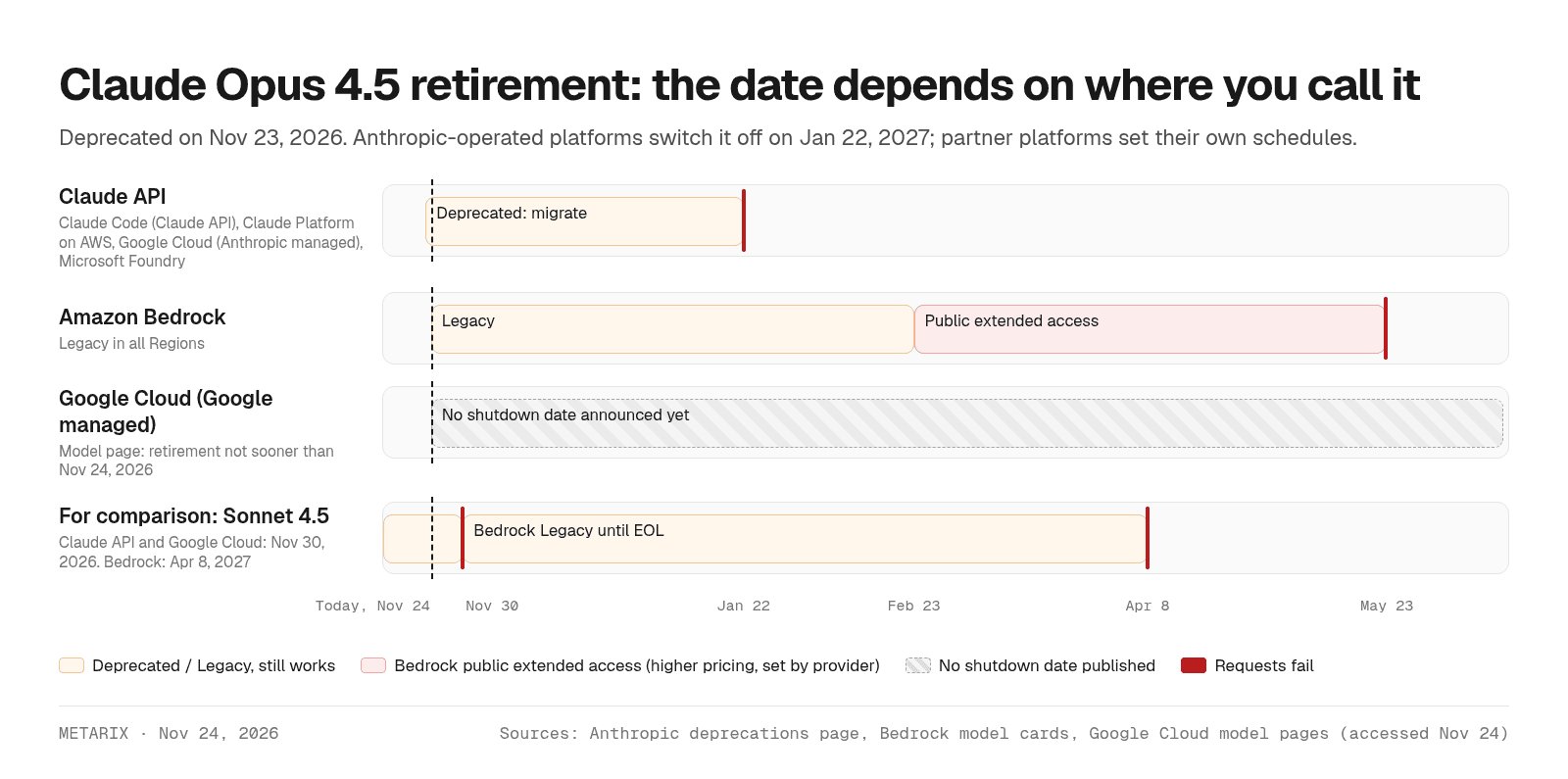
Anthropic's dates cover the platforms it operates: the Claude API, Claude Platform on AWS, Claude Models on Google Cloud (Anthropic managed) and Microsoft Foundry. Partner-operated platforms, Amazon Bedrock and Claude Models on Google Cloud (Google managed), set their own schedules. If you picked a cloud for Claude partly on lifecycle grounds, our Claude API vs Bedrock vs Vertex AI comparison covers the other trade-offs.
Scroll the table horizontally on smaller screens.
| Platform | Status on Nov 24, 2026 | Requests fail from | Notes |
|---|---|---|---|
| Claude API (incl. Claude Code on the API) | Deprecated | Jan 22, 2027 | Applies to the dated ID and the claude-opus-4-5 alias |
| Claude Platform on AWS | Deprecated | Jan 22, 2027 | Anthropic-operated, so Anthropic's dates apply |
| Claude Models on Google Cloud (Anthropic managed) | Deprecated | Jan 22, 2027 | Anthropic-operated |
| Microsoft Foundry | Deprecated | Jan 22, 2027 | Anthropic's deprecations page lists Foundry under its dates |
| Amazon Bedrock | Legacy in all Regions | May 23, 2027 | Public extended access from Feb 23, 2027 at higher, provider-set prices; then ResourceNotFoundException |
| Claude Models on Google Cloud (Google managed) | GA, no shutdown date listed | Not announced | Model page: retirement not sooner than Nov 24, 2026 (page last updated Nov 20) |
Amazon Bedrock buys four more months, at a price
The Bedrock model card says Opus 4.5 is in the Legacy stage in all Regions, with public extended access starting February 23, 2027 and end of life on May 23, 2027, after which calls return ResourceNotFoundException. Under Bedrock's lifecycle policy for older models, new customers can't adopt a Legacy model, existing customers may lose access after 15 days of inactivity, and during public extended access "you should expect higher pricing, which will be set by the model provider." Bedrock hasn't published that price.
So Bedrock is a buffer, not a plan. If a seldom-used batch job or internal tool calls Opus 4.5 less than every two weeks, it could lose access well before May. And from late February, every month you stay on it probably costs more than the cheaper replacement.
Google Cloud: check your console
Google's Opus 4.5 model page still lists it as generally available with a retirement "not sooner than November 24, 2026," and the partner model deprecations page had no Opus 4.5 entry on November 24. Google does list Sonnet 4.5 there, with shutdown on November 30, 2026, the same day as the Claude API. Expect a Google-managed date soon; if you're on that offering, watch for the notice rather than assuming May.
What breaks when you move to Opus 5.5
Anthropic's Opus 5.5 migration guide has a cumulative checklist: start at the top and stop at the group that names your current model. Coming from Opus 4.5 means working through every group down to "Claude Opus 4.5 or earlier," so this is the longest path in the guide. Here is what matters most, grouped by how it fails.
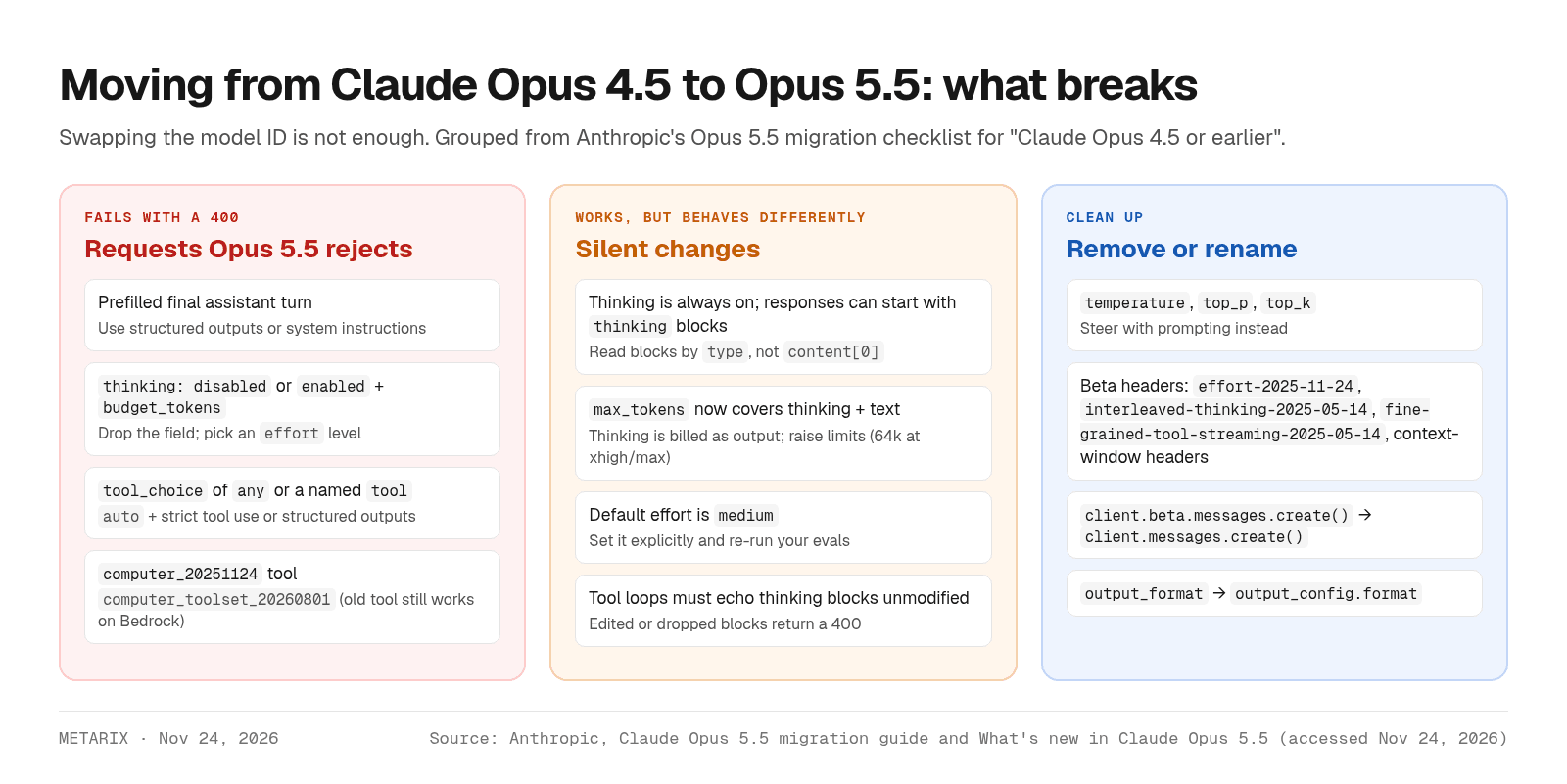
Requests that now return a 400
- Prefill. Ending
messageswith a partial assistant turn is rejected. Move the format constraint into structured outputs or the system prompt. - Thinking controls.
thinking: {"type": "disabled"}and manualbudget_tokensare rejected. Remove the field and setoutput_config.effort(low,medium,high,xhigh,max). - Forced tool use.
tool_choiceofanyor a namedtoolis rejected; onlyautoandnonework. For guaranteed schema-valid calls, useautowith strict tool use. - Old computer use tool.
computer_20251124fails on every platform except Bedrock. Declarecomputer_toolset_20260801and update the agent loop.
Changes that don't error but alter behavior
- Thinking is always on. Opus 4.5 ran without thinking unless you asked for it; Opus 5.5 can't turn it off. Responses can start with
thinkingblocks, so code that readscontent[0].textbreaks. - `max_tokens` covers thinking plus text. A limit sized for short answers can now truncate them. Anthropic suggests starting at 64k for
xhighormaxeffort. - Default effort is `medium`. Set it explicitly and run a fresh effort sweep on your own evals rather than guessing.
- Tool loops must echo thinking blocks unmodified. Filtering or rebuilding the assistant message returns a 400, and edits to earlier turns, the system prompt or tools can fail the prefix check. Use mid-conversation system messages for changes instead.
- Thinking text is omitted by default. Set
thinking.displayto"summarized"if your UI shows progress, or users will see a long pause before output.
Cleanup
- Remove
temperature,top_pandtop_k. - Move from
client.beta.messages.create()toclient.messages.create(). - Drop the
effort-2025-11-24,fine-grained-tool-streaming-2025-05-14andinterleaved-thinking-2025-05-14beta headers, and any context-window header. - Rename
output_formattooutput_config.format. - Handle
stop_reason: "refusal", and if you have a Priority Tier commitment, plan capacity separately: Priority Tier isn't supported on Opus 5.5.
A minimal before and after for a typical Opus 4.5 call that disabled thinking and prefilled JSON (illustrative, not a tested configuration):
# Before: Opus 4.5client.messages.create( model="claude-opus-4-5", max_tokens=2048, temperature=0.2, messages=[{"role": "user", "content": prompt}, {"role": "assistant", "content": "{"}], # prefill)# After: Opus 5.5resp = client.messages.create( model="claude-opus-5-5", max_tokens=8192, # now includes thinking output_config={"effort": "low", # replaces disabled thinking "format": {"type": "json_schema", "schema": schema}}, messages=[{"role": "user", "content": prompt}],)text = "".join(b.text for b in resp.content if b.type == "text")
Anthropic also ships a Claude Code command for the job: /claude-api migrate this project to claude-opus-5-5. It's a reasonable first pass, but review the diff against the checklist above, especially anything that parses responses by position.
What the move does to your bill
On paper, Opus 5.5 is cheaper on every line. Prices as of November 24, 2026, from Anthropic's pricing page:
Scroll the table horizontally on smaller screens.
| Item | Claude Opus 4.5 | Claude Opus 5.5 | Change |
|---|---|---|---|
| Input | $5 | $4 | -20% |
| Output | $25 | $20 | -20% |
| Cache write (5 min) | $6.25 | $5 | -20% |
| Cache read | $0.50 | $0.20 | -60% |
| Batch input / output | $2.50 / $12.50 | $2 / $10 | -20% |
| Context window / max output | 200K / 64K | 1M / 128K | Larger |
The catch is thinking. If your Opus 4.5 workload ran without it, every Opus 5.5 request now adds thinking tokens billed at the output rate. A worked example, illustrative only: a request with 10,000 input and 2,000 output tokens costs $0.100 on Opus 4.5 and $0.080 on Opus 5.5 at the same token counts. The $0.02 saving covers just 1,000 extra output tokens, so if Opus 5.5 thinks for more than about 1,000 tokens on that request, it costs more than Opus 4.5 did. At 3,000 thinking tokens, the request costs $0.140.
Anthropic says that, at default settings, Opus 5.5 costs about 40% less than Opus 5 on typical workloads (announcement, vendor figure). That comparison is against Opus 5, which already thought by default, not against a non-thinking Opus 4.5 setup. Measure your own traffic at low and medium effort before assuming savings. Prompt-heavy agents with high cache hit rates are where the 60% cut in cache reads helps most.
Which replacement to choose
Anthropic recommends Opus 5.5, and for most teams that's right. But the other active models are worth a look, because their lifecycle dates differ sharply.
Scroll the table horizontally on smaller screens.
| Model | Price in / out | Earliest retirement | Best for |
|---|---|---|---|
| Claude Opus 5.5 | $4 / $20 | Not sooner than Sep 22, 2027 | Default choice: cheapest Opus, longest runway, largest migration |
| Claude Opus 4.8 | $5 / $25 | Not sooner than May 28, 2027 | Teams that can't absorb always-on thinking yet; still needs its own migration from 4.5 |
| Claude Opus 4.6 | $5 / $25 | Not sooner than Feb 5, 2027 | Avoid: its retirement window opens two weeks after Opus 4.5's |
| Claude Sonnet 5.5 | $2 / $10 | Not sooner than Sep 28, 2027 | Workloads where Opus 4.5 was overkill; half the price of Opus 5.5 |
| Claude Fable 5.2 | $8 / $40 | Not sooner than Nov 9, 2027 | Hardest reasoning and long-horizon agents; requires 30-day retention |
Two cautions. Opus 4.6 looks like the smallest step, but a model that can't retire before February 5, 2027 may get its own notice within weeks; moving twice in three months is the worst outcome. And Fable 5.2, covered in our Fable 5.2 pricing analysis, isn't available under zero data retention unless Anthropic expressly authorizes it, which rules it out for some regulated workloads.
Don't miss Sonnet 4.5 on November 30
The more urgent date is six days away. Claude Sonnet 4.5 retires on November 30, 2026 on the Claude API, and Google lists the same shutdown date for its offering. On Bedrock, Sonnet 4.5 is Legacy with end of life on April 8, 2027 (April 27 in the GovCloud Regions), per its model card. The recommended replacement is claude-sonnet-5-5. If your stack uses Sonnet 4.5 for routine calls and Opus 4.5 for hard ones, plan both moves together.
A migration plan for the next eight weeks
- This week: export usage from the Claude Console (Usage, then Export) and search code, configs, Claude Code settings and gateway routes for
opus-4-5andsonnet-4-5. Fix Sonnet 4.5 first. - Early December: branch, switch to
claude-opus-5-5, and work through the 400-error items. Add a test that fails if any request still sets prefill,budget_tokensor forcedtool_choice. - Mid-December: run your evals at
low,mediumandhigheffort. Record quality, latency, output tokens and cost per task; pick a level per route, not one global setting. - Early January: roll out behind a flag, keep Opus 4.5 as a fallback only until the final week, and remove it before January 22.
- On Bedrock: set the same target dates anyway. Treat February 23 as your real deadline, since prices rise then, and keep low-volume jobs warm or migrated so the 15-day inactivity rule doesn't cut them off.
Verdict
This is a routine deprecation with a non-routine migration. Opus 5.5 is the right destination for most Opus 4.5 users: cheaper per token, a much larger context window and the longest runway in the Opus line. But always-on thinking changes request shapes, response parsing and cost, so give it a sprint, not a find-and-replace. Fix Sonnet 4.5 before November 30, finish Opus 4.5 by mid-January, and don't use Bedrock's extended access or Opus 4.6 as a place to wait.
Sources
- Anthropic: Model deprecations (Opus 4.5 deprecation dated Nov 23, 2026)
- Anthropic: Claude Platform release notes (Nov 23, 2026 entry)
- Anthropic: Claude Opus 5.5 migration guide and What's new in Claude Opus 5.5
- Anthropic: Pricing and Models overview
- Amazon Bedrock: Claude Opus 4.5 model card, Claude Sonnet 4.5 model card and Model lifecycle (Legacy)
- Google Cloud: Claude Opus 4.5 model page and Partner model deprecations
- Anthropic: Introducing Claude Opus 5.5 (Sep 22, 2026)
Tools covered in this article
Frequently asked questions
- When does Claude Opus 4.5 stop working?
- On the Claude API and other Anthropic-operated platforms (Claude Platform on AWS, Claude Models on Google Cloud managed by Anthropic, Microsoft Foundry), requests to claude-opus-4-5-20251101 and claude-opus-4-5 fail from January 22, 2027. On Amazon Bedrock the end of life is May 23, 2027, with higher-priced public extended access from February 23, 2027.
- What replaces Claude Opus 4.5?
- Anthropic recommends Claude Opus 5.5 (claude-opus-5-5). It costs $4 per million input tokens and $20 per million output tokens, versus $5 and $25 for Opus 4.5, and has a 1M-token context window. Its thinking is always on, so the migration needs code changes.
- Can I just change the model name from claude-opus-4-5 to claude-opus-5-5?
- Usually not. Opus 5.5 rejects assistant prefills, thinking disabled or budget_tokens, and tool_choice set to any or a named tool, and responses can start with thinking blocks. Remove those settings, set an effort level, read content blocks by type, and raise max_tokens.
- Will Opus 5.5 cost less than Opus 4.5?
- Per token, yes: list prices are 20% lower and cache reads 60% lower. But Opus 5.5 always thinks and bills thinking as output tokens, so a workload that ran Opus 4.5 without thinking can cost more. Test at low and medium effort on your own traffic.
- When does Claude Sonnet 4.5 retire?
- November 30, 2026 on the Claude API and on Google Cloud. On Amazon Bedrock, Sonnet 4.5 is Legacy with end of life on April 8, 2027 (April 27 in GovCloud Regions). The recommended replacement is Claude Sonnet 5.5.