Developer & Productivity Tools · Free
llama.cpp
llama.cpp is an open-source C/C++ library and set of command-line tools for running large language models, including multimodal models, on local machines and servers. It is maintained by the ggml-org organisation, is built on the ggml tensor library, and is released under the MIT license. Its stated goal is LLM inference with minimal setup and strong performance on a wide range of hardware, locally and in the cloud.
Who it is for: developers who want to run open-weight models on their own laptop, workstation or server without a Python serving stack; teams embedding a model in a desktop, mobile or edge application; and anyone who needs to test how fast a given model and quantization will run on specific hardware before committing to it.
Model format: llama.cpp loads models in GGUF, a single-file format that holds the weights and metadata. Most popular open-weight models are published in GGUF on Hugging Face in several quantizations, from 3-bit and 4-bit variants such as Q3_K_M and Q4_K_M up to Q8_0 and full BF16 or F16. Lower-bit files need less memory and usually generate faster, at some cost in output quality that depends on the model.
Key tools: - llama cli: an interactive chat and completion tool that can download a model directly from a Hugging Face repository with -hf. - llama serve (llama-server): an HTTP server with an OpenAI-compatible API and a built-in chat app. - llama-bench: the project's benchmark tool. It reports prompt processing (pp) and text generation (tg) speed in tokens per second, can repeat runs, set the context depth with -d, toggle Flash Attention, and write CSV, JSON, JSONL, Markdown or SQL output.
Hardware backends: CPU builds with optional BLAS, Apple Metal, NVIDIA CUDA, AMD HIP/ROCm, Vulkan, SYCL and Moore Threads MUSA, according to the project's build guide. Prebuilt binaries are distributed through the GitHub releases page and the llama.app installer, plus Docker, Homebrew, conda-forge, Winget and other channels.
Versioning: on November 13, 2026 the project released libllama and libggml v1.0.0 and moved to semantic versioning, with major-version bumps reserved for breaking changes to the public C API. Builds are also numbered (for example b12765), and benchmark results are tied to a build.
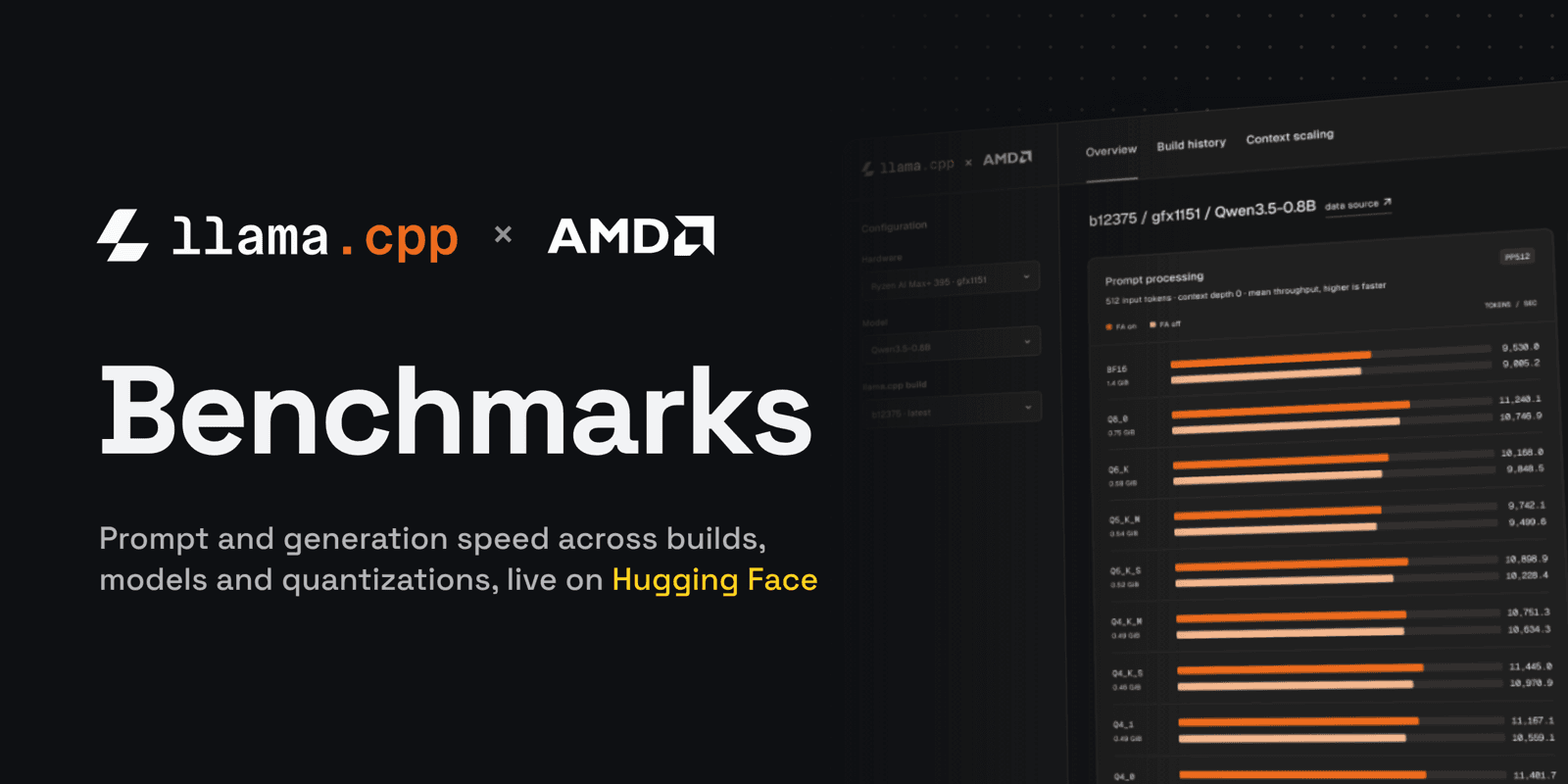
Public benchmarks: since November 26, 2026 ggml-org publishes a llama.cpp x AMD benchmark dashboard on Hugging Face with weekly llama-bench results for Radeon 8060S (Ryzen AI Max+ 395) and Radeon AI Pro R9700S, with raw JSONL in a public storage bucket.
Pricing: free and open source. Costs are the hardware and electricity you run it on.
Alternatives: Ollama and LM Studio wrap llama.cpp-style local inference in a friendlier app; vLLM and SGLang target high-throughput GPU serving with many concurrent requests; Apple's MLX targets Apple silicon.
Official site: https://github.com/ggml-org/llama.cpp