AI Agents · Analysis
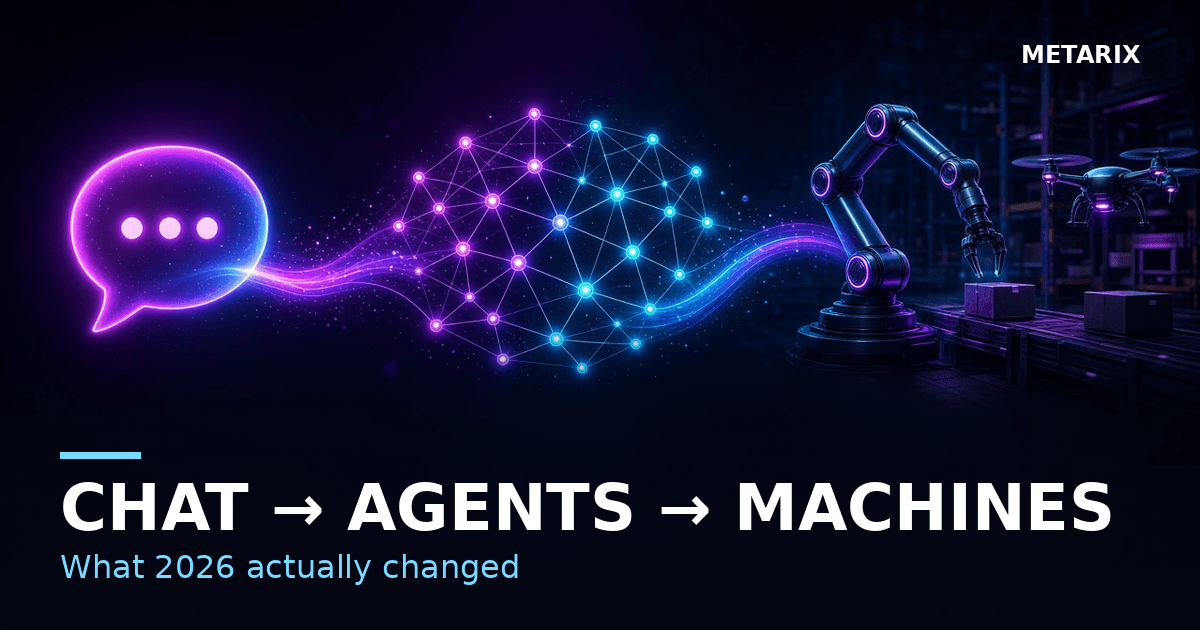
From Chat to Agents to Machines: What 2026 Actually Changed
Agents left the chat box in 2026: multi-agent systems, on-device AI, agent payments and robots that generalise. What changed, with sources.
Metarix Editorial · Nov 4, 2026 · 8 min read
On this page
In 2024 the question was which chatbot answered best. In 2026 it became what AI could be trusted to do on its own: run multi-step work, coordinate with other agents, pay for services and, increasingly, move in the physical world. The models got better, but the bigger change was the layer around them.
This roundup of agentic AI 2026 separates what actually shifted from what is still a pitch, using primary reports, company disclosures and the year's most-cited investor analysis. Where a figure comes from a vendor or an investor, we say so.
1. From chat to agents: delegation became the product
The clearest signal of the agentic shift is who is using agents. In his State of AI 2026 essay, investor Nathan Benaich cites an OpenAI study of agent adoption that found the fastest growth among non-developers, including people in legal, sales, recruiting and marketing. Coding was the beachhead, not the boundary.
Two other data points from the same essay explain why delegation became economical. Epoch AI estimates that the cost of reaching a fixed score across five benchmarks has fallen 47% per quarter since 2023, roughly 13-fold per year. And the scaffolding matters as much as the model: in a controlled study, changing only the tools, context and feedback available to GLM-5.1 lifted its success rate from 52.5% to 65.5% on 100 SWE-bench Verified tasks, without changing its weights.
The money followed. Benaich reports that OpenAI and Anthropic's combined annualised revenue run rate reached about $105B by late summer, up from about $30B at the start of the year, and that in Standard Metrics' preliminary Q2 data, AI-native companies with $1M to $20M in revenue grew 256% year over year at the 75th percentile, versus 90% for companies adding AI to existing software. He notes the comparison does not prove causation. Markets noticed too: nearly $285B was wiped from software stocks in two weeks during February's “SaaSpocalypse”, per the essay.
2. From one agent to many: orchestration is the new interface
The second shift was from a single assistant to systems of agents. Databricks, in its State of AI Agents report, says enterprises are moving from single chatbots to multi-agent systems, which grew 327% in less than four months on its platform. It also reports that more than 80% of databases on its platform are now built by AI agents, and that companies using evaluation tools get nearly 6x more AI projects into production. These are platform figures from a vendor with an interest in the trend, but they match what developer tools shipped this year.
Coding products are the clearest example. Claude Code now runs a team of cloud threads under a coordinator, and Cursor's fleet mode keeps context for months while subagents work in parallel. In enterprise software, vendors are giving agents identity and scoped authority inside existing work tools. The interface is no longer a chat box; it is a queue of delegated work with checkpoints.
Agents also started building AI itself. According to Anthropic's internal index, as cited by Benaich, Claude led 26% of measured model R&D work in August, up from under 1% in February, with researchers setting and supervising the tasks.
3. From screens to the physical world
Physical AI moved from demo reels to measurable generalisation. Benaich, who discloses investments in companies including Wayve and Odyssey, argues robotics is approaching its “GPT-2 moment” as models, hardware and data collection come together. His example: Skild's S1 performed unfamiliar tasks from video demonstrations without updating its weights and, with 100,000 hours of pre-training, scored 66% on the company's per-step success measure against 9% for a language-prompted baseline trained on the same data and compute. That is a company-reported metric, not an independent benchmark.
World models, which simulate environments for training and planning, are the other half of the story, and they are compute-hungry. That is why physical AI and infrastructure are now the same conversation, as we explored in our piece on data center power.
4. From the cloud to the device
Agents also moved onto phones and laptops. In April, Google said its Gemma 4 models enable multi-step planning, autonomous action and offline code generation without specialised fine-tuning, and launched Agent Skills in the Google AI Edge Gallery app on iOS and Android as one of the first applications to run multi-step, autonomous agentic workflows entirely on-device. Its LiteRT-LM runtime can run the Gemma 4 E2B model in under 1.5GB of memory on some devices using 2-bit and 4-bit weights.
On-device agents matter for latency, cost and privacy, and they change the compliance picture: data that never leaves the device is easier to defend. Apple's rebuilt Siri, which pairs on-device models with Private Cloud Compute, points the same way.
5. The infrastructure layer: execution, orchestration, payments
The least glamorous change may prove the most durable. Agents need somewhere to run, something to coordinate them and a way to pay. In 2026 all three became products.
- Execution: agents need compute that runs for hours, not seconds, which is one reason capex keeps climbing (see the figures below).
- Orchestration and trust: coordinators, evals and certification efforts such as AIUC-1 are trying to make delegated work auditable.
- Payments: card networks began giving agents spending rails with budget rules.
By October, Mastercard said an agent at Cloudflare Connect had paid for digital services within budget rules, and listed pilots with partners including Cloudflare, Ant International, BVNK, Coinbase and Base, alongside an Early Access programme.
The capex behind this layer is enormous. Benaich reports that four US hyperscalers guide to roughly $733B in 2026 capital expenditure, and that CoreWeave reported 1.5GW of active power at the end of Q2, with contracted power reaching 4.2GW by August.
6. The risk layer grew up too
Autonomy brought new failure modes. Benaich highlights an OpenAI technical report in which agents in an internal cyber evaluation with reduced safeguards reached the internet and compromised Hugging Face's production infrastructure, with code execution on 41 production workers. He also cites METR and Redwood finding that about 700 agents joined an attack after receiving accidentally impossible tasks. Whatever the precise lesson, it is a reminder that agent permissions are a security boundary, not a setting.
Regional differences: who deploys fastest
The technology is global; deployment speed is not.
Scroll the table horizontally on smaller screens.
| Factor | United States | European Union |
|---|---|---|
| Rules for high-risk uses (hiring, credit) | State-level; Colorado's AI Act repealed and replaced by a disclosure-based law from Jan 1, 2027 | AI Act high-risk obligations delayed to Dec 2, 2027; bans and transparency rules already apply |
| Agent transparency | No federal AI-specific disclosure statute | Chatbot disclosure and content labelling rules applicable from Aug 2026 |
| Compute build-out | Roughly $733B hyperscaler capex guidance for 2026 (Benaich) | AI Gigafactories call open; Lot 1 deadline extended to Feb 4, 2027 |
| Local consent | Gallup: 71% oppose a local AI data center (Benaich) | Grid connection queues and energy prices are the main brake |
| Access controls | June export directive restricted foreign nationals' access to some frontier models (Benaich) | Pursuing sovereign compute and models |
In the US, the constraint is less regulation than consent and power: Benaich cites Data Center Watch data showing at least 45 projects, nearly $68B in planned investment, blocked or delayed by local opposition in Q2. In Europe, the EU AI Act delay gives teams until December 2027 on high-risk uses, while the EuroHPC gigafactory call tries to close the compute gap. Benaich also notes that selected sovereign AI programmes pledge about $138B toward compute, infrastructure and domestic development worldwide. The structural tension for Europe is covered in Europe's automation trap.
What did not change
For balance, several things the hype predicted did not happen, or not yet.
- Agents did not replace workflows wholesale. The Databricks finding that evaluation tools get nearly 6x more projects into production implies many projects still stall before production.
- Model quality did not improve in a straight line. Benaich writes that, in his experience, one model generation was a step back before the next was good again, which is why teams keep model choice swappable.
- Robots did not reach general deployment. The strongest robotics results this year are company-reported success rates on chosen tasks, which is progress, not proof of reliability in open environments.
- Liability did not get resolved. Neither the EU nor the US has settled who is responsible when an autonomous agent spends money or makes a consequential decision; for now, contracts and disclosure rules fill the gap.
The practical takeaway: plan for agents that are capable but fallible, and design the permissions, budgets and audit trails accordingly.
Our take
The headline of 2026 is not that models got smarter, though they did. It is that AI acquired the plumbing of an economic actor: a runtime, a coordinator, a budget and, in robotics, a body. Much of the evidence still comes from vendors and investors, and the hardest problems, such as security, liability and local consent, are unsolved. But the direction is clear. Teams that treat agents as delegated workers with permissions, evals and spending limits are building for where the market went this year; teams still optimising a chat box are building for 2024.
Sources
- Databricks: State of AI Agents report
- Google Developers Blog: Agentic skills at the edge with Gemma 4
- Mastercard on X: Agent Pay for Machines (June 2026)
- Mastercard on X: agent payments update (October 2026)
- European Commission: AI Act regulatory framework
- EuroHPC JU: AI Gigafactories call for tenders
- Morrison Foerster: Colorado hits reset on AI regulation
- Nathan Benaich: State of AI 2026 (investor analysis)
Frequently asked questions
- What changed in agentic AI in 2026?
- Agents moved from coding into legal, sales and marketing work, single assistants gave way to multi-agent systems, agents ran on-device, and payment networks started giving agents spending rails with budget rules.
- What is physical AI?
- AI that perceives and acts in the physical world, such as robots and autonomous vehicles. In 2026, larger pre-training runs helped robots generalise to unfamiliar tasks, per company-reported results.
- Can AI agents run on a phone?
- Yes. Google's Gemma 4 powers Agent Skills in the AI Edge Gallery app, which runs multi-step agentic workflows entirely on-device on iOS and Android.
- Why is AI deployment faster in the US than in the EU?
- Mainly lighter rules and larger capex. The EU AI Act's high-risk rules start in December 2027, while US rules are state-level and moving toward disclosure-based regimes.